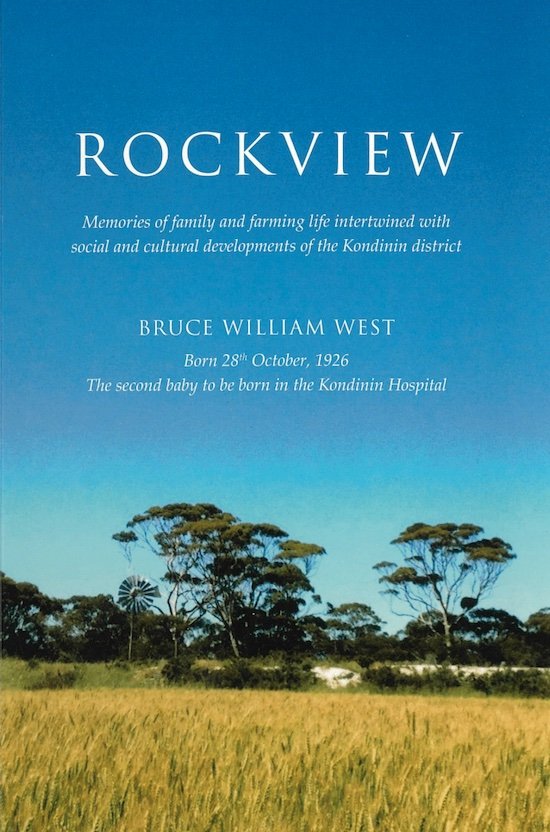
Author Bruce William West

This pdf version has been saved at low resolution for the purpose of downloading, if you need a higher resolution for printing, please contact Terri Strong at strong.t@bigpond.com

Dedication

It is with pleasure I dedicate my book to our father James William West, who came to Kondinin in 1920 soon after his return from the war in the Middle East.

Rockview is the last of many properties JW purchased in the Kondinin district and the only one in its virgin state. It remains the nucleus of his family's holdings in Kondinin today.

Introduction

Around 1995 my granddaughter Emily West asked me to write the story of my life for a school project. That is how this story began.

It got me thinking about my life and all I have been associated with over the years. I realised I did have a story to tell. Not only personally regarding me and my family and my farm but the growth and development of the Kondinin town and district.

During those years I have seen many changes—socially, culturally and economically—not only in Kondinin but in surrounding farming areas and indeed, the state and further afield as communication became easier and swifter.

I have enjoyed putting my story together from my farm notes and memories. I hope it is enjoyed by my immediate family and others.

Emily received a very good mark for her school project.

Fragments of Early Memories

Sitting behind Norma Tassel. My first teacher a stern older lady of 27 or 28 years.

Walking home sleepily in the hot sun when a snake slithered quickly across path a yard in front of me. Jacqs running screaming non-stop all the way home. Around the same time, again on the way home again, we saw some Aboriginals camped in the bush. Jacqs did the same act. Without a word she screamed all the way home but across the paddock this time.

I waited, often for hours, between the house and the gate for Dad to arrive home from Perth, sometimes in a new car. I remember a new 1932 Marquat, and the joy of being picked up and driven the 100 yards home.

Dad often took me in the car with him to Five Mile, Twenty Mile or perhaps some other farm where he was selling something or perhaps buying cattle for the butchery.

One day I remember him being in a hurry coming home and doing 40 mph. It was the first time I remember going that fast and I skited to my mates at school.

Chapter 1: Evasham

Chapter 2: Childhood

Chapter 3: Depression Years

Chapter 4: School, Family and Farm

Chapter 5: A Brief Background to JW’s Business

Chapter 6: Boarding School

Chapter 7: School to Farm

Chapter 8: Kondinin Lake Flooded

Chapter 9: My First Farm Years

Chapter 10: Giuseppe Bontempo - Tony

Chapter 11: Kondinin and the War Years

Chapter 12: From Farm to Business

Chapter 13: Call-up to Airforce 1944

Chapter 14: Home, Harvest and Cricket

Chapter 15: Settling Back to Farming

Chapter 16: The Twenty Mile

Chapter 17: The deLargie Family

Chapter 18: Back to Football and Farming

Chapter 19: Kondinin Football Club

Chapter 20: Bill and Bowe Stubbs Sporting Connection

Chapter 21: Royal Show 1948

Chapter 22: Christmas and Family

Chapter 24: Farming and Football Carnival

Chapter 25: New Holden 1949

Chapter 26: Road Trip East January 1950

Chapter 27: Renovating Rockview House 1950

Chapter 28: Wedding, Family and Farming 1951

Chapter 29: Farming and Davis Cup Trip

Chapter 30: Farming, Clearing and a Son 1953 - 1954

Chapter 31: Decision to Farm Separately

Chapter 32: Terri’s Arrival and Introduction to Goats

Chapter 33: Dad’s Death 1958

Chapter 34: New House and Farming Advances

Chapter 35: Holidays and Farming

Chapter 36: Development of Community Amenities

Chapter 37: Holidays, Farming and Drought

Chapter 38: The Kondinin Roadhouse

Chapter 39: Farming, Family and City House

Chapter 40: Invitation into Share Investment

Chapter 41: Overseas Trip 1974

Chapter 42: Back Farming Again

Chapter 43: Mum’s Trip to Europe

Chapter 44: Family, Weddings and Farming

Chapter 45: China with AMS

Chapter 46: Another Farm

Chapter 47: Separation

Chapter 48: Farming 1981 - 1982

Chapter 49: End of Story

Appendix: Cropping Programs 1946 - 1982

Evasham

Marjorie Bowe Stubbs, Jitarning - 1922

The farm Evasham, where we grew up is adjacent to the town and the first property on right-hand side of the Kondinin–Kulin road. Our home at Evasham was built by Mr Joe Atkins about 1920/21. Dad bought Evasham from him in 1923 just before he and Mum were married. It was a basic four-roomed weather board house with an iron roof and a veranda all round. A bathroom was built in the north-west corner of the veranda with a small bedroom butted on the corner on the west side. This was the maid’s room. Entry to the kitchen was directly from the back veranda and opposite a door led into the dining-sitting room. On the left a door opened into a passage to the front door. On the right was Mum and Dad’s room and on the other side was the spare bedroom.

Marjorie Stubbs - c1922

The kitchen had a Metters No 2 wood stove and in the corner next to the bathroom was a tap, always with a bucket under it to catch the drips. Opposite the stove, against the wall, was a big deal table used as a bench. Food preparation was done here as well as washing-up, in a basin. A myriad of things were stacked against the wall at the back. All the other rooms had open fireplaces and the main rooms had lino on the floor. As the family grew, the entire south and west verandas had a dado to about 3 feet with timber and above that was flywire with canvas blinds to keep the weather out. Mum and Dad had their own sleepout next to their bedroom where they always slept. The rest of the south side was a long sleepout, like a dormitory, where we kids slept. The west veranda between the maid’s room and our sleepout was called the back dining-room where everyone, including the working men, had their meals. Also in this room was a Coolgardie safe and an ice chest which only had ice in it at Christmas time.

In 1934 two cement brick rooms were built on the west side, slightly detached from the house by builder Ernie Hodges. I remember the structure going up and the smell of the cement, mortar and new timber. I was very interested because the room closest to the house was to be my room. Great joy when I moved in; away from all those girls. Don moved in when he was older. The other room was the dairy where the milk was separated and the cream kept and made into butter and food was stored. With cement floors it was cooler than the house in the summer.

The washhouse was near the back gate about 20 yards from the back of the house and outside the yard. Another 20 yards was the lavatory. The washhouse was open on the side towards the house with a copper in one corner and bench along the other two sides; fairly standard for those days. Washing for a large family by hand was a big job, especially as everything was ironed with Mother Potts irons. Mum nearly always had a live-in 16 to 18-year-old lass to help her and they became part of the family. We didn’t have any electric light until 1937 when we got a wind-generated power system which charged two 12 volt batteries. When the wind was strong we had good lights but not always strong enough for our large family gatherings.

Our water was from the local supply – still out near Sloans – but the dam often got low and then water was rationed. Mum had a reasonably nice garden with creepers and so on. There were a few trees around but generally speaking it was a windy and dusty place to live – the opposite to the situation at Rockview.

In about 1934 or 1935 we got our first reliable wireless set. It was too big to move and was positioned against the wall at the back of the dining-room. From then on we enjoyed listening to serials like Martin’s Corner and Dad and Dave from about 6.30 to 7.15pm. Later there was entertainment, plays and musical programmes which the older ones listened to. Then, of course, there were the cricket and football commentaries. Mum and Dad listened to the Test cricket from England nearly all night. Mum wrote down the scores for me to read in the morning.

The telephone was on the wall in the passage. The phone was the typical machine of the thirties with a receiver hanging on the left hand side and mouthpiece in the centre front which could be adjusted depending on the height of the speaker. On the right side was a handle which was turned briskly to alert the telephonist at the exchange in the Kondinin Post Office you wanted to be put through to a particular number. We were not on a party line as were any people out on farms. Calls could only be made during the hours the exchange was open. I don’t remember, but it may have been open all night as the Kondinin exchange served many farms which were somewhat isolated.

Xmas family photo c1938

BR Marj, Sylo, Grandma Growden, Grandpa Stubbs, May, Grandma Stubbs and JW
FR Bruce, Don, Nona, Grandma Growden's granddaughter, Jacqs holding Marj and Pat.

My parents were born into the era of hard work and making-do. My father was a well-built, hardworking, ambitious man of average height. He was born in Victoria and came to Western Australia as a 14 year-old-boy in 1903. He lived with his brothers in the Wagin–Dumbleyung area until he joined the 10th Light Horse Battalion and served in the World War. Soon after his return he moved to the Kondinin district which was in the early stages of development. He became an active business man; owned and ran a number of businesses in the town as well as working several farms. He was a keen sportsman, outgoing, liked and got on well with people.

Marjorie West - 1950

My mother, born in Kalgoorlie, was a slender intelligent woman of above average height. She lived most of her childhood and young life in Perth and was educated at Perth Modern School followed by Claremont Teachers College. She taught in one-teacher schools at Jitarning and Kondinin until marrying my father in the early twenties. She was a quiet, well-read lady, also very keen on sport. In later life I realised she was also a good tennis and a hockey player. She was captain of Modern School hockey team and we are lucky to have her team photo.

Claremont Teacher Training College hockey team.

Marj Bowe (West) lower right - 1920

Jacqs Debutante - 1946

Pat - c1940s

We had a reasonably good tennis court at Evasham just off the south-east corner of the house. The surface was originally of crushed anthill and was good to play on, but it didn’t stand up too well to wear and tear and was a bit dusty. I don’t remember when the court was laid but almost certainly before the depression started in 1929. However, I remember it being sprayed with asphalt about 1937. This was a better surface and easier to paint lines on. I remember Dad having ‘men only’ Sunday morning tennis parties—Dads friends and sometimes my uncles Bill and Bowe Stubbs. There were lots of laughs. I think Mum also had ladies tennis parties in the earlier days. There were a few anthill courts around in those days. The Tennis Clubs and courts were where Shire works yard is today, at the southern end near the road and not far from the old school. Occasionally we were allowed to go from school to play on them. I don’t really remember seeing Mum play tennis; too busy looking after us I suppose

Mum and Dad also had three golf-holes at Evasham between the house and the boundary fence along the railway and the track from main gate. The tees and greens weren’t anything special. The greens were levelled and sanded with a hole, an empty fruit tin, in the middle. The first hole went down to the railway, the second along railway to the main gate and the third back. The only hazard really was a stand of big grey morrell trees, Eucalyptus longicornis, in the centre area. Until I went away to school in 1940 I caddied for Dad on Sundays when he played. I enjoyed it. When footy was in Kondinin he often arranged to play early with others who were also keen to see some of the football. Also, I was paid a penny per hole; big money. 

Childhood

Apart from my parents, my maternal Grandfather influenced my desire to achieve in life, particularly financially. My early years were the depression years when few people around us had much money or security. My education was at Kondinin State School followed by two years as a boarder at Hale School in West Perth.

During my first year or so at school two Shetland ponies, one black and one white, arrived on the steam train. The black one was for me, the white one for Vic Howlett. Dad built a loose box alongside the garage for Charlie and showed me how to saddle and bridle him, ride him and look after him, which I did from then on. He was supposed to be for Jacqs and me but I don’t think she rode him very often. Charlie wasn’t all that loveable. He was old, only had one eye and knew every trick in the book—including biting my bum when I groomed him and given a chance, he also kicked me. Dad was brought up with horses, loved them and wanted me to enjoy that experience too. Motor cars were the rage by then and I never loved horses the way he did—it just became something I had to do.

I often rode Charlie down to Gran’s in that first year or two. His favourite trick was to wait and no doubt watch with that one eye until I wasn’t concentrating, then from a canter would stop dead with his head down and I would—9 times out of 10—slither over his head on to the ground. He would then gallop home flat-out to the stables and the other horses. Once I was too furious to let go the reins and was dragged about 50 yards before I let go.

By the time I was 9 or 10, in company with Bill Alga, I sometimes rode one of our stock horses out to a farm to pick up cattle and drive them home for slaughter for the butchers shop. I didn’t mind that as those horses were easy to manage and more comfortable and faster than Charlie. Bill was the odd job man on the farm and was employed by us for many years. He was a very good man.

Work horses. Nell on left dam of other six - c late 1930s

Edmond James West - 6 Months
28.12.1931 - 25.02.1933

One day walking home from school during my first or second school year we were met by our youngest sister Roberta with the unbelievable news that Jimmy, our little brother was dead. He was only 14 months old—born 28/12/1931 and died 25/2/1933. I wouldn’t believe her and ran home to confirm with Mum that it wasn’t true. I can still picture my mother in her darkened dressing room. I shouldn’t have needed to ask the question but being a small boy probably did.

While on the sadder things, a couple of years later—again on the way home from school—Roberta was thrown out of a neighbour’s sulky near our gate. The horse bolted soon after leaving the school and passed us at a flat-out gallop followed immediately by our sprinting headmaster. He had seen the horse take fright and sensed an accident. By the time we caught up he had our badly injured and unconscious sister in his arms and was halfway along the track to our house. Bob recovered well after many weeks in hospital.

Jacqs and Bowe - 1927

Bruce, Jacqs and Pat West - c1931

While on the sadder things, a couple of years later—again on the way home from school—Roberta was thrown out of a neighbour’s sulky near our gate. The horse bolted soon after leaving the school and passed us at a flat-out gallop followed immediately by our sprinting headmaster. He had seen the horse take fright and sensed an accident. By the time we caught up he had our badly injured and unconscious sister in his arms and was halfway along the track to our house. Bob recovered well after many weeks in hospital.

Jacqs and Bowe - 1927

Bruce, Jacqs and Pat West - c1931

Bruce, Bob, Pat and Jacqs West - c1934

Throughout our childhood years we were lucky in that Grandpa Stubbs called most afternoons on his way into town to get the paper or do shopping. His farm adjoined ours to the south. He was a tall man always with a broad smile for us and something nice to say. He often brought Mum vegies and fruit from their abundant garden at Tarrangower. Grandpa Stubbs was very keen on sport, as were our parents. Between them they influenced us—we all became keen on our own particular sport. At school we boys only seemed to play cricket in the summer and football in the winter. Nearly every Sunday afternoon when cricket or footy was played in Kondinin, I managed to get there to watch Bowe and Bill Stubbs play. Dad also played cricket in earlier years. I loved going to cricket because if they were short a player I got a game. I would field all day but rarely got a bat. Dad played golf in winter but I got to football via my Grandad.

There was a serious rabbit plague when I was a small boy. It went on for years. I remember helping pick up dead rabbits to be carted by horse and cart down the paddock to be burnt. The cart was piled high. Sometimes they were fed poisoned oats but in the summer when water was short, tins were filled with poisoned water. This would account for thousands of the poor rabbits. We never seemed to get rid of them all. Another method used towards the end of summer was to put a rabbit netting fence with several small funnel shaped holes near the ground around an almost dry dam about a yard away from the water’s edge. The thirsty rabbits got inside to drink and couldn’t get out. We herded hundreds into a smallish trap-yard in one corner and killed them. When I was about 9 or 10 I trapped rabbits. I skinned the bigger ones dried the skins and when there were enough bundled them up and sent them by train to skin buyers in Perth. The best skins were worth about 8 pence. Occasionally, if a fox was caught in a trap I got a 2/6 bounty from the local Road Board. Big money!

Jacqs with Don - May 1934

We had approximately 1,000 merino sheep on the farm in the mid-thirties. They were run in one mob in those days. The same mob would graze Evasham and Rockview—which was always called Five Mile. Several times a year we drove the sheep one way or the other between the two farms. This was done on foot by Bill Alga and me, always on a Saturday so I could help. Dad would drive us out, help muster the mob and get us on the road. We started about daylight and were usually finished before lunch.

We also had about 50 or 60 head of cattle on Evasham, from cows and calves to fully grown steers. Bill and I milked about 10 cows morning and night. I always milked the same 3 or 4. Looking back I think Bill gave me the quietest and easiest ones. He would then do the separating. The separator was an ingenious machine mounted on a bench in the dairy. The milk was poured into a basin on top of the machine which had to be turned by hand at a constant speed. It produced cream and skim milk which came out of different spouts. The skim milk was mostly fed to the pigs, but at times was used to make pancakes and other things. The cream was used fresh on sweets and bread and jam but mainly Mum made butter with it. Surplus cream was put in a can and sent by train to the butter factory in Narrogin; Mum’s pocket money.

Bruce West and Rob Wilkins - c1938

We had more cattle than most people because my father owned the butchers shop in town. He employed a butcher who did the slaughtering of sheep, cattle and pigs late every Tuesday and Thursday afternoon. The sheep and cattle were slaughtered in what we called the slaughterhouse with yards attached and about 400 yards beyond the stables from the house. On those mornings Bill would get the required animals into the yards so they drained out before slaughter. The butcher was Jack Gorringe, a nice chap in his mid-twenties, a farmer’s son from east of Hyden. Anyway, Jack would turn up late in the afternoon in his 1924 Dodge runabout and often I would go with him. The carcasses were hung in the slaughter house overnight to set. Early next morning he would partly cut them up and take them into the butchers shop. Once a week he would slaughter a couple of pigs. We had a lot of pigs too—up to 100 at times—which Bill looked after; probably his biggest job. The pigsties were close to the stables which in the 1930s were the hub of most farms.

Jack ran the shop until he joined the army early in the war. He served his country with distinction and was awarded the British Empire Medal after the war for outstanding service while a prisoner of the Japanese. He helped his fellow soldier prisoners survive on the infamous Burma Railway.

We always employed a teamster whose main job was to look after the teams. There were 15 to 20 horses altogether, mostly Clydesdale types, for pulling the ploughs, seeders and harvesters. As well there were 2 or 3 hacks and horses of a lighter type used to pull a cart or ride. There were usually eight horses used in a team for ploughing or seeding; either 8 abreast or 8 in tandem. A swingle for each horse was attached to the machine and chains from this were hooked to the hames on either side of the collar. The horses were attached to each other by a strap at the bottom of the collar as well as one from each side of the bridle. A good teamster was able to get all the horses to pull at once. It was necessary to have spare horses in case of lameness and also mares were spelled towards the end of their pregnancy and while their foals were young. The harvest of 1941, the year I left school, was the end of the ‘horse-days’ for us.

In those days as well as animals we also had poultry on Evasham. Not far from the house was the fowl yard and lots of hens. One of my jobs was to feed and water them as well as collect the eggs once a day. Further down near the stables were another semi-wild lot of fowls, turkeys and ducks. There was a big haystack here and they more or less looked after themselves and fed amongst the leftovers around the stack, the stables and pig sties. They laid their eggs in all sorts of places and often turned up with a batch of chickens from a nest I hadn’t found. I was supposed to collect the eggs down there every day, and sometimes I would discover a nest of 20 or 30 eggs. I put these eggs in the horse trough and if they sank they were OK to take home, but if they floated they were rotten and used for target practice. 

Depression Years

The 1930s were tough, hard times for nearly everybody who lived in and around Kondinin. Everyone knows about the worldwide Great Depression from 1929 into the late 1930s. The causes were many and have been debated ever since. It affected Kondinin and similar areas around Western Australia more than average as many were still developing their farms and businesses. For example farmers were the majority and the average farm was about 1000 acres. This meant there were probably 5 times as many farmers in Kondinin then as there are now, 1997, and they had nearly twice as many children. As well, the average farm was less than 10 years old, developed from virgin bush and established with a small amount of capital.

By 1929 many had incurred large debts with high annual interest and capital repayments to the bank. Suddenly the main income, wheat and wool, was only worth about one third of what it had been the year before. The banks rapidly realized the situation and became content to receive interest only on the loans they had out. That soon became difficult or impossible for many farmers and gradually they started walking off their properties as they could not pay the interest on their loans. By this time the banks had mortgages over property, horses, sheep and machinery; all of which was unsaleable anyway. So as the interest was not paid the farms became the property of the bank.

Before a farmer actually walked-off he would see his bank manager, cap in hand, discuss the situation fully with him and asked for a further advance—enough to put in another crop and get his farm and family through another year. If the manager didn’t think further risk was advisable there was no money forthcoming and there was no option but to walk-off. What usually happened was people would cart their furniture and personal belongings into town and load it and their families onto the train for the journey to Perth. In some cases they may have sold an odd horse or something to a friend or neighbour for a little cash; despite the fact that this was probably illegal.

Things were desperate; a lifetime tragedy for so many people. For example, on the property Jim and I farm today there are the traces of four farmers who had to leave during that period. Over the road, the property we call Eaton’s, was originally owned and farmed by a Mr and Mrs Butcher. One of my class mates in infants in 1932 was Lenny Butcher, he had a slightly older brother and sister who came to school every day in a horse and cart; there were two younger children at home. They weren’t at school the next year, so I presume they had to go after the harvest of 1932. Butchers had a reasonable house for the times—still there—and had cleared and fenced about 1000 acres of their 2 400 acre farm. They had stables, at least one dam plus horses, sheep and cows.

The small piece of land south of Butchers was owned by Mr and Mrs Pickernel. I can’t remember them at all but our neighbour Ron Sloan remembers them well. They had four children. The remains of their house and shed are still visible today. They must have left about the same time as Butchers. North of our houses on Rockview, less than half-a-mile away was the boundary of Jack Lynch’s block. As a boy I knew him as he lived in town. He was the bottle-o and carted goods from the steam train to various businesses around town in a cart pulled by a white horse. Jack was an old man then with white hair and moustache. His case was a little different in that his wife and two grown-up daughters ran a boarding house in town. I think Jack clung to his farm until about 1934 or 1935.

Jack Lynch’s block in 1950 was all bush. There had been no fences but we could see areas that had definitely been cleared with a well-defined track from the surveyed road across George’s paddock, as we knew it, to the hole where his camp and stables were. By then there was very little left. The rest of our land to the north of Lynch’s, belonged to a man named Bill Keogh, so I was told years ago by my old friend Bill Alga. He knew Bill Keogh but didn’t think he was there very long. Bill Alga himself farmed the block adjoining Butchers on the east side and was also a victim of that tragic depression era.

Signs of the depression at school weren’t that obvious really. Children adapt to conditions quickly and most children never wore shoes to school even in winter as they didn’t have any to wear. Pants and shirts with patches all over them were quite the norm, as were jumpers with the elbows out. This was common. Everyone ate all their lunch, if not there was no trouble giving a sandwich or an apple away.

Swagmen or Swaggies as we called them were, I suppose a sign of the times. To me they seemed the norm. My very early memories are of them coming up the track; probably 4 or 5 a week. By about 1935 or 1936 there were very few on the roads. The girls were scared of them and would run inside. I think I just stared at them. Poor men, they must have been demoralised. Jobs would have been impossible for them to get once they’d lost their confidence and looked like that. Their only hope of survival was to keep walking from place to place hoping to get handouts. Swaggies were always heavily bearded, ragged looking with tattered clothes and a huge swarm of flies around them. They always asked Mum if she could give them something to eat and a billy of tea and offer to do jobs in return—usually chop mallee roots for the stove. Mum always gave them a big pile of sandwiches and filled their billy. They walked back to the road gate before sitting down to eat.

All the time I was at the Kondinin School we never played a footy or cricket match against another school and there weren’t any interschool sports until 1938/39. We did however, every year in the spring have what was called a Picnic Sports Day. It was a bit like the faction sports today but more fun and less official. There were running races, jumps, sack races, egg and spoon races and three legged races. The mums and dads had a bit of a go too. It was a great fun day.

One year I remember there was a match race between two middle-aged men who had both been talented sprinters in their day. Reg Sykes a small wiry fit farmer from out near the lake had challenged store-keeper ‘Old Bake’ (Frank Baker)—not so fit and much overweight—to a fifty yard race in which Reg was to run backwards. The challenge had been made weeks before and many bets had been laid. To everyone’s amazement Reg won easily, he had obviously been training for weeks.

It was great fun and when the sports finished the ladies put on a wonderful ‘spread’ in the golf clubhouse, or shed as it was then. The sports were always held on the No 9 fairway. This wonderful spread included raspberry vinegar or lemonade made with real lemons to drink. As well, there were lots of bread and butter with 100s and 1000s, cookies, biscuits and cakes of all descriptions and we were each given a little bag of lollies. The Picnic Sports Day was a great day on the calendar as was the Bendering Sports which Dad took us out to every year.

They were held on a Saturday in the spring and this was also a great fun day and a fund-raising day. The cement brick hall still there today was built about 1938. As well as running races for kids and adults there were novelties like paper chases and catch the rooster. All the kids would be ready and the starter would let go a very fit and wild rooster, the poor rooster would run for miles in any direction to escape the screaming mob of kids; good fun for all except the rooster. There were numerous other novelty events. There were pillow fights. A pole was rigged up a yard or more above the ground and the two competitors would endeavour to knock their opponent off—great to watch. An old truck tyre was hung from a tree and the young men and boys would get three tries each to kick a footy through it. A cricket stump was tapped in near a fence and anyone could have three throws from about 30 yards to hit it. There was a small entry fee for all these competitions and a cash prize for the winners. As well there were stalls selling food, drinks and ice creams. A great fun day we loved.

Early in 1938, when I was 11 years old, I was offered a job by Mr Baker who ran the Kash & Karry grocer’s, later to become Laura Whyte’s drapery shop. Mr Baker offered me 4/6 a week to help him on Friday straight after school until 6 or 6.30pm and Saturday mornings from 8 to 12.30pm. On Friday I helped Mr Baker make up grocery orders and weighed up potatoes, onions and things like that. In those days these things came in bags by train. They had to be weighed out into paper bags. Spuds were weighed out at 7 lbs and 14 lbs and onions at about 2 lbs and 7 lbs. Currants, sultanas, flour and sugar also came in bulk and had to be bagged up. Saturday morning I took the shop bike with a big basket fitted between the handle bars and rode around town to all the customers and collected their grocery lists for the weekend. I came back to the shop, made up their orders and delivered them. It was great to have a job and also the money.

In those days Friday afternoons were really busy in town. It was shopping day and nearly all the farmers and their wives came to town. For many it was their only trip to town for the week and nearly all were dressed in their best. After shopping the ladies and some of the men would have afternoon tea with their friends in either Sam’s Café or the Blue Bird Tea Rooms. Some of the men went to the pub met friends for a drink or two. There isn’t anything like that today. You could really feel the excitement of Friday arvo’s, particularly on picture weeks. A picture show, as it was termed then, was on every second Friday night in the Town Hall. It started at 8pm with newsreels then a lesser film then interval followed by the main film It finished about 11 or 11.30pm. Most nights the hall was nearly full. A lot of farmers further out came regularly to do their shopping in the afternoon, have tea in town and go to the pictures. After I got my job I was allowed to go to the pictures each time they were on. I rode my bike in; it cost 6 pence to get in.

I remember the joy of having my own money and a little independence. Before the end of 1939 I had saved enough money to buy my own brand new bike for £8.12.6. Before that we only had an old second hand 3/4 size bike shared between all of us which we took turns to ride to school.

School, Family and Farm

At the end of 1938 Archie Woodbury who had been the headmaster in Kondinin for about a decade—a lovely man I thought—was transferred. I think he was English because Mrs Woodbury sounded very English. He was popular with parents and liked, I am sure, by most of his students; certainly by me. He taught us discipline and many other positive things not in the curriculum. In 1939 our new headmaster was Mr Potts a much younger man in his thirties. He was a big, straight, fit man who I liked. Our school year was going well until he was called up to join the army. War was imminent. I believe he had been in the army reserve. I never heard how his war went. He was replaced by Mr Membrey, brought back from retirement and in his late sixties; he was also an Englishman. Old Membrey was the opposite of Mr Potts. He was lax to the point of walking down to the pub on warm afternoons—in school time—for a couple of drinks. Those of us in Standard 6 were put into a correspondence course which he was supposed to supervise, but he didn’t really and we learnt very little that year.

Also, during the mid-thirties in Kondinin and some neighbouring towns, bicycle clubs were formed. They were very popular while they lasted. The Kondinin bike club had a graded oval track near where footy oval is today, only bigger with the finishing straight on the town side. There were races for girls, boys and young men; scratch and handicap races as well as road and track races. I rode in some of the boys’ races but I don’t remember Jacqs or Pat racing. My abilities were very average but Bill Loxton, one of the older boys at school, was very good, probably off scratch. His dad was Jack Loxton, the foreman of the Road Board gang and footy umpire. Gordon and Alex Wilkins were also good as were Bill and Bowe Stubbs although they weren’t always able to be there. A cut above those was a chap by the name of Morton from Morton and Grants, out near the water supply somewhere. He may have been a scratch-marker. I seem to remember a couple of Cusacks from the Narrebeen club who were very good riders. There must have been some inter-club meets occasionally. The meetings were on Sunday mornings during summer but I think they faded out about 1938.

About 1937 maybe 1936, Dad engaged a local builder, Bill Skippari, to build a new house at Five Mile, later known as Rockview. It was built for a married couple to work on the farm. Bill Skip, as he was known, was a big powerful Swedish man about 35 years-old. He had built a lot of houses, mainly cement brick, in and around Kondinin before and after the war. I think Skip made the bricks just down the hill past the track, in the sand pit where I made smaller cement bricks in early 1951. This is now where Jim’s waste chemical-water finishes up. Skip was a well-respected, hard-working builder but sadly some time in the 1950s he contracted cancer and eventually died. It was said possibly from injuries he received in a motorbike accident a few years earlier.

I clearly remember the house going up. It was the basic plan for those days; four rooms with a verandah all around. No bathroom or laundry and the only water came from a tank on the ground not far from the kitchen door. The room next to the kitchen didn’t have a connecting door when the house was built. This room was for a single man working for Dad, to give him privacy. The married couple were paid to feed him. The only window was where the double-doors open into the sleep-out today. The kitchen didn’t have a sink or cupboards but it did have the basic Metters No 2 stove and an unlimited supply of mallee roots, also used plenty in the open fireplace in the lounge. The verandahs were built up with gravel to roughly the height of the cement ones today.

Skip worked on his own building this house while new bush stables were being built to the front and slightly east of the general purpose shed and workshop there today. They were built almost entirely of materials from the farm—bush timber and straw. The uprights were white gum, a variety of eucalyptus hardwood, cut from around the rock somewhere. Most of the other timber was a very straight, strong tree, the gimlet, Eucalyptus salubris, cut from the other side of the rock or more likely, about a mile north of the shed from what we call now the Heavy Country paddock. The roof was finished with at least a foot of straw laid or thatched on top of gimlet supports. It was fairly waterproof until sometime in the 1950s when another layer of straw was added. In the north-west corner of the shed was the chaff house almost fully enclosed with second-hand corrugated iron. Flat rocks were laid over the chaff house floor. The only other external wall was the other half of the northern wall also made of gimlet and old iron. A manger, made from hollowed out logs ran from the corner of chaff house to the southern end of shed. Along the eastern side were eight or more stalls for the horses. At the same time a post and rail horse-yard also from white gum, was built out from eastern side. The western side was where machinery and other odds and ends were parked out of the weather. This was the only shed on the farm for almost 20 years. The cost of the materials for stables would have been very little, and although a lot of labour was involved, the cost of labour in comparison with today was very cheap.

The stables and yards were built by Bob Smith with an offsider. Bob, known as Bullocky Smith, was a big strong man of about 60; a Boer War veteran. Presumably he had been a bullock team driver earlier. He, with his wife and family lived in a cement brick house in town opposite the wheat bins. I understand Bob built it himself. His family grew up there. Bob’s son Con was the baby of six children and about four years older than me. He joined the navy just before the war and was lost when HMAS Sydney was sunk off Geraldton in November 1941. Bullocky also lost Dan, another of his three sons in the Middle East; he was in the army. Bob could turn his hand to anything and was well known for his veterinary knowledge—self-taught no doubt—with horses, cows and pigs. He did all our branding and castrating.

Although Five Mile had officially been named Rockview by Dad as part of his chain of farms it was still called Five Mile. The others were Nereview, Fairview and Snowview. The odd one out was Evasham which I always thought was named by the original owner Joe Atkins. He may have come from that lovely town in England, Evasham, where Mum, Phyl and I stopped once.

Before 1925-1926 the original block of around 1564 acres was taken up on conditional purchase terms by a man, whose name I now can’t remember. My old friend Bill Alga often talked with me at night, after everyone else had left the table, about old times around Kondinin. He told me the person who originally had the property only cleared about 40 acres south of the track and up to the old well when he decided, with the small amount of capital he had, it was going to be too hard. Dad must have heard about this or maybe it was advertised in the Kondinin Kulin Courier. I don’t think he would have paid much for the property then.

Soon after he bought it Dad built the first humpy cow shed. Traces of it can still be seen close to the track about 50 yards above the remains of the government well. The government well was sunk early in the century for the sandalwood cutters. It was probably one of their main tracks in those days. Fifty years ago when I was clearing north of the rock the sandalwood track could still be seen. It went north from the well and west of the rock across the 25 acre paddock, then across Keith’s paddock and north, north-east into Woodbury’s somewhere. Not that many years ago I did pick it up before it went into the 25 acre clearing in that patch of bush somewhere. The old well was about 100 feet deep but didn’t make a lot of water. To wind the windlass and the big bucket it was equipped with would have been hard work to water a team of horses. The small dam a few chain up the hill would have been sunk fairly early. There was an old manger in the open not far from the cowshed for the horses.

The first married couple to move into the new house built by Bill Skippari were Alf Johns and his wife. Alf was from Narrogin and came here first as a shearer and worked for Dad in the off-season as a truck driver and odd-job man. Before his days on Rockview, Alf married Cecily, one of Bullocky Smith’s older daughters.

Their eldest daughter Pat has been a lifelong friend of ours. Pat went to school in Kondinin, for some years before the war, then spent a few years in Perth where she met and married Jim Smith; no relation. Not long after their marriage and still fairly young, they moved to Kondinin and Jim worked for my uncle, Keith Growden Snr. For some time after Uncle Keith passed away they worked for Max and then shifted to be his neighbours on the eastern side for a few years. By then we had become great friends. Pat and Jim’s next move was to take on leasing or share-farming a property west of Kondinin Lake owned by Mrs Gamble. After a few years Jim landed a job as assistant Shire Clerk and was there for 20 years before retiring to the Busselton area where they still live. Their five children went to school with Mandi, Jim and Terri.

After Alf Johns, the next person to hold down the job on Five Mile was Geoff Fletcher. He was a tall good looking Englishman with a son Gordon, my age and younger twins Jack and Cecil. Geoff may have had a housekeeper. Gordon in our latter school days used to drive a horse and sulky, with his younger brothers into school every day from out there. Geoff was a talkative chap and was around Kondinin at least until after the war. He worked for Dad for two years, maybe three, then managed a farm well out west of Kondinin for a number of years. During or after which, he operated the Hannaford wheat grader for a few summers. I worked with him grading our seed wheat and oats in some of my earlier working years. While Geoff was at Five Mile, he met and married a school teacher who taught in Kondinin. They had two children. I met Cecil Fletcher at a 75th school reunion. Geoff grew up in Central England, one of many sons of a well to do and fairly big farmer. He was well educated for those days and came out from England with his wife and child in the 1920s. Sadly his wife died after giving birth to the twins.

The next couple to work at Five Mile, just before and early in the war, was Kevin and Marion Harken. Kevin probably came to Kondinin because his brother Len Harken was the barber in the town for a few years before 1938. Kevin was also a good talker. He had been an engine driver or fireman in the railways, and was stationed on the Nullarbor driving the Trans trains. I first met Kevin when he became the teamster on Evasham and shared the humpy with old Bill. While Kevin was there Marion Thompson became Mum’s domestic offsider. She was the eldest daughter of Mr and Mrs Thompson of east Kondinin and Ron’s big sister. Marion and Kevin, who was 10 years older, became close friends and married after the 1938 harvest. Marion and Kevin had a son Bob who I saw a little over the years. I played Country Week cricket against him once when he played for Narrogin. I saw too much of him that day—he made a few runs. Then in more recent times I was to see him at the local CBH bin occasionally when he was carting wheat for his nephew or cousin Steve. He did that for a few harvests, probably after he retired.

Sometime late in the winter of 1937, before I started work at the Kash & Karry and probably during school holidays, because it was a Friday, Dad sent Kevin Harken, our teamster and me out to Five Mile to do a job in what was known as the New Mill paddock. We were picking mallee roots and would have taken our lunch. We had the old Chev 4 truck we used then, or maybe the Graham and we were to bring home a load for the woodheap at Evasham. About 4 pm we got the truck hopelessly bogged in a really wet patch. We tried to get it out but it was hopeless—no tractor to get in those days. Even a horse or two may have helped but no horses out there then. There was only one thing to do—walk home—it was less than two miles to the gate on the Kalgarin road and hitch a ride to town. We walked straight across the paddocks to the road and started walking towards town. There wasn’t a lot of traffic in those days and we looked forward to being picked up but nobody going our way came along. Before we reached the railway crossing in town we took the short cut down the line and up the track and reached home just before dark. I bet Kevin was tired by then. I don’t think I noticed my tiredness because it was picture night and Dad had promised to take us all to the movies—a rare happening. After tea Dad still hadn’t arrived home and I didn’t want to be late, so I walked to town just in time to sit with my mates in the front two rows.

Kevin left Five Mile after the 1941 harvest and joined the railways again as the war was at a very serious stage. All able bodied men were at, or training, for the war and the railways were crying out for staff. Kevin began work in Narrogin, where they lived for the rest of their lives in a railway house. I heard of Kevin’s death a long while ago, I don’t think he was 60 and Marion died in Narrogin a decade or so later.

Jacqs went away to school in Perth from 1937 to 1939. She boarded with Aunty Hett and Bell Bodkin in Fitzgerald Street, North Perth. They were Dad’s close cousins; a couple of lovely old spinsters loved by us all. Jacqs went by tram every day to Perth Girls, much closer to the city. She did very well. This was followed by a business course at Hartnells Business College. She also learned to play tennis well and was coached by Max Bonner.

The only forays I made away before the war were with Rob Wilkins to Rottnest. Our parents booked us into the Rottnest YMCA camps in January 1938 and 1939. It was quite an adventure for us to travel on our own to Perth and back on the steam train. We were met in Perth by Gordon Wilkins and he must have delivered us to the YMCA. We were then taken to Rottnest on the Zephyr—the old ferry that plied the Perth to Rottnest route for at least 30 or 40 years. We were not far from the lighthouse in a camp of mainly canvas tents. At least 10 boys slept in each round tent. There were about 200 boys with 10 or 12 men to cook and organise us all the time. That was our first taste of that sort of discipline. I don’t remember what we did really but we went for swims more than once a day and the first one was before breakfast, which was early. We swam in the Basin. We did a lot of interesting things and I remember my surprise that apart from quokkas there were peacocks in the bush. Their tail feathers were prized, and worth one penny each. Everyone took home a small bunch of feathers. After a fortnight we went home the same way. We stayed a night in the YMCA headquarters in Perth as Gordon took us to the movies at the Grand Theatre. It was great and probably the first time in a theatre for either of us. It was great to be home again.

A memorable occasion for me in 1939 was to get a game for Kondinin in the cricket final against Kulin, at Kulin. It was probably the last pre-war season of cricket. I played the whole match. One or two players must have been away or hurt or sick. I had only occasionally played when we were short and rarely got a bat. I must have batted twice in the final and couldn’t have made many runs because I can’t remember but I do remember catching a hook shot at square leg from Barry Beckett. He had made a lot of runs and looked like winning the game for Kulin. Soon after we walked off the ground, George Stewart, Kulin’s skipper called the teams together to say a few words of congratulations to our team. He presented that ball to me. I was flattered of course and kept it for donkey’s years; before somehow I lost it.

In those last few years before the war, when I wasn’t at school, I helped Dad a lot with yarding and drafting sheep; mainly at shearing, crutching, and dipping time. Our shearing shed on Evasham was then in the corner of the farm closest to town near where the school and school house was then. The yards were originally put there as saleyards for Dalgetys. We were agents for Dalgetys from the 1920s through to the 1950s. Sheep and cattle sales, but mainly sheep, were held there, usually in spring. Elder Smith, the other big stock firm of those days had their yards across the road, where Peter Harvey runs his fabrication business today—2006. A two-stand shearing shed was built at the western end of the yards, probably about the same time, and a plunge sheep-dip was incorporated into the northern side of the yards. Even in my young days, the old shed was known around Kondinin as the depot shed. It was available for hire to any farmer who didn’t have shearing and dipping facilities. In the early years it was used by a lot of farmers but by the late 1930s apart from us, West & Olivers and Major Howlett were the main users. There were others who used the dip; Joe Watson was one.

The old shearing shed where I spent an awful lot of hours, was probably as good as most when built, but in my day it left a lot to be desired; from both an efficiency and a comfort point of view. It held about 100 big woolly sheep on grating and was open at the front or east side. In the middle of the front was the stand for the plant and 2 shearers. Along the south side were 6 wool bins with just enough room for a wool table between the bins and pens; the old wool press just fitted in front of the table. The work isn’t hard when you are young and fit and the yarns and general conviviality at smokos and cutouts were wonderful.

A Brief Background to JW’s Business

Dad was known as JW. Before he went to the War in the Middle East he had been a partner with Jack his eldest brother who was in a similar business in Dumbleyung. As a 14 year-old JW arrived in Dumbleyung about 1903 from Victoria. He worked for a while with brothers Sam and Jack before he took up a 1000 acre block nearby which he began clearing and developing. Don and I were fortunate to be taken by our cousin Cliff West and his son Jim, past that block on the afternoon of the reunion on Jack West’s original property.

Sometime around 1909-10, JW was invited by his brother Jack to join him in his established business in Dumbleyung. I know it had the HV McKay Massey Harris agency and other agencies he later had in Kondinin. They continued successfully in Dumbleyung until JW joined the 10th Light Horse in early 1916.

Four West brothers - Left to Right: Sam, Frank, Jack and JW

Soon after his return he sold his business interests in Dumbleyung and shifted to the war service property he and Andy Oliver took up close to and just west of the newly established farming town of Kondinin. They called the farm Nereview. This property had previously been owned and developed by Tom Collett. He came to Kondinin from Dumbleyung in the about 1920. My Grandfather Bill Stubbs told me one day when I was a young man that the first time he saw my father was in 1920. He watched from his shed as a horseman driving a small mob of horses past his front gate stopped, opened the gate, cantered up the drive, dismounted and introduced himself as Jim West, one of the new owners of Tom Collett’s place. He began his business in Kondinin 1922.

The first shop he built—still standing today—was of timber, asbestos and iron. It faced east where the lane is today about 7 or 8 yards behind the eastern end of the brick shops. The door was on the left side of the front and it had the normal display window. On the façade above and very faded as both Pat and I remember it in early 40s was: JW WEST and underneath Ironmonger Shop & Agents for Sunshine Machinery Dodge Cars & Trucks. In the early 1940s the space was mainly used for Shell lubrication oils and greases, kerosene and petrol in 4 gallon and smaller tins. The old shop was commonly called the Oil Shed, but it had other things too; mostly junk. At the back or western end were very small living quarters with a Metters stove, a back door and perhaps a small window. This area as I remember also held junk. On 4 week nights George Brown, who ran the Garage during the war, slept there. George had been ‘recruited’, to run the garage at the beginning of the war when Jack Tamlin, the previous manager, with his wife and family left for Perth. If I remember rightly, Jack had an important job in a munitions factory. During the war things like that were a bit hush-hush and not talked about much—for obvious reasons.

Dumbleyung - early 1920s

Jack Tamlin’s wife Olive played an important part in our family in the early 1930s. She was a lovely, newly immigrated English girl when she came as domestic help for Mum who became very fond of her. Olive stayed two or three years, perhaps more, before marrying the young manager of JW’s garage, Jack Tamlin. They set up home in one of the houses just along from the old bakers shop. Sometime after the war at a relatively young age, Jack died. Later Olive, probably after her two sons had grown up, moved to Esperance and lived there for many years. She died not long ago; probably in her 90s.

JW business buildings, Kondinin - c1930s

George Brown lived with his wife, son and daughter at Bendering siding. At Bendering apart from the store with house attached there was only one other house. I think George had been there for a few years running a mechanical business from his house and no doubt the farmers in the area used him a lot. He was English, about 60, and a wiry little bloke. JW managed to persuade him to keep his garage open four days a week which was about enough. The movement of cars and trucks during the war was curtailed due to petrol rationing. As well, tyres and spare parts were almost impossible to buy.

In about 1926 JW built the block of brick shops and the big shed, still there today. This was also the year the Hotel was built. The main block of shops is still being used but not in the same format as they operated during the war. JW, Pat and I all had input in the business. Later on Jacqs and her husband Stan were very involved. Looking from the street on the left was the garage with the blacksmith shop built on at the rear. Next, with no connecting door—that wall was removed in John Garland’s day—was the then ironmongery shop, with a desk behind the counter to the right and a phone on wall—Kondinin No. 1. Beyond that was a big safe, and in the corner a fireplace, used in winter, and a little office was partitioned off for JW with a door and window opening to the back.

Next door was the butchers shop with a cold-room and a sausage making machine. During the war the shop was run by Alban Wignell, better known as Wiggy. Wiggy was a middle aged man who, with his wife raised a large family in Kondinin. They came here in the mid-1930s and left some time in the 1950s. Jack Gorringe was the butcher before the war and JW must have offered the job to Wiggy when Jack was called-up and join the 2/4th Battalion sometime in 1940. Wiggy had obviously done some butchery before but previously had worked for the Road Board.

TW Motor Garage Business - c1930s

The next shop was rented by the National Bank and next was the shop we called the Parts Shop. It was full of Sunshine Massey Harris machinery parts and also housed new tyres, car and truck parts, mainly General Motors for which we were also agents. The door was kept shut unless someone came for parts; it didn’t take long to open up to serve them. The big shop at the Post Office end had been the Kash & Karry grocery shop run by Frank Baker, better known as Old Bake. JW closed this business down early in the war and it remained empty throughout the war.

Kondinin looking towards station - early 30s

Also about this time, 1926, JW built what became known as the Big Shed in the north-west corner of big block. It would have originally been built as a produce shed with sown jute bags of chaff, oats, wheat and stock salt stacked up. Probably many other things as well as these were still the horse days. There was possibly new and second-hand farm machinery as well as cars and trucks parked there. It was a well-built shed, with a dirt floor and only one door. The entrance was a big set of double-iron doors in the centre of the east side. The dimensions would have been approximately 120 feet square with a high flat roof sloping from west to east. The north and west walls were completely enclosed with galvanized iron but on the other sides the iron only went up about 10 feet.

Along the south or shop side of the shed, outside and right against it was a long ramp, to store all types of fuel and oils sold in 44-gallon-drums. The ramp was truck-tray height and built from old railway sleepers on top of reject 44-gallon-drums. The fuel ramp, busy during the war, was a reasonably good earner for the business. Early in the war the government rationed petrol and at the same time a company called Pool Petroleum was formed. For the rest of the war it handled all fuel and oils in WA. Fuel companies such as Shell, Vacuum, Mobil, Golden Fleece and others had some interest, but Shell was the biggest. They had total charge of distribution, and JW was the Shell agent in Kondinin. We supplied a very big area and our supply in drums was delivered by truck from Corrigin. The drums were painted a dull grey; not easily seen from the air.

Ted Stockwell ran the shop and did all the accounts. He did that job for a long time, longer than either Jacqs or I can remember, but he left early in the war. I am not sure where he went; he may have joined the services. He was married and probably in his mid-30s.

Christopher West - b.1843 d.1919

JW - Harley Davidson, Kondinin - 1925

Turning on town water supply - Left to Right: Trembath, Coleman Hynes, unknown, Bobby Nichols, Mr Cunningham - Minister for Water and JW

Pat West - c1940s

Boarding School

I had about a weeks’ notice to go boarding at Hale School West Perth. In that week Mum and I spent a lot of time buying my uniforms, sheets, towels, footy togs and so on. She must also have spent a lot of time sewing on name tags. However, we made it and I was delivered to the Boarding House off Havelock Street West Perth for the start of the school in 1940. I only knew one boy in the whole school of just over 100 boarders—about 250 altogether. He was Peter Tregurtha who was from Kulin way somewhere. He was a year older and I had met him once before somewhere.

It wasn’t long before I knew all or most of the boarders. They were mainly like me from the country as well as a few from the station country and northern goldfields. There was also a group of about 15, all ages from about 6 years-old, from Singapore. They were even worse off than us. They only got home once a year, at Christmas, by ship. This also applied to boys from up north. Most of us went home by train each term holiday.

The first year I travelled by steam train—the goods train with one or two passenger carriages on the back—from Kondinin to Narrogin. We left about 4 pm, arrived in Narrogin at 8 or 9 pm and waited in the waiting room—usually with a good open fire going—until the Albany Express got in at around midnight. This got us into the Perth Station about 9 am. There were always others on board on their way back to school. I didn’t mind the travelling too much but found the trip home much more exciting than going back to school. Early in 1941 the railways took delivery of a few diesel/electric trains. These only carried passengers and mail. One was put on the line to Kondinin via Merredin every Friday. It left Perth at 8 am and arrived at Kondinin about 6 or 7 pm. It then went back to Perth to arrive about 8 am. Everybody thought the Diesel was fab; new, clean and fast. As it ran only once a week we went back to school on the old steam train.

The first term of 1940 I was a bit homesick—like most boys I suppose. Of course there was the ‘new boy’ old boy’ thing which probably still happens today. The old boarding-house was more or less one building, two-storied with the dormitories and showers upstairs. The three main dorms held close to 30 beds in two long rows, one next to the windows and the other against the inner wall. We were in a dorm of mostly sub-juniors; equivalent to year 9 now. One of the things that shocked me was that we had to shower every morning all the year, and there was no hot water at all. We soon got used to that. Not much time was wasted in the showers in winter.

Another thing I took some time getting used to was having so many clothes. Two suits for instance, one for everyday school wear and the other for going out. I had never had anything remotely like a suit before, nor had I had such a range of footwear—2 pairs of black shoes, a pair of footy boots; WOW. As well I had a pair of sandshoes for cricket. I loved the organised sport; both practices and matches against other schools. I was slotted into the 7th eleven for a start. In the first game I made a lot of runs and was immediately put up to the 4th eleven where I stayed for that summer.

Some weeks Saturdays were great. If nothing much was on and enough keen players had stayed in we organised games of tennis on the two well-maintained grass tennis courts on the east side of the Headmaster’s house. Generally speaking, leaving the school grounds at any time, except when we had leave was just not on. However, Bill Altofer, the housemaster used to allow two boys—probably the ones who liked ice blocks the most—to go down to the corner shop in Hay Street and get an order of ice blocks, only ice blocks. They had to go round the whole boarding house and grounds with a pencil and paper taking orders from everyone interested, collect the money and deliver on return. They were terrific ice blocks and cost one penny each. This only happened on Saturday or Sunday arvo of course. We couldn’t buy many each, as the only money allowed to boarders was dished out by the housemaster, one shilling each, plus fares for my age group, 1/6 for me because I had to get to Aunty Hetts and back and it was two sections each way—a penny a section on the old trams.

That brings to mind a meeting in Perth I’ve never forgotten. I had to walk a couple of streets through Perth to catch the No 22 tram to the other side of North Perth where my Aunties lived. While walking along Barrack Street I ran into my Uncle Bowe Stubbs in his army uniform, with some mates. They were in Perth for weekend leave from the Northam Army camp where 2/4th Battalion were training before going to the Middle East war campaign. I had a good chat to Bowe. It proved to be the last one. As most people know the 2/4th never went to the Middle East. They were sent to Singapore where a lot of them died in defence of Singapore; Bowe amongst them. I have since seen his grave in the Changi War Cemetery.

I enjoyed going to my aunties most Sundays. One thing I liked about it, apart from the nice food, was during the winter months Aunty Hett, who had an old car, drove us out to Kenwick Golf Club where they were members and played nearly every Sunday afternoon. Aunty Hett lent me two or three old sticks, probably from the second-hand shop she ran in Hay Street. I sometimes played in the competition and occasionally with other kids. The Kenwick Golf Club then was just like a little old country course. It hadn’t been going long and the greens were sand and the club house was a corrugated iron shed.

I suppose I was sent away to school to learn maths and English. Well, after the exams at end of first term I was given a nice looking report card to take home, with my percentage for each subject and the average for the lot. I can’t remember exactly what they were but one thing I do remember was my position in the class of 4B. I think I was about 45th out of 48 for that term. Seeing that in black and white really shocked me. As a competitive person it did ‘jerk me into gear’. From then on I definitely worked harder and more importantly learned to concentrate better. Although, at the end of 1941 I only passed three subjects in my Junior exam, I had improved my class position from 45th to somewhere between 30th and 35th. I felt a lot better.

There was no such thing as the luxury of being able to ring home those days, but I did get a letter from Mum once a week to which I replied. Mum suggested in her letter one week she would like me to visit my little sister Pat. She was in Belmont St John of Gods Hospital recovering from an operation and would be there for about 2 weeks. I managed to get special leave, probably for Saturday afternoon, and got to Belmont hospital by tram and bus. I remember Pat looked so tiny in a big hospital bed in a brand new hospital. We had a good chat. I think Pat’s operation was on her nose or antrums; something that had been holding her back for quite a while. I am sure it was successful because I remember the shock, on leaving school at the end of 1941, that my little sister at 13 was taller than me at 15 years-of-age. That then, big new hospital on Great Eastern Highway Belmont, was demolished in about 1996 to make way for housing development.

Another story of interest while at school was one Saturday or Sunday morning after breakfast a rumour buzzed around the boarding house there were troop ships anchored off Fremantle. One ship could be seen from the Perth Observatory. The observatory was just south of school towards Kings Park. For a start we all thought someone was having us on. However, we found that on going up to the top of the observatory—about three stories—we could indeed see the misty blue outline of a huge ship. It seemed to be sitting on the top of the trees of Kings Park. It turned out to be the Queen Mary. It was anchored in Gage Roads as it was too big for the harbour. It was in convoy with the Mauritania, a modern French liner and both ships had been taken over and converted to troop carriers. They had picked up troops and airmen from Sydney and Melbourne and stopped at Fremantle for a few hours only, to pick up more men before heading for England at high speed. To travel at the speed of the slowest ship in a big convoy would have made them very vulnerable. It must have worked as the Queen Mary certainly survived the war and I think the French ship did too. There may have been a couple of destroyers travelling with them. It would have been extremely difficult for a submarine attack to be effective against ships travelling so fast and suicide for the submariners.

Football was my other main sport at Hale. I really enjoyed footy practices which were really well organised. The interschool matches were great at all levels and very competitive. The only schools Hale played against in those days were Aquinas, Scotch and Guildford. I think I played in the 4th eighteen. Then in second year I got a few games in the thirds. This was to be the last footy I played until 1946 apart from an occasional game in RAAF in 1945. There was no cricket or football played in Kondinin or thereabouts during the war. There was a short season of footy in 1945 which I missed. I got home for the start of cricket in late 1945.

When I came home from Hale in early December 1941 I had not given much thought at all to my farming future which was about to begin. The big news was the war against Rommel in the Middle East. Then suddenly there was the threat closer to home of the Japanese fighting their way rapidly down through south-east Asia to Singapore. Until then, it seemed, nobody had considered Japan a threat. All we knew about Japan were the cheap tinny Japanese toys available in shops so if they had guns or planes they wouldn’t be much of a threat. We thought! Anyway the British had a formidable base at Singapore between them and us. How different things were destined to be; and rapidly!

School to Farm

I arrived home on the Friday nights diesel; great for me. Next morning Dad told me I would be helping Ron cart wheat when the bin opened for wheat receival next Tuesday. Ron Thompson was 17 and had just got his driver’s licence. That was my first job on the farm. We carted our wheat in a Graham truck, which I think Dad had from new; probably a 1925 or 1926 model. We could only cart 33 bags a load with an average speed of about 20 mph. We carted enough each day to keep up with three horse-drawn harvesters. Apart from the team at Evasham there was a team at Five Mile where Kevin was harvesting and at West and Olivers Tony Bontempo was taking off his last crop with horses. Between them they kept us going. I don’t remember exactly but we probably carted five loads a day. We both found it hard work but I remember enjoying moving around the place, getting things done and meeting other people at the bin.

As we got used to wheat carting it was great to be part of the workforce. Lifting 33 open, topped-full 170 lb bags of wheat on to the old truck in the hot sun was no ‘piece of cake’ for a spindly, short 17 year-old and a skinny still growing 15 year-old. After a couple of months it became easier. We weren’t the only ones. There were a lot of very old and very young wheat carters coming to the bin that season. Most of the able-bodied young men were in uniform and the mature or older farmers left to do the harvest. I remember the generosity of men like the late Rex Growden and Doug McGregor, who would sometimes jump up on the truck and tell me to have a spell while they proceeded to help unload the truck. I learned a lot from these men as I observed their skills which made the job easier.

Before the seeding of 1942 we bought our first tractor and that was the end of the horse teams.

By this time, the end of 1941, Jacqs was well established in her job in the Road Board office helping Wally Butler, the Secretary at that time. Pat may already have had one year away at Kobeelya Girls School in Katanning. Bob probably started there in 1943 and Marj went to the same school a few years later.

After Christmas that year I was lucky enough to be taken for a fortnight’s holiday by Rob’s parents Mr and Mrs Harry Wilkins. We stayed at Happy Days, an ageing holiday home on the banks of the King River. A lovely spot about 5 miles east of Albany run by a middle-aged German couple by the name of Rhonefeld—not sure of spelling. I remember Harry used to have in-depth conversations with him over dinner. It was a lovely holiday. The thing I remember most was Harry, Rob and I going fishing on the river nearly every morning. Harry would wake us about daylight and we’d row up the river to a suitable spot and fish for an hour or two, mainly catching bream. They were all small fish which we cleaned and usually had for breakfast; they were lovely. It was a great way to start the day and the river upstream from the main road was lovely in those days; and may still be. After our Albany holiday it was a rather dull time. It usually is at that time of the year on a farm.

One day late in February 1942 Dad said we were buying a tractor. This was our first tractor. It was in the big shed behind the shop and the tractor expert from HV McKays was to show us how to operate it. He then told me that Tony Bontempo and I were to drive and look after it. This was a surprise to both of us. We drove out to Oliver’s, picked Tony up and drove back to town. Sure enough in the big shed, almost hidden away, was this brand new red Model 25 Massey Harris tractor. It wasn’t shiny as it was covered in dust. It had been standing there for months. The story which came from Mum was that the tractor had been there on consignment since before harvest. It was possibly one of the last in the state until after the war. Dad didn’t want it sold because he had ideas of buying it himself. He approached the bank manager, probably after harvest, and the manager said he couldn’t advance that much money—between £350 and £400. Maybe it didn’t seem to a good idea at that time for several obvious reasons. From Dad’s point of view it was a fact of life that most of his labour had joined the services or were about to and to make the best of the labour left, myself and Tony Bontempo, Italian and not able to go anywhere as we were at war against Italy, he needed a tractor to farm our 4000 acres plus of land. Meanwhile because of the war worldwide beef, mutton and pork, not to mention wool, were getting scarce. Stock on farms then was worth more money. I think he sold some stock to pay for our tractor.

Tony and I were still washing the dust off our new tractor when Hughie Walker arrived in his 1938 Ford V8 Van. He had all the necessary tools to service all models of Massey tractors. We got to know Hughie well over the next few years; he was quite a character. In the next few hours he patiently taught Tony and I how to start, operate and mostly how to service our new tractor. It was equipped with a charcoal burning gas-producer. This meant we could start it on petrol and then run it on charcoal all day. The charcoal could be bought locally from burnt mallee roots. The best charcoal we used was from big white gum trunks which came from Peter Castonelli whose farm was on the Notting Road just north and east of Rockview. There were a lot of gas-producers around by then, fitted to cars and trucks as well as tractors. Petrol was already strictly rationed and farmers needed a permit to buy kerosene and diesoline. The real worry was that the supply of fuels might run out. It never came to that and a lot of farmers did not have gas-producers on their kerosene tractors. They were lucky as things turned out.

Soaking up the information on this modern tractor was a bit mind-boggling for us both. Tony was a teamster, looking after and driving his horses and pulling relatively simple machinery for years. He had been a partner in a truck contract carting business about a decade before. This only lasted about a year but may have helped a little. Although I had been driving cars and old trucks for a few years I hadn’t done any sort of maintenance or mechanical work. Dad owned a garage! It was something of a miracle we didn’t make any serious blunders that first season. There were two of us to talk things over so that would have helped. Within days Tony and I got our tractor going and kept it going from daylight to dark—we didn’t have lights. We had paddocks to be ripped up and probably over 1000 acres of fallow now green with weeds to be cultivated.

Kondinin Lake Flooded

On 4 March 1942 in Kondinin we had 4 inches of rain overnight. It started to rain about bedtime and stopped at daylight. I was out of bed at daylight to have a look around, hoping it would be wet enough to use our new tractor. Walking out from the front of the house I thought I could see the rising sun shining on water in Growden’s paddock and down towards the town where I had never seen it before. I climbed on my bike and went down to the road. Sure enough, there was a great sheet of water which seemed to go over the railway line and into the bush towards where Peter Harvey’s sheds are today, 2007. Closer to town I noticed there was a huge lake starting just over the road from Peters, across our paddock for about a quarter of a mile, across Lake Road and 100 yards or so into the recreation ground. It was lapping about 50 yards from the old school and the Headmaster’s house. Our sheep yards and shearing shed were underwater. Only about 3 feet of the shed showed above waterline.

Nobody could remember water there before and certainly there hasn’t been since. Within a few days the Kondinin Lake was overflowing and anything that looked like a hollow or a pothole was full of water. As the Lake Road was under a 4 or 5 feet of water a detour was used from town past our house and sheds at Evasham down a fence line and back to the Lake Road. It remained that way for at least 6 or 8 months. I even remember a funeral procession going through there.

The Kondinin Lake was full of water for the summer of 1942–43 and became the place for many family picnics and swimming. As well, a few yachts appeared. Dad had one mothballed in the Big Shed from a previous filling of the lake in the 1930s; Shirley. I don’t remember whether she had been built in Kondinin or where she came from, but she was about 13 feet with a flat bottom and a removable and adjustable centre board—handy for shallow water—with a mainsail and jib. The hull was wood and iron with lots of sealed tanks; she was unsinkable. Dad often sailed on Sunday mornings with friends from town and sometime I was one of the crew. It was great fun. Shirley was just pulled out of the water and left there when not in use. Bill Skippari, our Swedish builder, built himself a yacht about the same size, but a little more elegant; he knew what he was doing. Bill sometimes sailed it by himself. Tommy Wilton also built a boat and from what I recall it was a little bigger but not as elegant. There were other boats I can’t remember.

A gala sports day was planned for Boxing Day to raise funds for the Kondinin Hospital. It was advertised widely and early. The main theme apart from sports was a Hospital Queen competition. A young lady was nominated from each of the surrounding towns of Kondinin, Kulin, Corrigin and Narembeen. The entrant and her committee who raised the most money would be crowned as the Hospital Queen at the Hospital Ball that night. I remember we had busy-bees to construct a reasonably permanent jetty for the day, near the edge of the main lake a few hundred metres east of where the creek comes in. Twenty years later the creek became the centre where ski boats took off and the jetty the focal point where people gathered to sit or swim. Nearby were the lunch/afternoon tea spot and ice cream and drinks shop. Close by was the finish for the running track and jumps. There were serious sprints, high jumps and long jumps. Prizes were awarded for running races for men, boys and girls. As well there were raffles and fun and games for all. There was a big crowd there during the day and again that night at the Ball when the young lady entrant whose committee raised the most money for the Hospital was crowned the Queen.

She was none other than the Kondinin entrant, our big sister Jacqs, a pretty, outgoing 17 year-old.

My First Farm Years

I didn’t write any farm notes those first 2 years and can’t remember how it went. It was fairly dry through autumn but we managed to seed over 1800 acres in all the properties reasonably successfully. That included oats, some for feed. This was good going really. We must have started very early in April and probably finished late in June. It would have been a very good day to get near 40 acres in a day at a top speed of 4 mph with a 10 foot cut and a fertilizer box which only held two bags. Plenty of refilling from the old wagon we used to cart enough bags of seed and super to last a whole day.

Thinking back now on our first farming year with a tractor we would have definitely put in more acres, and quicker than the three teamsters and horses we replaced. I don’t remember Dad or Tony talking about that. We are lucky to have Grandpa Stubbs farm notes from his early days on Tarrangower when he put the entire crop in by himself, with a similar seeder pulled by horses. He mentioned day by day, how many acres he seeded and he only averaged 10 or 12 acres a day.

I will describe a bit more about how we operated on my first seeding. West & Oliver’s Nereview and Evasham were just across the road, so if we were cultivating on Nereview for instance and finished we could shift over the road and continue on Evasham and cultivate there before starting the seeding. But as far as Rockview or Farview—always called Gnarming—were concerned, both were at least Five Miles to the nearest point and in different directions. Gnarming was on the Kulin Road and as it took a half-day to shift there we didn’t do that too often. When we shifted to either of those properties we towed all the gear with us so we could do the cultivating and the seeding while there. That meant the tractor pulling the combine seeder behind that the scarifier, then perhaps the Sunderseeder, a disc plough with a seed and super box and behind that the old wagon, loaded with a supply of charcoal, all the tools, tins of oils and grease, plus our swags and bikes.

The Sunderseeder was used to seed crops in very weedy conditions. We always batched or camped when working on either of those two properties and needed the bikes to go home on Sundays. Behind that lot we dragged a log which acted as a brake so each machine could not run up against the one in front when going down steep hills. The log didn’t damage the gravel roads.

When we were at Rockview, we camped in the old house and had our meals cooked by an old pensioner who lived there all year round. Harry Chitty was about 70 years-old and had spent most of his life as a stockman in the North-West. He came from England and loved to tell yarns so the nights weren’t dull while out there. When we were batching in the old camp down at Gnarming we had to cook for ourselves, but I remember, Mrs Oliver—who didn’t have any family—sent down several tins of cakes with Andy whenever he came to see us. We also had company after tea some nights. ‘Shank’ Bryan Graham, who lived with his parents just over the Kulin Road, would usually arrive after lobbing a rock or something on the iron roof and frightening the daylights out of us. I still keep in touch with Bryan and we often have a few drinks and lunch in Perth.

We finished seeding late June or early July and almost straight away started fallowing. The two of us stayed involved with the tractor fallowing for months whenever conditions were suitable. In those days to grow reasonably good crops the ground had to be fallowed the year before to minimise the weed growth and seed-set and also to conserve some moisture. Otherwise you were virtually wasting your time. We had a lot of good land so we put in a lot more acres than we would have if we wanted to do the cropping really well. This way was better for sheep. There were no clovers or mechanical toppers then as there were 10 or 20 years later. Anyway that’s the way Dad and Andy Oliver wanted it done.

A normal day fallowing for us was to get up in the dark, have breakfast and soon after daylight get the tractor ready. We always took it back to the shed at night because it was such a rigmarole involved, mainly with the gas-producer, to keep it operating well. Even with two of us it would take an hour to an hour and a half, before we cranked her up every day and longer when the periodic oil changes and oil-filter changes were involved. However once going, depending on which property we were on, one of us could go off and do other jobs; of which there were plenty. No doubt reminded occasionally by one of our bosses, perhaps coming back at lunch time, to swap over for the day or maybe just while the other had some lunch.

One of the standard jobs to be done in that era after seeding was to sort out the empty bags. All told there were about 1100 empty bags after seeding 1800 acres. They were dumped in heaps at the sheds where the seed and super had been stacked. They needed to be sorted as soon as possible before the mice moved in and made holes to be mended. The seed bags were easy. Just give them a good shake out and hang them up in bundles of 30 on wires strung high across the shed and out of reach of the mice. The super-bags weren’t so simple. After giving them a good shake out they were washed to kill the acid otherwise come harvest they would be rotten. The most popular way was to throw them onto the back of a truck and take them to a dam with plenty of water, thread a dozen or more onto a wire, throw them into the water and tie the end of the wire onto a steel post driven at the waterline. They were left there for a couple of days or more then hung on a strong fence to dry before being hung in the shed. The seed and super boxes on the seeders had to be cleaned out. The super boxes were hardest. It took time to chip the caked on super off the stars and bottom of the box. Then this was painted with sump oil to kill the acid and stop rusting.

The sheep had to be checked in case of blowflies, running out of feed or other problems. They were the most urgent things, but getting the fallowing done and the roots picked were top priority. At that time of the year the sheep were concentrated on the paddocks to be fallowed so as to keep the growth down as much as possible, particularly in bad years. This enabled the feed paddocks to get away a bit as they had to keep the sheep going until after the crop paddocks were harvested in summer.

If the ground got too dry and hard during a dry spell, we might start working-back on the paddocks already fallowed until we received more rain. Then we could get back to fallowing again. Most people tended to work their fallow back. The aim was to have a 100% kill of the weeds if possible. However, we had to be wary about erosion and some of the lighter sandier paddocks might not be worked back, or definitely not with a disc plough. The disc plough was used a fair bit for working back but mainly on heavy soil.

The disc plough of those days had been designed in the 1920s to be pulled by horses. It was very light compared with the more modern versions we used in the 1950s through to the 1980s and not comparable at all. The pioneer of the modern plough was designed, built and sold by Chamberlain Industries in Welshpool WA. I bought serial No 10, an 18 disc plough and one of the first batch made. It was to tame the latter half of Rockview to be cleared. It did have quite a few teething troubles on new land, but those ploughs were sold by the 1000s and were to plough a big slice of WA.

Late in September, Tony and I cut about 56 acres of crop on Evasham for hay using an old Sunshine Reaper Binder; called binder for short. It was pulled by our Model 25 tractor. All farms had a binder once. They simply cut the standing crop of oats or wheat of about 3 to 6 inches above the ground, and tied it tightly into sheaves all exactly the same weight with binder twine. They were carried on a platform on the machine until the operator, by tripping a lever, dropped seven to ten sheaves in line with the last round. As you can imagine there were a lot of moving parts and things did go wrong at times; the knotter could be temperamental. The tie had to be tied but Tony had driven a binder for years and this would have been easier for him without one hand on the reins of the horses. So he operated the binder and I drove the tractor.

It would have taken a few days to cut the hay, and I expect as soon as we finished we spent another couple of days putting them into stooks. The sheaves had to be stood on their butts about 20 to a stook, leaning in at the top so as to cure and dry out well and if it rained most of the water ran off. I imagine everyone has seen stooked hay. As a boy I was often roped in to help Tony with the stooking. After a week or so, we started hay-carting, using three horses and a big wagon with a high hurdle front and back. Dad employed a young farmer’s son from North Karlgarin, Arthur Tolland, almost the same age as me, but bigger and stronger. I had never got to know Arthur as he had gone to Narrogin School of Agriculture with Rob. Arthur had been engaged to help with the hay and the shearing which followed. We got to know each other, got on well and have remained great friends ever since. We played cricket and footy against each other for years. Arthur played both games for Karlgarin and was a very good footballer. Anyway we carted the hay.

Arthur tossed the sheaves up and I stacked the loads on the wagon. Quite a load we used to get on, about six feet high. Andy Oliver was the expert and would have told me the right way to stack the wagon and when we got back to the yard he was the stack builder. I tossed the sheaves off and Arthur tossed them to where Andy was stacking, we used special hay forks—pitchforks. Building haystacks was an art. They had to be neat and tight with the roof tapered fairly steeply to run the water off. If stacked badly the water got deep into the stack and a lot of hay would go mouldy and rotten. Also, if it too green it could catch fire from spontaneous combustion. While we were carting hay and shearing Tony was on the tractor most of the time either fallowing or working back.

Soon after the hay-cutting and carting, we started shearing. As previously mentioned, our shearing shed, the old depot shed, was under water, so it was arranged with Grandpa Stubbs to do his shearing, Albert Howlett’s, ours and West & Oliver’s all in his shed at Tarrangower. Albert Howlett’s farm 1000 acres farm was just over the Kulin Road from Stubb’s. Albert had previously shorn in the depot shed.

The regular shearers had gone away or joined up, so uncle Len who had been a good shearer and Andy who had also been a shearer undertook to shear all these sheep—around 5000 in total. Andy was now aged about 53 not all that fit and hadn’t shorn a sheep for about thirty years. Stubbs’s two-stand shearing shed and yards were probably as good or better than our old depot shed so that was OK. Arthur and I were the shed-hands. We had both had experience as kids. An older Welshman Tom Allen was the wool classer and boss of the shed for all four mobs. The wool-classer is always the boss of the shed, and I’m sure Arthur and I learnt a lot from Tom in that month or so. Tom worked for Dave Allardice for years and classed our wool and others for a long time; I took over about 1946 or 47.

Vic Howlett, Alberts only child, was Bowe Stubbs age and had also joined the army. He was to return safely after the war and with a wife from Sydney. Vic after a few years working with his dad was able to get a war service farm on the Corrigin Road, now part of Robert Browning’s farm. Vic also played cricket for Kondinin for a number of years as a slow bowler and occasionally got a very quick 30 or 40 runs going in at 8 or 9. Vic and Nita didn’t have children and retired early to live in Sydney where she no doubt had family. Albert and his wife were English and came out just after the World War 1, having served in the English army. They retired sometime in the 1950s and went to live in Perth. They were nice people.

The shearing went off well, though slow, particularly for the first week while our ageing shearers were getting going. We worked six days a week those days, and probably averaged 1200 sheep a week. It took a month or more to finish them all.

During the first half of November we started harvesting oats. I don’t remember what the yield was but it wouldn’t have been very high. We stacked the oats in sewn bags in the sheds as feed for horses, cows and sheep in the autumn. The reason I know the oats wouldn’t have yielded well is because as wheat was worth more it was planted on the fallowed land. Then oats always seemed to be seeded on the worst paddocks and put in very early. So although 4 inches of rain in early March brought up a good germination I don’t think there were any good follow-up rains for ages. A lot of weeds would have come up with the oats, so my bet is the oats we harvested wouldn’t have yielded more than four bags to the acre.

We went straight on with harvesting wheat as soon as there was a paddock ripe. That would have been great, always was, because wheat dust didn’t itch like the oat dust, particularly the oats of that era. It drove everyone mad. Harvesting wheat, even in those days, was a pretty good job especially with two men. We could bag up the 7 or 8 bags at the dump fairly quickly and get going again. We always strived to get as many bags off in the day as possible. The machines didn’t break down often if they were well maintained. We would often get 100 bags off daily in an average crop of four bags, because the days were long. After a warm night we might be harvesting by 8.30am. After a cold night it would be more like 10 am before the heads would thrash well. At times we didn’t knock off until around 7.30 in the evening.

The CBH wheat bin in Kondinin usually opened about the 6 or 8 December in those days. Some farmers by then would have a couple of thousand bags full of wheat standing in dumps in the paddock. So with all their empty bags full they were waiting for the bin to open.

We had all our wheat carted by contract that year. One was Sam Nicholaides with his nephews Spiro and Nicho Harris from Perth working with him. They were probably both still under eighteen. Tony and I knew them as they had at times gone to school in Kondinin. Frank Boehm helped by Tommy Wilton was also contract carting; both too old to be in the services.

I don’t remember any serious breakdowns through that long harvest, but I do remember the first puncture we had in our new tractor. It was on Evasham, close to the middle of the paddock that ran alongside the railway to our boundary with Tarrangower, only 200 yards or so from my grandparents’ house. It was the middle of a very hot December day and I had run over the top of a few roots we had tossed loosely together while seeding. The crop had grown up through them and it was difficult to see them. By the time I stopped both right hand tyres had a gone over the roots. The back tyre had a bad puncture and was already half-flat by the time we found the root sticking out. We switched the tractor off, walked back to the house and eventually got back with all the jacks, levers, vulcanisers including a hand-pump George Brown from the garage lent us. George must have been busy or he would have come and helped as he was experienced at that sort of job. Neither Tony nor I were. However he must have told us enough because we had it fixed and going before sundown. I know neither of us ever forgot that day. For the rest of my farming life I made root picking a ‘must do’ job. I can’t remember when we got the last of the crop off that year but it must have been well into January. All things considered it was a very successful year on the farms.

After we finished harvest probably February 1943 Dad set me up to pick mallee roots in the front paddocks at Five Mile. It was fallowed and there were plenty of roots, sticks, and rocks to be picked. We harnessed three horses to an old wagon. Lady was in the shafts with Kate and Don on either side. I camped out at Five Mile with old Harry. It was quite a job and started with harnessing up every morning near the stables. Until I got the hang of it I took my lunch and waterbag and stayed in the paddock for the whole day. Normally, when working a team of horses ploughing for example, they were taken home at lunch time, unharnessed and fed and watered. These horses had an easy day and only had to move the wagon about 50 yards 3 or 4 times an hour. They got it easy but I found it hard work and not very inspiring at that. We, the horses and I, finished cleaning-up those paddocks. I brought a load of mallee roots back each night and threw them off onto what became a very big woodheap at the edge of the clearing just down from the old house.

The old wagon when last parked was destined never to move again. It rotted away over the years but the remains, mainly the iron work can still be seen. This must have been the case for countless thousands of old wagons all over Australia, indeed the world, as they were superseded by mechanisation. They no longer had use or value. The wood heap too disappeared over a few years into wood stoves and open fires. That job kept me occupied well into March of 1943. By then Tony and I would have been getting everything organised for seeding. I wasn’t keeping records then but I know we successfully put a big crop in on the three properties with the one little tractor. I am sure we were more efficient than the year before when we relied on the gas-producer and the wagon with no lights.

Guiseppe Bontempo - Tony

Tony Bontempo

Tony—whose real name was Giuseppe Bontempo— I could write a book about. He was sent to Kondinin in about 1926 at the age of 15 where his mother’s brother Uncle Mick Scavoni, lived in those days. Mick, I believe immigrated to WA soon after the First World War. They both came from an area in Italy near the Adriatic coast, almost opposite Rome. Mick worked in a clearing gang around Kondinin. There were about 5 or 6 men, maybe more, in a gang, each with their own axe. Usually one experienced man would be the contractor and would arrange the contract to chop down so many acres for the farmer who owned the land. The usual price for clearing on heavy land was about £1 per acre; lighter areas would be less. Every morning the contractor marked out strips one chain wide enough to keep them working all day. I believe one acre per man per day was good going. They would mark out several one acre strips 10 chain long by 1 chain each day.

Tony was taken along as a learner in the same clearing gang as his uncle. He no doubt became very proficient, as he was a very good worker. From what Tony told me he came from a big family of nine or ten children. He was one of the older ones. His father owned a small acreage and grew a lot of vegetables as well as fruit trees and grape vines. He loved working with his father on the land and he often talked about the morning teas. As was customary in Italy they didn’t drink tea but had a jug of vino with their food while having a spell. The vino was made from their grapes every year and if you were old enough to work you had a share of the vino. Tony apparently wasn’t a good student, didn’t like school and often talked of the fun he had with his mates around the town, when he wagged school. He was also a bit adventurous when young. Anyway for whatever reason at 15 he was put on a ship and sent to his uncle on the other side of the world. He was the only one of his family to come here.

He continued in clearing gangs for 4 or 5 years and made a bit of money. In the very early thirties he joined forces with another young chap with Italian parents living in Kondinin and they went to Perth and between them bought a second-hand truck. I know they carted wool mainly from areas north-east of Perth and probably any other freight they managed to pick up. After about a year they gave up and sold their truck, there were too many breakdowns. Judging by the yarns Tony used to spin I’d say they had a very good time.

He returned to Kondinin for a year or two and got a job working for John Young’s father, Todd Young, on his farm. After that Dad gave him a job working for West & Olivers. He started as an odd job man before becoming a teamster. He remained there until the late fifties when soon after Dad died in 1958 Andrew and Mrs Oliver decided to retire. Don bought Nereview and Tony worked for him for a few years. He then got a job working in the railway gang, first in Kondinin and then in Lake Grace, before he retired. He bought an old house in Kondinin where he lived a peaceful existence with a nice garden for many years. He was just over 80 when he died in the local hospital and we buried him in Kondinin. During his retirement I used to call and see Tony at least once a week and we usually had a beer together and swap yarns. I took him manure, mallee roots and things like that. He always gave us something from his lovely veggie garden.

Tony kept in touch with Italy for a long time. He wrote to his mother until she passed on, and then had apparently lost all contact. When he retired with a bit of help, for his writing ability was limited he managed to make contact with at least one of his brothers and found out a lot about his family. They were still mostly around the same area, except for one younger sister who had been living in Argentina for a long time. Probably when Tony was about seventy and in touch with his rellies in Italy, I talked him into going back to where he came from, at least for a holiday. After he, with help, advised his family and they said they would pick him up from Rome airport, I bought him a return ticket to Rome—Don helped pay for it. Tony got a letter off to his rellies who met him. The day before we left for the airport, Carl Mullins came up from Duidinin, Don from Kulin and me and we bought a few drinks and sat around Tony’s kitchen table and gave the old chap quite a send-off, which he really enjoyed. We three were certainly among his closest friends, Carl was Mrs Oliver’s nephew and used to come up from Perth often to stay with his aunty during the school holidays and he would have followed Tony around a lot while there. Carl had kept contact with him all his life, and was at his funeral.

Next morning we drove down, in plenty of time and I put him on the Jumbo for Rome, he had never seen an aeroplane on the ground before, let alone flown in one. I didn’t hear anything from him but I turned up to meet the flight he was expected on three weeks later. Sure enough there he was and pleased to be back. It was about 4 am so we drove straight back to Kondinin and I had heard all about the holiday by the time we pulled up at Tony’s house in Kondinin.

The flight over was good and he was met by a bus load of rellies. They took him straight back across Italy to where they all lived, for a banquet with lots of drinks and gave him a wonderful welcome which he thoroughly enjoyed. He confessed understandably so, to being very weary. He had a wonderful holiday generally except he caught a bad ‘flu during the second half and spent about a week in bed and only recovered in time to come home. I tried many times before he left to persuade him to stay longer. I could extend return tickets for up to six months in those days with a little notice. I told him a niece or nephew would gladly do it for him in ten minutes. I also knew he would be back as soon as possible.

Kondinin and the War Years

The first few months of 1942 saw an increase in the population of Kondinin mainly due to the evacuation of women and children from Perth. It would have been the same in many country towns. Every house, even on farms, was pressed into service, often two smaller families to a house. The school in particular must have been under all sorts of pressure. I remember the expansion was too much for the local dairy and as old Bill had a plentiful supply, Dad used to take a large container full of milk to work with him every morning and those who ordered it bought it from the Ironmongers shop. Strange things happen in wartime.

The telegram advising of Bowes death arrived late February 1942. I mentioned seeing him in Barrack Street when I was at Hale. Mum would have been the first person Grandfather contacted when he got the news. I still remember exactly where I was on Evasham when my father told me the tragic news. The devastated look on his face brought home to this 15 year-old just what it meant to us all. Also in 1942, when so much seemed to happen in my life, my Grandmother was to get another telegram. In July Bill, her other baby son had been killed in a flying accident just outside Parkes in NSW. It was another cruel blow to the whole family.

When Bowe joined the Army early in 1940, a decision had obviously been made on farms in Australia both brothers weren’t able to join up, particularly when their father was elderly. One of them had to be man-powered and forced to stay on the farm. Wheat and wool were considered basic essentials. I never heard whether the brothers tossed a coin to see who would go — a common way to make a decision then — or whether Grandpa Stubbs made that decision. Bill was 24 at the time and I know he had been helping his Dad with the management. Late in 1941 Bill approached and managed to convince his much older brother Len to come back and help his father run the farm so that he, Bill, could join up. Until two or three years prior Len had spent his life farming with his father and later his two much younger brothers. He had left, probably about 1939, when he married Iris and they lived in town. He then got a job on the Road Board. Len did not get on too well with his Dad and I believe this was a factor. He, or they, managed to bury the hatchet and Bill joined the RAAF and trained to be a pilot, obviously with distinction. When he qualified and got his wings, he was also commissioned, which was rare.

About June after more training in WA Bill was given embarkation leave, part of which he used to visit his parents and friends in Kondinin. He was given a send-off by his male friends in one of the public rooms in the Hotel. At the time Tony and I were still putting the crop in and were seeding down at Gnarming. I decided to ride my bike into town after tea in the hope of seeing my uncle Bill, but when I got to town the send-off was in full swing and this rather shy 15 year-old wasn’t brave enough to go in. A decision I have always regretted.

It was Friday night picture night and Paddy Baker still showed movies as usual on his round in the country right through the war. I went to the movies that night. I had heard that my Uncle Keith, a tee-totaller had offered to drive Bill to Narrogin in his Ford ute, fitted with a gas-producer, to catch the Albany express to Perth. When riding back to Gnarming I could see the light of a vehicle a long way behind me and as there were very few vehicles around then I figured it would be Uncle Keith. Instead of just stopping on edge of road and waving to them in which case they probably would have stopped, the shy 15 year-old withdrew into the shadows of the bush. I could actually hear them talking as they passed.

Bill would have spent most of his leave with his new wife Kath whom he had married not long after joining up. When he reported back after his leave, he was expecting to go to Britain, where aircrew were badly needed and most were going. He must also have wondered if he would become involved against the Japanese but he received orders to go to Parkes RAAF station in NSW to be an instructor. I heard he was very disappointed about that, but he would have been better suited to that position than many other freshly trained pilots most of whom would have only been 19 at that stage of the war. Whatever, it was a tragedy when Bill and his pupil were both killed in an accident Five Miles out of Parkes 2 or 3 weeks after Bill had arrived back. It was a terrible shock to everyone so soon after he had been in Kondinin.

During 1942 not much was happening around town. Most businesses and farms were short staffed, so people wouldn’t have been looking for much except a spell, if they could get one, on a Sunday. The cricket and football associations definitely didn’t function at all during the war. I don’t remember about tennis or golf, there may have been occasional games played. Come to think of it, I remember going out with Rex Crowden and some others to Karlgarin where a cricket game was organised to celebrate the return on leave of one or two cricketers. They were probably soldiers returned from the Middle East campaign. Then a similar cricket game played in Kondinin for Bill Young some time in 1943. Bill was invalided home from the islands. He told me about coming back to a desk job in Perth because he couldn’t shake off some jungle-fever. I didn’t get a game that day.

There were quite a few dances in the Kondinin Hall throughout the war, to either send off or welcome home young service men or women. The whole community would turn up and there would be a great supper and a good time had by all. Our fortnightly movie show carried on unabated right through that period and I certainly got to most of them. They were run forever and a day, by Paddy Baker, a well-known bachelor, as far as I know. I think he went running those shows until the drive-in opened in Kondinin. I don’t remember what year he started but he had a regular run throughout the Eastern Wheatbelt.

Another thing that happened every second Sunday, or maybe every month, was Home Defence. They paraded and had talks and instruction at the Kulin Sports Ground. Comprised of 40 to 50 year old men—mostly returned soldiers from World War 1—and 16 to 17 year olds. We were taught how to and use a rifle. I was picked up on those days by Howard Henderson from Bendering, Geoff and Keith’s dad, who took a ute to every parade. Howard was an army man from the first war. Men from all around Kulin and Kondinin, as far as Jitarning and Bendering paraded there. It was at Home Guard or Home Defence I first met Jim Lewis. The first time I saw Jim, he was driving his almost brand new Ford V8 truck. I was most envious.

Both Kondinin and Kulin were full of extra women and children evacuated from the city because of the threat of a Japanese invasion from the north. As well, many were accommodated on farms and would have been kept busy. We were lucky to keep a doctor throughout the war years. Dr Otto Schlaffrig and his wife came to Australia around the start of the war. They may have been from Austria also may have been Jewish. They stayed in Kondinin during that period and afterwards for a while. Jacqs told me Mrs Schlaffrig was an excellent seamstress and made her wedding dress.

Early in 1942 an aircraft spotting organisation was formed in WA no doubt at the instigation of the RAAF. I think a separate Government system organised a committee in most towns throughout the state. In Kondinin for instance we had our headquarters in a room located at the back of the hall, close to the back door and near a big vacant block outside the hall stage. This room was manned 24 hours a day all year round. This was before the new shire offices and NAB bank was built. The room was equipped with a telephone with a direct line to the aircraft spotting centre somewhere in the metro area. The room was also well equipped with heaters, fans, tea and coffee making facilities and a couch. When on duty you were meant to be wide awake. We occasionally got a surprise phone call from headquarters I think to keep us on our toes, or maybe less formally just to tell us we were doing a good job.

The person on duty had to listen and watch for any sign of aircraft—there weren’t many planes around Kondinin in those days. If a plane was seen or heard it was their duty to immediately phone headquarters with the information—direction, height it was flying and more importantly, what sort of aircraft and an estimate of how many. There were charts of all sorts of aircraft we might see and we needed to study those charts. Kondinin spotters never did see a Japanese aircraft, but spotters from Exmouth and northern coastal towns certainly did. The enemy had aircraft carriers in 1942 and it was possible a carrier could send an aircraft from anywhere in the southern ocean on a surprise attack on Pearce Air Base. The people spotting were anyone over 16 who had the time. During the day it would have been mostly women. People like me, who worked during the day, would have taken the night shifts. I think I only spotted one six-hour night a week. A lot of people were involved.

About 1942 Italian Prisoner of War depots were set-up throughout Australia to provide much needed farm labour to outlying areas. There was a critical labour shortage on farms at this time as most able-bodied men had been called up for war service. Italian POW depots provided cheap labour. A depot was established in Kondinin. I am not sure of the exact area looked after by the Kondinin PoW depot but it stretched east of Hyden and probably beyond Kulin, Corrigin and Narembeen. The farmer had to provide reasonable quarters and food for the prisoners and be responsible for them. The depot checked periodically on the men. It was a highly successful system—cheap and reliable labour for the farmer and men who had been manpowered could then apply for active service. The Italians were reasonably content, fit and healthy men who were able to learn new skills.

The depot was based around Mrs Lynch’s boarding house, which was on the site of where Bob Lockyer’s trucking business is today. The small squad of army personnel, about 8 to 10 men, were under the charge of Captain Jock Tweedie. Jock, a Scotsman, had served in the British army during the First World War and had risen to the rank of Captain. He joined the Australian Army early in the war and retained his commission. How he wrangled the PoW job in Kondinin I don’t know, but it made a lot of sense. He knew the area and the people fairly well. Tweedies owned the other motor garage business in Kondinin. The building is still standing close to where Smeed’s hardware shop is today. His wife Clarice, a nice lady, kept their business operating in a low key manner until Jock was able to resume the running of it after his discharge from the army.

Gus Ben Venutis, a good friend of mine and of many people around Kondinin and Karlgarin, was one of many ex-prisoners who came back from Italy with his wife a year or two after the war. Gus had worked for Jack and Mrs Rae during the war and kept in touch with them. Jack helped them to migrate and get started on a ‘new country’ block north of Karlgarin. There are still Ben Venutis on that land today.

From Farm to Business

Early in 1943 I joined the ATC and began studying by correspondence to give me more chance of getting into the RAAF as an aircrew trainee at 18. I was made aware when I joined that with my low standard of education I would have to work very hard to make the standard at 18. This I did. I studied the best part of a couple of hours every night which was easy enough for me to do once I had taken Stella’s place in the business. I was home every night about six and did not start work until 8.30 in the morning. Rob Wilkins joined the ATC at the same time. It was easier then too, to do the physical exercises expected of us. We were expected to attend a week’s camp a couple of times a year, some at Claremont Show Grounds and once at Pearce Aerodrome. The first camp we went to was at Claremont. On the Diesel going to Perth we found that there were a few others in the ATC including Dave Quick, one of the Orchards from Kulin and Norm Cheetham from South Kumminin.

The first morning we were issued with uniforms and did a lot of marching on the camp and had tuition on various subjects. On a later camp at Pearce one day a lot of us were given a flight in a DC3 transport plane. It turned out the pilot was being converted from flying some other type of aircraft. While we were on board he did seven take-offs and landings. Circuits and Bumps they were called. Most of us were sick before the flight finished. Still it was very exciting as not many of us had flown in any sort of plane before. All the camps were fun really, and certainly good preparation and experience for what was to come; if we made it into the RAAF.

Very soon after the seeding of 1943 finished Dad surprised me by changing my occupation from farmer to business man. At the time there really wasn’t any other option. I don’t think I was too pleased for a start as I was just beginning to think I knew a bit about what was happening on the farm and getting to like it. My close friends were doing the same things. After less than two years on the farm I was getting hardened and learning a little about farming. It was a shock to me. I had never thought, even vaguely, about working in business. Still it had to be done and I gained a lot of knowledge useful for the future. I enjoyed my 18 months in the business.

It was just after Stella handed in her resignation JW came home and told me to put my good clothes on in the morning and ride my bike down to the shop by 8.30am. I had one week to learn how to run that business from Stella; she was very good at getting the message across. Anyway, Stella Henderson was a very nice lady and in a week or so she managed to instil a certain amount of knowledge and confidence into me. Dad was there a lot of the time to help solve problems. My job was to open the shop every day, keep the place clean and serve customers.

Tom Henderson had run the newsagency, still there but now an empty shop next to the Lesser Hall. It had a billiard room at the rear and he was also the town SP Bookie. Ted’s job was taken over by Stella Henderson; the only child of Mr and Mrs Tom Henderson. She was over 30 and had spent most of her life in Kondinin. Stella ran the newsagency shop for ages, probably as soon as she left school. The shop closed early in the war, maybe about the same time Stella took over from Ted Stockwell in Dad’s business. Stella was very nice and still single at this stage. Sometime in 1943 she and Sam Nicholaides were married. Sam was a great man and about 50 years old then. He was a fit, strong, hard-working and generous man who had come out from Greece as a young man after spending time in the Army. In early 1944 Stella and baby died in childbirth. It was very sad. That was the first funeral I attended.

There wasn’t much to sell during the war as non-essentials were not available and even tyres and tubes and everyday tools like spanners and screwdrivers were difficult to obtain from the wholesalers. Apart from tyres, farm machinery parts in the main were not a problem. Fuel was in bulk; 44-gallon drums mainly. A permit was needed to buy it and farmers didn’t have a problem getting a permit. Although people worried, fuel never became short. The parts and fuel side of the business took a lot of time, particularly the bookwork. Business hours then were 8.30am to 5.30pm and Saturday mornings we shut at 12.30 or 1pm. George Brown worked at the garage Tuesday, Wednesday, Thursday and Friday each week and spent three nights a week batching in the kitchen of the original shop. I had quite a lot to do with George as I had to charge to the accounts the work he did in the garage. Customer’s monthly accounts were a big job and always a busy time.

Allan Wignell, as mentioned before, was running Dad’s butchers shop on his own. He had taken over from Jack Gorringe and was doing the killing or slaughter work twice a week on Evasham. He was on his own and it must have been hard work for him. Jack Gorringe and Wiggie’s eldest son Jack both joined the AIF in 1940 or 1941. Jack was in the 2/4th battalion with Bowe Stubbs and by this time was a prisoner of the Japs on the Burma Railway. Jack Wignell went to the Middle East for a start. They both returned from the war but neither lived in Kondinin again. The butchery was mostly a cash operation and I had nothing to do with those accounts.

We were agents for Pool Petroleum and the only distributors of this fuel in WA. We sold a lot of fuel in 44-gallon drums as well as a lot of oil and grease. All this was delivered by truck from the big distribution centre in Corrigin. I got to know Ben, the driver very well. Ben delivered everything from the Corrigin depot and was kept busy. He averaged a couple of loads a week of more than thirty drums; petrol, kerosene, diesel with oils and greases loaded on top. It took two of us the best part of an hour, each load, to stack the full drums on the ramp next to the Big Shed and load up with the empties. I then followed up with the paperwork. Apart from this the shop itself was fairly quiet during the week except for the milk rush early in the morning. We supplemented the milk supply when the influx of refugees arrived from Perth in early 1942 and this still continued when I joined up. There would be the occasional farmer in town during the week for parts, bolts, fuel or something but Friday was the day nearly everybody came to town. Saturday morning was also busy at times.

On the plus side for me working in the business was it enabled me to get to know so many more people; older farmers I hardly knew before. Going out the back to load fuel for instance, or in the parts shop looking for particular parts for a machine, would usually lead to a conversation about crops, machinery, tractors or the season. I got to know a lot more about these things during my 18 months or so in the business. I enjoyed this period as I was interested in the people and the workings of the business.

Occasionally during those wartime years on Sunday afternoons Bryan Graham and I would go off on our bikes together. We occasionally went out to the lake with our guns and a meagre supply of ammo; we both had old .22 rifles. There was a considerable amount of bush in those days at the back of West & Olivers and Keith Repacholi’s. We walked around the east side of the lake through the bush. The object was to shoot ducks or rabbits. The ducks were very safe; I don’t think we ever got one. We got a few rabbits though and enjoyed ourselves. One day when we got back to town Bryan got the idea to go to Doc Jermayne’s shop and buy a small tin of condensed milk each. Sweets, chocolate, ice creams and things like that couldn’t be bought during the war; sugar was heavily rationed. Bryan had discovered that Old Doc still had a supply of condensed milk behind the counter in his little shop, so in we went and bought two small tins. Bryan had done this before. We soon had two holes in each tin and we sucked them dry. He thought it was fantastic and so did I for a start, but it was sickly sweet and I don’t think I have ever tasted it again.

Talking of Doc Jermayne, I remember as a very small boy, one of the sinister stories occasionally and quietly talked about among small boys was a story that Doc had shot a man dead in his boarding house sometime in the 1920s. I don’t remember ever hearing it discussed among adults but it was fact. Apparently Doc shot this man, a motor mechanic working in either Dad’s or Jack Keegan’s garage. Jack owned and operated the other garage then, which Tweedies bought off him about the mid-1930s. Anyway this fellow, a permanent boarder was shot dead in bed. Doc was charged with murder. It was alleged that the mechanic had been sleeping with or at least courting Mrs Jermayne. Whether the case was proved or not, I am not sure. I don’t think Doc went to jail, but the story did indicate that Doc who had previously had money was left much the poorer financially. I think he was previously of good character. So perhaps he engaged a good defence lawyer who was able to create enough doubt for a jury not reach a guilty decision. Perhaps someone else did it. The story didn’t say that. Doc and his wife lived together in Kondinin for at least another 20 years and ran the boarding house with a small shop at the front but they rarely joined in much social life.

Another big event about this time was the disappearance in the bush east of Narembeen of a Vultee Vengeance training plane from Pearce. It went missing and the RAAF decided it must have crash-landed in that area with its two man crew. A search was organised from Merredin, Narembeen, Burracoppin and Hyden. Even people from that side of Kondinin were involved—I know Pegrums were. At least one book has been written about the event which I have read and still have. We also heard a gossip version while at an ATC camp at Pearce, which must have been soon after the crash. The story is too long to include here, but briefly the pilot walked into a farm on the edge of cleared land out there, some three days after bailing out. They had engine failure and decided if they crash-landed in the bush they could be hurt or killed and decided to bail-out. He said the navigator had bailed out before him. No traces of the plane or the navigator were found during the search which went on for a week or more. I think the remains of the crashed Vengeance were eventually found in the early 1960s in the newly opened-up farming area of Holleton. There wasn’t much left of the plane but enough to identify it. If the pilot’s story was correct, he would have controlled the plane until the navigator jumped clear and then jumped himself and they would have come down in bush several miles apart. It would be too hard to meet up in the bush, so it was logical to strike out alone in the direction where they’d seen habitation.

Call-Up to Air Force 1944

Bruce West

Soon after I turned 18 in October 1944 I received my call up from the army. Before hopping on the train for Perth to report to the army on the designated day, I helped Pat ease into my job in Dad’s business. She held this position until she married and did a really good job.

Jacqs enlisted in the WAAFs soon after she turned eighteen and was called up in June 1943. Jacqs had run the Road Board office for a few years before joining the WAAF. She went almost immediately by rail to Melbourne to be trained as a Wireless Telephonist—morse code—at Ascot Vale Melbourne. She spent the rest of the war working at the RAAF Communications Centre in St Kilda Road, Melbourne. She was not able to come home once on leave. It was late October 1945 before she finally came home. However, I was lucky enough to catch up with her several times in 1945 when on leave in Melbourne.

On reporting to the Army recruiting centre in the city, we found an RAAF Sergeant with a truck and driver outside and once his list of names were ticked off we were whisked off to No 5 ITS training station where Clontarf orphanage was before and after the war for a while. Clontarf, as the ITS for air crew was generally known, was on the edge of a big pine plantation and would have been somewhere near Manning Road and south of where Curtin University is today. The only prominent and permanent buildings were a rather nice church and a hall which had been the centre of the orphanage.

First we queued up for a very strict medical examination which most of us passed, probably because all the ex-ATC people had gone through the same thing before. Then more queues for needles, uniforms, clothes, shoes, boots, overalls and all the necessary gear including blankets and an empty jute bag which looked like an overgrown chaff bag. We had to take this to a hay shed and stuff it full of hay or straw. That, with the blankets became our bed on the wooden floor of our designated hut.

I enjoyed the start of my training, something I had been looking forward to for so long. Our day started at 6 am. We were woken up by a recording of a bugle call. By 7 am we had to be on parade and woe betide anyone who was late. It was a frantically busy hour. We had to be spic and span—well dressed, shaved, in our overalls and beret with boots well-polished by the time we formed up for parade. We also had to have breakfast and leave everything in the hut neat and tidy. We were learning the air force way of doing things. For a start we did several hours a day of marching drill on the parade ground as well as the odd route march—fairly long on occasions—when we were allowed to relax a little and maybe talk or sing marching songs, as long as the pace was kept up. All that to strengthen us up and teach us discipline. The rest of our ten hour day was divided into one hour periods with five minutes allowed to change classrooms or instructors. After a while the marching was eased off and the studying increased. Other things were introduced, like rifle shooting, clay pigeon shooting and gym work. These were one hour a week subjects. One half-day a week we would have something a bit more relaxing like a cross country run or maybe a game of football. Every second weekend from Friday night to Sunday night we would go on leave. In between home visits were ten hour days and more private study at night if you wanted to do well—which most people did.

After about three weeks it was decided to close Clontarf. Until room was found in one of the other ITSs around Australia, we were to be posted to another RAAF station somewhere on Temporary Ground Staff duties. The next day a lot of postings were put up on the board and 6 from our course were to catch the Kalgoorlie Express that night and report to 4AD Boulder on arrival. One of those six was me. We were disappointed our training was held up. Until then after an intense six week course at Clontarf, providing you passed successfully, you were categorised. This meant you were paraded one at a time in front of a Board of five experienced Air Crew Officers sitting on the other side of table. These men would have in front of them your passing out exam results and any bouquets or black marks you may have earned during the course. They asked questions and looked you over and I presume after you had saluted and marched out they would make a joint decision on which of the four categories you would be best suited for, taking into account which category each person had applied for. Apparently 90% of trainees wanted to be a pilot, so that didn’t help much.

The four categories were PNBW—pilot, navigator, bomb aimer-air gunner or wireless operator-air gunner. This meant you went off to a flying school which in our case would have been outside Cunderdin. If you had trouble with the flying part you would be failed as a pilot. Many were, and given a second chance in aircrew by postings to navigation course or they might choose to put you in one of the other two courses. In any case there was a second chance; with the other categories you didn’t get a second chance. Another reason for our disappointment was that we were only three weeks away from knowing where our future lay. Also on passing that course we would have been promoted to LAC on 10/- a day instead 6/6 a day.

That didn’t stop us from enjoying 3 months in our wonderful and hospitable Goldfields. The 6 of us had got to know each other well at Clontarf as we were all on the same course. Most of us had not been to Kalgoorlie before and during the next three months we became really close friends. We were all just eighteen and in those days the voting and legal drinking age was 21. None of us had been in a hotel bar before but in uniform we could legally drink anywhere, go anywhere and take leave any night we liked at 4AD. We did a fair bit of enjoying ourselves and grew up a bit in that relaxed three months.

One fellow, Merv Holden, had worked in the Commonwealth Bank in Kalgoorlie and contacted a girl he knew and arranged for her and three of her girlfriends, about our age, to meet and go dancing at the Railway Institute. They ran dances there every Tuesday and Saturday nights. Merv, John Eggleston and I took the three lovely Commonwealth Bank girls dancing twice a week for most of our stay in Kal. I remember Jean Willman was the name of the lass I partnered up with. Jean was Kalgoorlie born and lived at home with her family. We corresponded for quite a while.

4AD was a big air station situated on the old airport and horse-racing track about a mile west of the centre of Boulder. The present airport is further out of town. We soon realised what the 4AD stood for—Aircraft Depot. It was where the RAAF carried out major repairs and overhauls on all types of planes. Everything from Spitfires to four-engine Liberators was flown in there. When they flew out again everything the engines, machine guns and the air frames were as good as new.

Two or three of us were assigned to the Armament Section and were set to work. I was mainly pulling Browning machine guns to bits and cleaning them, not much skill required but it must have saved the skilled armourers valuable time. It was a relaxed attitude at 4AD Boulder. I don’t think we had any parades to speak of. We just turned up for work every day in our sections; went to meals on time; got to know a few people. Although we worked long days and six days a week, they didn’t work us to death.

We were given a few days leave to get home for Christmas. A couple of weeks later there was a big strike by the wharfies at Fremantle Port. All temporary ground staff people from 4AD and other air-crew trainees besides our six who were at various stages of their training were flown to Perth at short notice in a DC3 to be strike-breakers. I don’t remember where we were quartered but we were trucked to the wharf early next morning to join soldiers and a few sailors. We were roughly formed into one big squad and marched onto the wharf towards an assembly station where we were to be assigned our jobs for the day. On the way was a big mob of wharfies in an ugly mood. We expected there might be some excitement and were told by the army officer-in-charge marching beside us, to keep on marching. Just before we met the wharfie mob they rapidly parted and we kept going. There were a lot of statements exchanged as we marched on.

We worked in eight hour shifts around the clock because there was a back log of ships lined up and unskilled labour required. People from the ships operated the cranes. Commodities I remember loading were sides of bacon wrapped in cloth which we carried on our shoulders from a shed to the side of the ship. We stacked them on a platform which was lifted by crane and lowered into the hold where more of us stacked them. We also shifted a lot of 44-gallon drums of fuel. Special trolleys were used for that job. We didn’t have time to get bored with being wharfies as it was only about three days and they decided to go back to work. I doubt they had a win. We enjoyed the experience but I don’t think they did. With the excitement over we weren’t flown back to Kal but caught the Kalgoorlie Express. It was all fun anyway.

Another great memory I have of those days was a cricket match at Ora Banda. Jack Cheetham, from South Kumminin, one of the armourers in our section, was a regular player in the 4AD team. He invited me to play in a picnic game one Sunday against a team at Ora Banda organised by the Osmetti family who were running the Ora Banda Hotel. It was a great day and night; my first experience of real goldfields hospitality. I don’t recall much about the cricket match except enjoying it and we had the customary few beers after at the old Hotel, very close to the oval. The locals turned on a lovely meal for us all and afterwards the publican’s daughter played the piano and we joined in a sing-song around the piano, something we had a lot of in those days; a great time. Jack was an older brother of Norm whom I first met at ATC camps. After the war I played cricket and footy against him a few times. Norm died early in his fifties but I think his older brother Jack is still going but retired now.

Ora Banda is where a member of the Gypsy Jokers, Billy Grierson was shot on 1 October 2000. At the time the hotel was owned by ex-detective Don Hancock. Less than a year later, Hancock and his friend ex-detective Lou Lewis were blown up in their car near the Belmont Racecourse.

It was probably early March when we six from Clontarf finally received our posting from 4AD to 2ITS in Victoria at Somers, a little village on the bay about 60 miles from Melbourne. We were pleased as none of us had ever crossed the Nullarbor Plain and we looked forward to that. The WA railway lines were a narrower gauge than the Trans line and terminated at Parkeston a mile east of the Kalgoorlie station. We boarded a troop train for Melbourne here and we were all in the same dog-box carriage and at meal time the train stopped, the cooks lifted the coffers of hot food to the ground, we piled out, queued up with our dixies and mugs and in about half an hour we were fed and on our way again.

After three days we arrived in Melbourne and were picked up by an Air Force truck with all our kit and driven directly to No 2ITS, close to the small village of Somers. I thought it was about as far south as one can get in Australia—but it isn’t. We were there in autumn and winter. It was cool and rained frequently. It seemed more like English countryside than Australian with small paddocks and blackberry hedges. I remember eating blackberries when we went on long cross-country runs. It was pretty country and I imagine worth a lot of money today because of its location.

We were rapidly organised and I became part of C flight, one of four flights of 63 Course. We all fitted into one Nissen hut, which was to be our home for about five months. Apart from not having to be medically examined, needled and kitted out, we started ITS all over again with a lot of marching for a start. One of us was chosen as flight leader—Dex Rick—and he was responsible for marching us from one venue to the next every hour or so. Dex was a great choice. He did his job well and was well respected by all of us. He was a West Aussie, from Narrogin where he had been all his life. His father ran a business of some sort and I think Dex worked there, he may have taken it over eventually. I have heard bits over the years but have yet to get around to calling on him.

We started our ITS course right from the start again, we six from Clontarf were probably the only veterans of three or four months service on 63 course and we were told this was to be eight weeks instead of six weeks before we were categorised. It was a very tight and thorough course. Within two or three weeks people were being scrubbed, the term used for failing in progress tests or stepping out of line in any way. Once scrubbed they were immediately taken off course and put on temporary ground staff duties, put in other quarters and given little red patches to sew on their overalls. They still rubbed shoulders with the rest of us at meal times and were usually around the station for a week or more before being re-mustered to other ground staff courses or posted to another station.

Dick Vincent was a day boy at Hale who I knew a bit and met again at Somers on 63 Course. I ran into Dick in Perth probably five years ago and we had a good chat. Dick told me he was scrubbed and re-mustered to the RAAF Air Sea Rescue unit as he had spent a lot of time on the water sailing around Perth. He loved it and spent about a year in the New Guinea area in motor torpedo boats before being demobilised.

Anyway nearly 50% of us passed the course and went through the categorising process. Next morning the results were up on the notice board. It was quite a thrill to find my name in the PNBW group. It was now about May and some who had been categorised as air-gunners fairly soon found themselves posted to start their next course. The rest of us went on to our next course at Somers and that was the flying training course but minus the flying. It was very disappointing and we half-expected to be posted any day to a flying training station.

I have talked a lot about work but we did have a little play as well. At Somers, like Clontarf, we had a full two day weekend off every second weekend. We always headed for Melbourne, which was a lovely wartime city for servicemen and women. I think the airforce must have put on transport to Frankston where we caught the train to the city. We left after tea on Friday night and got into the city before nine. There were a lot of large, good accommodation places for servicemen and we always seemed to get in easily. The cost from memory was about 2/6 a night which included breakfast. It was less than a day’s pay of 6/6 for the weekend. A lot of things like fares, movies, footy and races, servicemen only paid children’s rates. That would have applied everywhere in Australia. We did all these things along with dances and always had a good time. Also in Melbourne there were Kiosks where we could get free tickets to go along to private parties, somewhere in the suburbs. One day some of us finished up on a picnic in the Dandenong Ranges with some nice young ladies and a few mothers who spoilt us with lots of nice food.

As I said earlier, Jacqs was working in St Kilda in the WAAFs and had been there for over eighteen months. I managed to catch up with her a few times and meet some of her friends. It was good to catch up with my big sister after such a long time. We had to be back at Somers by midnight on the Sunday night and we slept well that night. Now we were categorised the pressure seemed to be off a little. We were still studying the same hours but some of the subjects were becoming more interesting as we advanced through the course. There wasn’t any suggestion of being scrubbed and indeed no one was. There may have been, had we been learning to fly. I believe there were always a few who couldn’t handle it well.

At this time the European war seemed to be drawing to an end. Then suddenly one morning at breakfast, the CO marched in and announced the Germans had surrendered. When the cheering subsided the CO told us a big march by all the services through Melbourne was being organised and we were to be part of that day; VE Day. He also told us when we were dismissed at the end of the march we could have the rest of the day and the next day as well on leave. That also raised a cheer.

Well I don’t know if we finished our breakfast or not. I suspect we did in spite of the excitement. There was a loud hum of conversation around the mess hut as we tried to grasp the sudden change in our world. I think we were old enough to realise to some extent the enormous relief. Yes and joy, that so many countless millions of people all over the world would have felt right then. The terrible six-year war that had killed and maimed so many millions was actually finished. We had also been told by the CO that we needed to be on parade before leaving for Melbourne at a very early hour so we wouldn’t have spent too much time in the mess hut.

On parade and after inspection the CO spoke to us again. I suppose it was aimed at steadying us down and putting things in perspective. The relaxed mood that he was in at breakfast was gone and he told us that after this special leave we trainees would be continuing our training as before. We were a necessary part of the air force during the next two years it might take to push the Japanese out of the Islands and South East Asia. Then Japan would have to be invaded. Anyway we were soon on our way to Melbourne.

I don’t remember where we formed up to march or which streets we marched along, but there was a huge mass of servicemen forming up along from us. We trainees were only a small part of the Airforce. The Navy and Women’s Services, including my big sister would have been there and others as well as five or six bands. Anyway the march soon got under way and before long there was only enough room for the six abreast to get down the streets through streamers and balloons everywhere. That immense crowd was cheering and laughing. It was very emotional stuff. We must have been marching close to a band because I still remember the thrill of swinging along to wonderful band music. The march which went a long way—certainly through the inner city and perhaps until it ran out of the packed crowd. I can’t remember what the estimation of the crowd numbers were. Most of Melbourne was out to celebrate.

When the march halted there wasn’t any ceremony, we were just dismissed and told to enjoy ourselves. Soon we were just part of the teeming crowd and as we were in uniform being hugged and kissed by women, girls and men too. Everyone smiling laughing, crying. Very emotional! I had never seen anything like it. Later VP day was much the same. Eventually the three or four of us who had managed to stick together spotted a pub and decided to buy a drink. The pub was already bulging at the seams. We hadn’t had anything to eat or drink since breakfast and by then it was about two or three o’clock.

There we stayed for quite a while with the crowd even happier perhaps than outside in the street. Alcohol does that and I know we were quickly handed a glass of beer. We didn’t pay for them and don’t think we paid for anything that whole day and night. I can’t remember how we filled in the rest of VE Day; more of the same probably. We went to a dance and finished up very late at night or early morning in the Botanical Gardens just the other side of the Yarra. We hadn’t booked in anywhere so we decided to sleep there and we weren’t the only ones. I don’t recall much special about the next day’s leave in Melbourne, but I think we were home reasonably early at Somers and appreciated the luxury of our straw palliasses and blankets that night. By the time we were back to work the following morning we had digested what the CO had said to us on the parade ground before leaving for the march. We were feeling confident that before long we would be posted to flying school which made a lot of difference to us at the time.

We were well and truly used to Somers by now—almost like home—and life had become a little more stable since categorisation. None of our mates disappeared every now and again, being scrubbed, and we had become accustomed to the cold wet climate. One of the pleasurable parts of life was the canteen run by the WAAFs which was open every night until 10 or 10.30. We studied until about 9.30 every night and went there afterwards and bought a big mug of cocoa, coffee or whatever and a toasted cheese sandwich or two. It was nice to spend half an hour there chatting and warming up before we turned in on those cold damp nights.

Before we were categorised we had to pass quite a few physical tests. The one I worried about most was swimming 100-150 yards in the open sea. I had never had a swimming lesson and had done very little swimming. Anyway our turn came one day and we were taken out in the bay in two motor boats. They anchored them the required distance apart and sent us off in batches of about ten. The water was quite rough but some got there quite easily. Some of us took quite a time; including me. Luckily there wasn’t a time limit and we just kept plugging away. We were fit young men by then and we all made it.

During this time we did all the studying required at the flying training school even though we couldn’t learn to actually fly. There was at least one Link trainer installed in a shed at Somers. The Link was the earlier version of the modern simulators still used today. There would be a lot of simulators today especially for the Airbus 380, the huge new airliner being bought by most of the big airlines around the world. When airlines get their very expensive 380s those pilots will only need minimal training time in the valuable new plane and thus be less likely to cause damage.

Anyway the Link trainer we had at Somers in 1945 as I recall was nothing like a real plane in appearance. It was just a complicated hunk of machinery with a few steps to climb to open the door. Once inside with the door shut it was the cockpit of a more advanced training plane with blacked out windscreen and windows and every instrument including joystick an exact replica of the real plane. The simulator allowed you to have the experience of flying a real plane in the dark. You had to fly by instruments alone and every noise, the engine noise, all sounded real once flying.

For instance when backward pressure was put on the joystick you really felt you were climbing.

If you glanced at the altimeter it showed the height and rate of climb. As well the engine noise became more of a groan with the hard work and when the stick was pushed forward to descend the noise would alter accordingly. Rolls and spins could be executed. It mimicked everything the real plane could do. It was so convincing. Great! We each had a flight or turn on the Link once every three or four days, while the student before you was flying in the Link, you were being instructed on exactly what you had to do on your flight. Before this of course we had all spent quite a lot of time in the classroom being instructed on how to fly or use the Link. So just before your flight your instructor would be briefing you on what the lesson or the flight of this particular day was to be and how to go about it. We mostly did it very well.

For a start we were practising take-offs and landings until the instructor, who spoke to you by microphone and vice versa, was satisfied you had a grip of it. Later we might spend our flight doing a cross country of some sort, not only to get the flying experience but to practise navigation nearer the real thing. We had been learning navigation right from the start in the classroom. Single engine pilots had to do all their own navigation. On one of those trips I made a mistake and allowed the plane to stall and we were spinning and heading straight for the ground. We had been taught in theory how to recover from that situation and I went through all that but it seemed to take forever and there wasn’t much height on the altimeter when I pulled it out or recovered. Talk about realistic! When I finally climbed out the student about to have his turn pointed out that my overalls were wet right through with sweat in patches and he was right. I hadn’t realised it was from tension not heat. That’s how realistic the Link was. I really thought I had it which was the main object of the Link. It was much better and cheaper to make mistakes on a simulator than the real thing.

We continued for about two months at Somers before the Atom Bomb was dropped. A huge shock to everyone; it was a very well-kept secret by the Allies. They had been working on it for a year or more possibly and so had the Germans. We know all that now but I don’t know of anyone who had an inkling of it at the time. As history tells us the second bomb was dropped a few days later and the Japanese surrendered. Everyone seemed more than a little stunned for a start, whereas on VE day the world knew that any day the Germans would surrender. The day before Victory Pacific Day no one was even thinking of surrender by the Japanese.

It didn’t take too long to sink in that this time it was “all over”. A wonderful feeling! Particularly in this half of the world, VP day was at least as great a celebration in Melbourne as VE day had been. Another wonderful celebration march was quickly organised in Melbourne in which we were included. A great day and again we probably had two days leave. Years later when I spoke to Jacqs about those two days—VE and VP—she had marched in both but remembers even less about it than I do.

In Somers, as expected, we were told our aircrew hopes were finished and were given several options we could take-up in the next week or so. The obvious and most popular option was to apply for discharge as soon as we liked and go home. In hindsight I, along with most of the boys in my course should have done just that—applied for a discharge. I don’t know that many did. It is hard to explain why but I’ll try.

You see, we of 63 Course and like a heck of a lot of others were only thirteen year old boys when war was declared in 1939 and spent the next years in a world where the priorities were focussed on winning and surviving this World War. For the first three years it seemed fairly doubtful we were going to win. There wasn’t much fun. No chocolates, sweets, icecreams in the shops and hardly any clothes to buy even with the necessary coupons—also, no cricket or footy. We were lucky we always had plenty to eat but a lot of the luxuries were missing.

There was plenty of work to be done, still movies to be seen. For mothers and young wives knitting socks, baking fruit cakes of the sort that would keep and travel were encouraged. Special tins were made at the time to send their cakes to sons or hubbies fighting overseas. Annie’s Dad Cyril Bird, spent most of his nights on duty as an air raid warden here in Perth—making sure windows were blacked out so hopefully the city couldn’t be seen from the sea or the air. All the street lights were out of course.

I and thousands of others spent lots of nights ‘spotting’ for enemy aircraft as discussed earlier. There were countless extra things to be done during the war which were considered essential at the time. Holidays for thousands of people were only a dream. Retirement was not possible and many people who had retired came out of retirement for the war years. Businesses, factories and farms had to be manned and kept running. With so many people needed in the war effort there was a chronic skill shortage and everyone left at home in Australia of working age who could work, did work.

The boys growing up into men at this time did not have heroes like Matthew Pavlich, Ben Cousins, Justin Langer or Lleyton Hewitt to admire or worship. Our heroes were elder brothers, fathers, uncles or older friends who were off to the other side of the world somewhere. Our war heroes were handsome and fit in uniforms and looked up to by everyone in the community, especially young boys growing into young men. If one of these heroes was killed, his name and photo would be in the West Australian, sometimes on the front page for all of us to read. The first thing adults did each day during this time was to read the West for news of our men. Men who died were heroes for ever. Killed in Action.

Back at Somers, with the war over, we didn’t have a job to do. We were 18-year-old young men training to join our heroes and help win the war. We didn’t realise that this war was about to finish, we thought it was going on for a long time. We found ourselves feeling lost without a cause. We were going to join the Navy, Army or Air Force, learn to do a job and maybe be taken off around the world if we were lucky. Most of we survivors of the 63 course from Somers had joined the ATC soon after we had turned sixteen and started working towards where we were now. Suddenly we became ‘crazy mixed up kids’ or perhaps just disappointed young men gradually realising that the study etc of the last two years or so meant nothing and had achieved nothing. It was VP day and the war was over. Dick Vincent was the only one who went on and did anything worthwhile except go home that I knew of. Dick got into Air Sea rescue and it worked out great for him. He had been scrubbed three months or more before VP Day so it was a little different for him as there was still a war going on then.

After VP Day, a few of us including John Eggleston and I finished up in Ascot Vale a big training station the RAAF had in Melbourne, doing a ground staff training course. We had no idea why now, after applying for and thinking about all sorts of alternatives I received a letter from Mum. I opened that letter from Mum and five minutes later knew where I was going—home. I had a job to do. It was just the usual letter from my Mum. We exchanged letters regularly every week or so keeping up-to-date with things. However a paragraph that went something like this. “Your father isn’t very well these days and there is so much to do with the harvest coming up. It would be nice if you could come home before harvest.” It was one of the major turning points of my life. I have never had any doubt about where I was going since.

Bill Stubbs - c1940s

Jacqs WAAF Group - c1940s

John Stubbs - c1940s

Jack Gorringe and wife

Home, Harvest and Cricket

I pulled out of the course right away and applied for discharge. It was probably me getting jerked into gear that caused John Eggleston to make the same move. It only took about a week for the discharge to be organised at 5PD and we travelled together on the train to Perth. During that week I ran into Bill Young in a queue somewhere at 5PD; he was also getting discharged. When Bill joined up I was a thirteen year old away at school in Perth. Bill and I had just missed the footy season for Kondinin but played cricket together all that summer.

It was late in October when I travelled home on the diesel or the old steam train. It was great to get home. When I arrived Kondinin, after playing a shortened season, was just getting over the excitement of winning the footy Grand Final for 1945 with I believe old footballers like Eustace Sykes, Dick Napier and others to make up the team. It must have been good for the community to get footy started again.

Jacqs was home a few weeks before me and settled back in her old job at the Road Board Office and I am sure enjoying life again; just as I was. Dad and Pat were efficiently and confidently running the shop by then. That must have been lovely for Dad. Then in 1947 JW asked Jacqs if she would like to come into the business to help Pat. The business would have been increasing somewhat by then as things were coming back on the market again after the wartime lull. After Jacqs and Stan Giese were married in 1948 JW asked Stan to manage the growing business with Jacqs helping out. A few years later Marj also worked there for a while.

Mum was well then, but very busy still with all her family to look after except, Roberta who was still at Kobeelya in Katanning. Bill Alga was well and continued to look after all the animals at home although another person for Mum to feed; he was like one of the family. Dad was still going fairly well and no doubt like everyone else glad to see our world getting back to some sort of normality. As far as his business was concerned it was quite a while for a lot of the stock we sold became freely available again. It took many years for the supply of new farm machinery, tractors, cars and trucks to catch up. All fuels were available again and spare parts were available most of the time.

Dad’s 1938 Chev car was well worn but still going and most Saturday nights he would lend it to me to go to a dance somewhere—providing I took my sisters of course. From the time I got home there seemed to be a dance or ball or something on nearly every Saturday night. In those days they were very popular and always pulled very good crowds. We went to Kondinin, Kulin, Corrigin, Narembeen, Bendering and sometimes Karlgarin as did many other young people. The girls, my sisters, were all good dancers. I had never learned but managed to get by in most old-time dances. A lot of my male friends and I liked to have a drink or two and a catch-up on Saturday nights. In those days with 6 o’clock closing we had to take a bottle or two and drink them with friends in the dark behind or in the car. This was accepted in the country. We also enjoyed a drink in the hotel after sport before 6pm closing if we had time.

I don’t remember many details of the 1945 harvest. It was about an average yield as Tony wouldn’t have seeded many acres on his own. We would have harvested the oats first, carted and stacked them all in the sheds—no silo’s then. We had to sew the bags in the paddock, cart them in on the truck, lump them into the shed and stack them up as high as we needed; sometimes seven or eight high. Oats were light and easy to handle. We grew oats and wheat but nearly all wheat. As soon as we finished the oats we started on the wheat. We could only harvest the wheat if it was hot enough to thresh and providing there was a paddock ripe enough to harvest. We filled all the empty bags as we did for the oats, always a great relief to start harvesting wheat away from the itch of oats. Wheat was also generally easier to get through the comb of the harvester with few stops as a rule. Oats straw was more brittle and often blocked up in the comb. Sometimes oats leant over badly and blocked the harvester and stopped us until it was unblocked. For a start while harvesting wheat we would spend the cooler part of the mornings carting and stacking the oats and the rest of the day harvesting wheat. After the oats were stacked away we had an easier time, perhaps catching up with the sheep or something earlier in the day. Some summers we had all our bags full before the CBH bin opened for receivals usually about 7 December. This gave us a chance to catch up with other jobs. When the bins opened it was—Go Go Go.

We always loaded the truck with 50 bags of wheat when we finished stripping for the day, at about dark, and took it home so as to be at the weighbridge by 6.30am. It opened at 7 am but unless we were early we’d be the end of a long queue and lose up to an hour. The first week or so of harvesting wheat was often hectic, having to empty enough bags to harvest for the rest of the day. We did three or four loads every morning until we got some damp weather or a really cool day then we might cart all day or half a day and build up a reserve of bags. I remember our best day ever—Tony and I—in 1946 when there was a break in the weather. Misty rain from the south during the night was followed by a really cool southerly all day. We carted all day, fourteen loads from the front paddock of delargies, behind the sewerage dam today—then it was a 300 acre paddock of good crop. We had just finished harvesting and it didn’t take long for each load after the morning rush but very hard work. However it was a lovely cool day.

On a good day after we had unloaded the first load and got back to the paddock we were harvesting it would be 8 am or perhaps 8.30. If it was a normal hot day coming up and we had lots of empty bags, we were ready to start. It took 45 minutes or more filling up with fuel, greasing-up and checking everything on the tractor and the old harvester. Then we might have a quick morning tea and get going. It was a good day with the old 10 foot WA Type harvester if we took off 200 bags and it also had to be a good crop. A good crop in those days was 6 bags or more to the acre. I still remember the feeling after a good day; and they mostly were. We had a reasonably good run that harvest, no major breakdowns, fires or accidents—no such thing as a ‘fire ban’ in those days.

We had a lot of work to do in the summer even after we finished harvest but Dad had always encouraged us to play sport so country week cricket came first. The first post-war Country Week Cricket was in February 1946 and I was chosen to play in the Roe Districts team. It was a great week. Others in the team were Rex Crowden and Frank Graham from Kondinin; Eddie Bowie, Bill Butler, John Healy, Tosh Wilson and maybe Allen Day from Kulin; Albert Sisisky and perhaps others from Corrigin. There was plenty of pre-war experience and quite a few first timers. We didn’t set the world on fire but we did win a few games for sure.

Eddie Bowie and I opened the batting that year, although I had never opened for Kondinin. Rex Crowden was the skipper. It was good thinking looking back because Eddie was an aggressive hard hitting batsman and the No 3, big Bill Butler, also from Kulin was a talented bat and hit the ball hard. So our skipper who promoted me preferred to play correctly for a start until I got set, made the right setting for the team. In our first game Eddie got 20 or 30 quickly and then Bill got 60 or 70 also quickly, while I was probably only a little over 30 when Bill went. Big Bill was a nice bloke; he was overweight, physically lazy and never ran more than a single and that not often. That is why I was only 60 odd and the team well over 200 I think. However, the team ended up with a good score. I am sure we won that match.

Country week cricket was great fun and a great experience which couldn’t help but improve our game. The standard was higher than club cricket and there was always a smattering of really talented players whom you couldn’t help but learn from, particularly while young.

Settling Back to Farming

During the summer for the first few years after the war we didn’t have to look too far for something to do. It was just a matter of which was more important. For a start sheep were becoming more important, meat was worth more and wool in particular was steadily going up in price. During all those depression years I believe wool prices ranged from as low 6 pence per pound to as high as 16 to 18 pence. During the war years it wasn’t much better but gradually over the late 1940s the wool price continued to climb higher still, until, it became a pound a pound.

Our sheep before and during the war were run in one big mob, ewes, lambs, hoggets and wethers. On some farms the rams also ran with the mob. Often 1000 – 1200 or more sheep in a mob, I suppose it was easier to manage them this way. When they started to make more money it was soon realised if the ewes were separated from the main mob and looked after better, it meant more and better lambs. Lambs were starting to be worth more money. If the lambs were weaned at about three months old and run on better feed, they survived well and grew into stronger and better sheep. We were gradually working towards this method. Before long, in the late forties early fifties, instead of running one mob of sheep we had one or perhaps two mobs of ewes. This meant the fences had to be up to scratch and more watering points installed. Although the sheep made more money they also made more work in the initial stages.

Tom Allen still classed our wool and Tony and I kept the wool away from the two shearers. If we cut any hay at all in 1946, it may have been just the firebreaks and it probably the last time we used the old binder. I think Bill was down to milking only three or four cows. I still had old Lady for picking roots and old Ginger was there for Bill to use yarding sheep and cattle into the slaughter yards.

This year was the start of my farm diary notes—although brief at times. We planned to crop over 1800 acres in 1946 so Tony and I started in early April seeding oats in dry conditions on the four properties. Most went in under dry conditions and none of it went in on fallow. After some rain on 3 May we started seeding wheat on the fallow at Farview or Gnarmining, as it was usually called. We still did not work on a Sunday—footy season anyway. By 3 June we started seeding at Evasham. By now it was getting a bit wet and the weeds were getting big because on Evasham we were scarifying with harrows behind and also seeding with harrows. This was common practice at the time.

I mainly scarified at night—I had been working the night shift right through seeding because it’s much quicker to fill up with seed and super during daylight. Tony would start seeding again just after daylight. After the combine the weeds would be mostly lying on top of drying soil with practically no soil around the roots and unless rain came soon after they would nearly all die. This was long before chemical farming. The other reason for working this method was if we got too far ahead with the scarifying and received a fair drop of rain, the soil could become boggy and then needed time to dry before it could be successfully seeded.

In May 1946 we were able to buy a new eighteen-tine Sunduke Scarifier from HV McKays. They were good scarifiers in those days and quite big enough for our old 25 tractor to handle, particularly fallowing. Before we only had an old scarifier from West & Olivers. It was very average and the Sunder seeder was also very average. Although it wasn’t really old it wasn’t much good for fallowing the heavy clay soils of which we had plenty. It was pleasing to get that new reliable scarifier and good to have a machine which could break up any of our paddocks when conditions were reasonable. That was the fallowing process.

We continued fallowing and seeding at the five properties—Five Mile (Rockview), Nereview, Evasham, Farview (Gnarmining) and deLargies. We seeded the last of the wheat on Five Mile in the paddock we still call the Outside paddock. It wasn’t fenced along the boundary with Tommy Wilton until 1942. We finally finished in wet conditions and on light soil on 24 June. That crop was pretty well a write-off—one of the penalties for trying to put in too much.

In deference to our ageing bosses—Dad and Andy—who had drawn up the cropping programme we did have a huge number of acres for the plant we had. The last paddock and some of the earlier crops of oats certainly were not profitable crops. We had to think of the overall picture. In paddocks not cropped every third year the pasture became more dominant with less desirable plants such as barley grass, Broome grass and wild geranium. Apart from being less palatable for sheep a lot of suffering was caused as the seeds caught in the wool and penetrated the skin and flesh, particularly the dense wool of the merino. A loss of income all around.

The Outside paddock would have been more value left to produce useful sheep feed for the next two years rather than a crop of wheat with a low yield and profit. It was a long seeding in 1946, but the 1500 acres of wheat we sowed, on the five farms was to yield 11 bushels per acre on average, which was about the district average then; and profitable. That year was the first time we had seeded any crop on the deLargie farm.

The shearing was done in the old depot shed on Evasham. It was my first shearing there since the flood years when we had to shear at, Grandpa Stubbs’s Tarrangower for two years.

As harvest approached we started to get our old harvester ready. During the winter the old Massey tractor had been completely overhauled by Tom Rutherford, a McKay’s tractor expert. We expected sooner or later to have the opportunity to buy a new Massey tractor in West & Oliver’s name. This was high priority as they had yet to get a tractor—the old Massey was ours.

Although we didn’t get much rain towards the end, 1946 was memorable for me. deLargie’s hadn’t been cropped for many years and the soil had accumulated more vigour—nitrogen. In the best soil along the road the crops looked outstanding.

We started harvest on 30 October by the 17 November had stripped and carted all the oats on three properties. That very day, 17 November 1946, we got some fantastic news. Dad had managed to buy us a new AL Harvester from Bill Butler, the McKay agent in Kulin. It had been allocated to a farmer in Kulin who had changed his mind at the last minute—or the bank changed it for him! We may have been next on priority list or it could have been Dad was the better talker. I was told the AL was at Butler’s in Kulin ready to go. So off we went next morning in the Oldsmobile, with a log on the back to drag to act as a brake behind the AL, a front wheel on it, and the necessary flags and signs required. We successfully brought the machine home to deLargies and Tony and I managed to get it working that very day, 18 November, in the 300 acre paddock of Gluis wheat. We did the 44 acre piece along the road end first. The crop here was leaning over badly which made it harder for stripper harvesters. We had a bit of fun, ‘trouble’, with new flat leather belts. According to our records it averaged eight bags, which was very good for those days and the whole paddock averaged out at 19 bushels.

It was 18 December before we finished the harvesting at deLargies and we had been carting our few loads every morning to the bin since 8 December. We had shifted into Nereview and harvested another good crop of wheat when there was more good news; West & Oliver’s new tractor was coming. Tony’s new tractor was a Massey Model 203, which from then on was referred to as the 203. It was a slightly stronger six-cylinder kerosene tractor with lights and I think a self-starter and lots of shiny new red paint. Andy had been getting an old Massey header ready, not worked since horse days, to pull with the 203.

From Saturday 21 December, we worked the two plants in the same paddock. Carl Mullins, Mrs Oliver’s young nephew who was about the same age as Don, drove the new 203 with Tony operating the header. Don not quite thirteen drove the old Massey pulling the AL with me operating it. The boys were a bit young but they didn’t have to start until about 11am most days. Tony and I needed to cart four loads or more every morning before getting ready to start up and with ground drive machines which couldn’t go any faster than 3 mph. Anyway both boys went very well and we made a lot more progress.

We didn’t finish harvest that year until the 14 January; not unusual in those days. We averaged 11 bushels of wheat per acre over 1493 acres—not a bad result looking back.

During this harvest we managed to cart 300 bags of wheat from the Twenty-Mile or Snowview as it was officially known, where Dad had Tom Sloan doing some share-cropping.

The Twenty Mile

Dad and Bill Snowball and their respective wives had become very close friends since Bill was manager of the National Bank in Kondinin about 1926 or 7 and they remained close friends all their lives. It was before the depression, when things were really booming around the world; Kondinin included. Dad and Bill got together and bought a farm between them or they may have taken it up as a virgin block. The farm as I knew it, was twenty miles by road or track, south-east of Kondinin and inside the Kulin Road Board.

At that time George Frazer, a Scotsman and possibly a First World War veteran, managed and worked the Twenty Mile. That was probably in the very early 1930s. George may have been there well before and possibly still there at the start of the war. He was a nice bloke, but rough perhaps but a great friend of Dads. Dad often took me with him when he visited.

George had recently married, I can’t recall his wife’s name and they had their first baby, Bob Frazer. She had been a school teacher perhaps from Kondinin School. Bob was around Karlgarin or Hyden until he was 20 or more. The Frazer’s went on to have 5 or 6 children during the years they were running the Twenty Mile. They probably left about 1939 and may have lived out Hyden way later. A reasonably sized galvanised iron humpy of at least two rooms was the dwelling on the property which was about 2,000 acres in total. It was mostly of good medium to heavy grey soils, mainly cleared, fenced and reasonably improved. I don’t remember much from the George Frazer time until the 1946 harvest. Tom Sloan had been there that year and possibly longer.

Bill Snowball and family were transferred by the National Bank to Melbourne, probably early 1930s and lived in St Kilda. Jacqs had stayed with them a few times while over there in the WAAFs. She knew all the family except for Brian the eldest son who was a fighter pilot in England. He had joined up early in the war, more or less straight from school and had or was having a very hard war. He finished up a Squadron Leader. He didn’t talk much about it. While over there I also went to meet them and had a meal with the family. Apart from Bill and Mrs Snowball there was Mitzy, about my age and Kevin perhaps a little older than Don.

Bill Snowball was transferred back to Perth soon after the war and finished up as the Manager for WA. Brian on returning after the war would have been discharged in Victoria and went to university over there. I don’t know for how long but he told me he gave it up after about a year or so as he just couldn’t maintain an interest in the subjects. He went to South Australia around the bay somewhere working in the professional fishing industry. Brian was in the fishing game long enough to meet and marry Betty a very nice young lady. Later they came over to Perth. It may even have been in Perth where Brian went to Uni.

Anyway in 1947 or 8 Brian turned up in Kondinin and stayed with us. Bill Snowball still had a half share with Dad in the Twenty Mile and Brian spoke to Dad and I at length about that farm and the possibility of him taking over the farm with financial help from the Government War Service Assistance Scheme. Many returned World War II servicemen were helped post-war that way. Dad was, after the first war. I took Brian out and showed him all over the Twenty Mile and also our set-up, to give him some sort of an idea of what he would be in for. He had, early in the peace, asked me if I wanted the farm myself. I had assured him that I had plenty on my plate without that property and would be glad to see him take it on.

After the few days up here Brian had decided that if he could get the War Service crowd to back him, he would like to have a go at farming Twenty Mile. No doubt his father was in a good position to help him with the financial side of getting started. It took a while but eventually Brian and Betty were able to get themselves established there. They did reasonably well I think, living in the old humpy—done up a bit—for a few years. They built a new cement brick house right up the nearest end of the property to Kondinin. Phyl and I with our children had a meal there a few times. I don’t know how long they stayed on the farm, ten years maybe or even more before they shifted to Perth when their kids were getting to high school age. They lived in a house in Circe Circle Dalkeith for quite a while. Stan Chapman share-farmed their farm for a few years before Brian eventually sold it.

I didn’t see much of Brian after that and the last time I saw them it was at Stan Chapman’s 70th birthday party in Perth. Ann and I sat with them both for quite a long time. I had a great chat with Brian that night. That was over ten years ago and about five years ago Brian died. He and Betty had spent a few years up Gin Gin way where Brian oversaw the development of a big winery. I think he was also involved with real estate during his post-farming years. As far as I know Betty is still OK and at least once I have caught up with the younger brother Kevin, at an Old Haleian day.

The DeLargie Family

The name and family is worth talking about a little. I believe Senator deLargie and Dad met in 1919 on the train from Perth to Dumbleyung when Dad was returning from the war. Dad was impressed by him to the point of going to look at Kondinin and eventually move his life there. In 1919 Senator deLargie owned and lived on the property north and adjoining the town; owned more recently by the Tyson family. I understand he lived there most of the time with his family. He and his eldest son Paul may have at the same time selected the property we owned just across the road. I have not heard of anyone owning it before Paul. The deLargies may have selected those properties in about 1910, when Grandpa Stubbs selected Tarrangower. Anyway Paul deLargie was working that farm when he married his lovely wife. She was the first teacher at Kondinin School in early 1921 when my mother, Marjorie Bowe Stubbs, took over and became the second teacher at the Kondinin School. Paul and his young wife lived in a weatherboard house which used to stand on the side of the road where the present sheep yards we built are still located. We sold the house to the Road Board in the 1950s and it still stands on the main road roughly opposite the swimming pool. It was jinkered there as a staff house.

This deLargie family, the only one in my time, grew to nine surviving children. Most attended the Kondinin School in the 1930s until Paul got a job in a bank in Merredin about 1939. He abandoned the farm a little later and it became the property of the National Bank. It was the last farm to be abandoned that I know of. A little further along the road towards Corrigin, Sam Gordon put some crop in, 150 to 200 acres on his side of what was then a 400 acre square paddock which ran within 50 yards of Paul’s house in 1940-41. That patch of crop was on the western end of a big, mostly heavy red soil paddock. Nothing else happened on Paul’s abandoned farm until about April or May 1942 after the 4 inch downpour of rain on the 4 March. By April this abandoned farm with the dam and the many pot holes brim full of water was covered with a mass of green feed ideally suited to run cattle on.

Dad must have seen the local National Bank manager and got some sort of grazing lease on the property. I don’t think it would have cost much. He then managed to buy about 120 emaciated cattle through Dalgetys, the stock firm he was then agent for. He wouldn’t have paid much for them as they came from a drought affected pastoral area. I can dimly remember being dragged away from the seeding operation to help unload these poor beasts from railway trucks and drive or coax them gently up to the first gate of the property where, from the time they got through the gate, must have felt they were in heaven. They all made it to the paddock that day although 4 or 5 possibly had rickets and tended to buckle in the hind legs. They improved rapidly from then on and most, if not all survived. Dad and his great mate Bullocky Smith watched these cattle closely and kept the mob going there for quite a while. A lot of the cows were breeding and they were mostly looking really good and fat by the spring that year. Gradually they were sold off at a great profit.

That leasing arrangement was the start of our involvement with Paul deLargie’s property and it must have been early 1943 Dad arranged with the bank for us to take over the property in my name. The bank advanced me £2000 to pay them for the farm, which was about the going rate then. It stayed that way until about 1952 or 53 after Phyl and I married and made our home on Rockview and I had taken up the entire bush north of the house. One day Dad and I decided to do a swap—deLargies for Rockview. They were near enough to the same value and it was tidied up by or with the help of the bank.

Sometime after Dad’s death, WA Trustees, Mum and I decided for various reasons that Mum take over the deLargie property as part of her inheritance and it was transferred into the name of Mrs MB West. Mum leased it, first to Don, then my sister Marj and her husband Ray Parsons and later to me. I think it was early 1967 when Mum sold the property to me and we farmed it until sometime in the 1990s when Jim and I decided to sell it. The Tyson family bought it and in 2006 Keith Crowden purchased it from the Tyson family.

At this very point 2007, by some miracle Annie and I were out to dinner with three other couples, all old friends of Annie’s. I was sitting with Judy, nee Crooks, and John Law when I became aware they were originally from Merredin. I asked them about deLargies and if they had known them at all. Sure enough, they had both been at school with some of them. Judy’s best friend was Margo deLargie and she had known the whole family. She wasn’t aware they were ex-farmers from Kondinin. She told me that Paul deLargie senior was a very good violinist, played football and was prominent in the local repertory club. He went into the bank in Merredin for a while before, according to John Law, spending years in the railways in Merredin. We don’t know at what stage he passed on but quite a long time before Mrs deLargie who, a lovely lady in all ways, passed on in the 1970s. I drove Syd Repacholi, an ex-student of hers, to her funeral in Merredin where I met a lot of the family; but only briefly.

Pat deLargie was the eldest of the nine and a lovely person, very like her mother. She stayed in Kondinin and boarded with Mrs Oliver while she worked on the telephone exchange during the early part of the war. She married ‘Blue’ Williams from Kondinin. He worked in the railways in town before the war; a short stocky man and a very good footballer. Marcel, the second daughter, was Jacqs age. Pat and Marcel were good friends of Jacqs. Pat perhaps much more so because they both worked in town as young ladies. I saw a little of Pat sometimes at Mrs Oliver’s, but have only seen Marcel once since she left Kondinin. About twenty years ago, Mal Armstrong, my son-in-law, took me to a farm in the Belka Valley for a machinery sale. The farm had been sold. After Mal bought some of the machinery the chap, a Starcevich, took us up to the house for a cup of tea and who should his wife be—Marcel deLargie. We recognized each other straight away even after 40 or 50 years.

Paul deLargie, the eldest son was my age and started in infants with Rob, Bryan and I. He was a good mate of mine. Paul worked at the Merredin brewery until it closed in the early 1950s. I only saw Paul once after he left Kondinin, maybe late forties and found him a bit strange. We don’t know if Paul Jnr ever married but he did go into the railways. He didn’t like it according to John Law and the thought is that Paul is still around. Des was next in the family and I met him a couple of times in later life. He was a nice bloke and had a fairly high up position in one of the insurance companies in Perth. He died in his early sixties. Then John was about one year after Des followed by Margo, Cecile and Tommy. Last was a little girl. I remember well the first five children from school.

Back to Football and Farming

It was absolutely great to get into football when it started about April 1946. We had a fairly strong team as I recall. Jack Pond was home from the army and was our skipper. Roy Pond was still playing. Quite a lot of pre-war players lined up such as Rex Growden, Bill Young and Gordon Wilkins after a long war in the RAAF as an aero-mechanic. Syd Repacholi and his younger brother Harry, who had spent a lot of the war in the Navy, also played. As well, Keith Repacholi was still playing a very good game and there were a lot of us who had never really played any footy. Edgar Millburn was starting to take over the ruck. Others were Laurie and Murray Pegrum, Bryan Graham, his older brother Frank, home from his war in the RAAF Air Field Construction mob. He was driving a bulldozer up in the islands. Rob Wilkins and Max Growden also played in the 1945 Premiership team.

I don’t remember much about that particular season, except that I played on a half-back flank alongside Syd Repacholi who was a great kick and mark. He was also a very hard man to get past in the more conventional brand of footy we played then. I’m not sure who we played off against in the Grand Final that year. It may have been Corrigin in Corrigin; anyway we won. At the Club wind-up I was presented with a gold medal for Most Improved Player, donated and presented by Charlie Pond; I am very proud of it and have it still.

The Kondinin Football Club had a very good season in 1947 and won the premiership again. The Grand Final was played in Corrigin against Corrigin. I think Clive Elliott coached us and the captain may have been Jack Pond. Clive was the new headmaster at the school, about 30 years-old and a nice chap. He had been a state hockey player, was shortish, light and still fairly fit. He definitely played and coached us that year.

Umpire Mick Cronin and Bruce West - 1950

Grandpa Stubbs still enjoyed going to the footy, although Gran rarely if ever went to any sport then. However, whenever I saw her she wanted to know all about the last cricket or footy match I had attended and asked my opinion on the opposition. She was really interested in sport. Gran no doubt talked sport to all her Grandies as well as listening to Grandpa’s ideas every week. She went to church most weeks and spent an enormous amount of time in her large and beautiful garden.

I think it was 1946 when Grandpa got his new Chev car, one of the first new cars allocated in Kondinin since the war. It was nice too. One of the reasons he was a high priority would have been, apart from being an old man, his previous car, a 1933 or 34 Vauxhall—great box of a car—was really worn out. Bowe his youngest son, managed to borrow it one Saturday night, well before the war, took a corner near the hospital a bit fast and finished up against some trees. All the streets were gravel then. That no doubt would not have been good for the old car. However, after Grandpa got his new Chev he got to nearly all the away football games and home games. He often lined me up to drive him. He would get others like Max or Don, if he was home from school and also Jacqs or Pat along with other Grandies. It was great for all of us.

Once or twice I remember on our way to Karlgarin for a game he would chat with enthusiasm about that beautiful bush. I thought so too. Thousands of acres of virgin country on the north side of the road running from Jim’s farm—Rockview—all the way to Ron Triplett’s old farm and back as far as the eye could see. Some patches, cleared before the depression had regrown by then. I have often wondered how many seeds were sown in my mind by Grandpa Stubbs in those days. He may have been getting old but still had stacks of enthusiasm, cheerfulness and ambition. He had certainly achieved plenty himself. Uncle Keith and Max, who didn’t have much cleared land, were to take up about 7,000 acres of that bush a few years later. I had as much as I could handle then. Later Don and I were to take up a fair lump attached to that area.

1946 was a memorable year in and around our family socially. Jacqs and Stan Giese began going out and Pat and Jim Lewis too. About the same time Bryan Graham and I started taking out two lovely sisters from Kulin; Shirley and Betty Wilson. Betty, Shirley and Billy were the three lovely daughters of Tom and Mrs Wilson. I always knew Tom’s wife as Mrs Wilson, a nice lady and a sister of Jim Lewis’s mother. At this time Tom was a great friend and mentor on cricket.

Dad and Mum put on a very special 21st birthday party dance for their eldest daughter Jacqs in the Hall, close to her actual birthday; 11 January 1946. It was terrific. There was a big crowd of invited guests and we danced to one of the usual dance bands of the day from Kulin or Corrigin. There would have been a lovely supper and a speech or two. Dad presented Jacqs with the traditional key. Most guests were local but some would have come from Perth. Apart from all our family and local rellies Stan was there but I am not sure about Jim Lewis. When my turn came along in October of the next year 1947, Mum and Dad invited perhaps a dozen or twenty of my closest, mainly male friends around on the Saturday or Sunday for a few drinks and a lovely supper which is what I preferred. The usual key presentation was performed by Dad. In fact I think I still have it in a drawer at the farm.

Mum was keeping well and happy I think in the aftermath of the war. Busy I am sure with such a big family around her. Marj was still going to school locally and growing up quickly. Two working men, old Bill and I, were lining up for meals three times a day. There were no mod-cons then like washing machines or vacuum cleaners. Mum had live-in help some of the time. Eileen Matson lived in and helped Mum for a while long before she married Rob Wilkins. Eileen was very good and played hockey with Jacqs and Pat. She was part of the family.

Dad was going reasonably well then, though I guess he’d slipped a lot from before the war. He wasn’t far short of sixty, which was regarded as ‘getting on’ in those days. He still had a big hand in most of the decisions on the farm. As well he controlled the retail business with a lot of help from his very able daughter Patricia.

By early summer of 1947 Jacqs, Pat and Bob would have been enjoying their tennis. Jacqs was playing very well at that stage. Stan also played tennis. I enjoyed my second year of senior cricket. I remember taking Don down to start at Hale in February 1947. It was the first time I’d been back since leaving in 1941. I was pleased to meet up with Bill Altofer again. He was the housemaster running the boarding house and he didn’t look one scrap different. Having chatted to Bill for a while and introduced Don I somehow felt a lot better leaving my little brother there. I remembered how homesick I had been in the first few weeks of school. Don appeared to be very relaxed about it all.

During this summer I was lucky enough to meet and get to know a very nice young lady by the name of Enid Riley. Enid was a sister at the local hospital and was also a farmer’s daughter from Trayning. We got on very well and went out together for the rest of the time Enid was in Kondinin—probably more than a year.

It was this year I learnt a costly lesson on poison. Champion Bay poison is a very harsh prickly poison bush that grows freely on and around gravelly soils. There were lots of healthy bushes here and there on Five Mile, which had mainly grown up along fences when these paddocks had been newly cleared. I wasn’t aware of its name or that it was poisonous. I took a mob of big fat shorn wethers out to Five Mile one day—about 400—to put in a stubble paddock. As there was still a truck load of oats to be shifted out of that stubble paddock I left them in a fallow paddock overnight. Next morning when I arrived back to move them into the stubble I was shocked and upset to see about 40 sheep dead or dying in the fallow paddock. In due course I found it was Champion Bay poison which had poisoned them. It had been there for years along the fences and sheep, unless they are hungry, don’t eat it. These wethers, after the long drive that day were hungry and as there was practically nothing to eat in the fallow paddock they ate the poison. It was an expensive lesson because by then sheep were worth a lot of money. Before long I had to spend a lot of time chopping out all those bushes and carting them away.

Water or lack of it was a big problem that summer. This was the second fairly dry year in a row and on top of that, because of higher wool prices farmers were running more sheep. The local scheme water dam for Kondinin was getting dangerously low and the Water Department decided to ration water for the first time. It was bad news for Mum, Grandpa Stubbs and all the gardeners. They didn’t get as much water to keep the gardens going as they would have liked. Gardens in the main were reduced a lot from then on unless other water could be found. Auntie Sylv was a keen gardener and had a beautiful garden. She lived where Val and Keith Growden live today. Uncle Keith Growden was always one to do something to solve a problem. I think that summer he and Max sank the first of the two dams in the gully just east of their house and graded a catchment. It is still there near the road. He built a tank and probably the next winter Auntie Sylv had as much water as she needed. A lot of people in those days were starting to do that. Phyl and I put our set-up in at Rockview around 1956 or 7.

The rationing of scheme water made a lot of work for me, we had the scheme on at deLargies as well as Evasham. Water on those two properties had been a breeze previously. The water pressure was good and smallish troughs at two or three points was all that was needed. There was one small dam on each farm which was handy in the winter but only in wet years. At Five Mile were three small similar dams but during 1945 Dad paid Terry Gallagher, a boring plant operator, to put a bore hole down. It is still there in the Mill paddock eighty feet deep and produces a supply of good stock water. Once Terry had found the good water, Dad installed a ten foot Metters windmill and a 2,000 gallon iron tank installed with a sheep trough down the hill a little. It was still doing a good job in the summer of 1947. The mill pumped a good stream of water continuously, as long as the wind blew. This proved a great asset this summer and for the next few summers. I don’t remember when the water rationing started but it was probably during harvest that year. As soon as harvest was finished I started carting water. We had two 400 gallon ex-army square water tanks Dad bought before I got home and a centrifugal water pump with engine and hoses. This equipment was used a lot in the next few years.

Wherever there was a big mob of sheep on Evasham or deLargies, I set up a 1000 gallon tank close to the end of the trough. I extended the trough and made sure there was always water in the tank. This meant for most of the summer I carted the 800 gallons of water every night after tea and sometimes an extra one. The only respite was when sheep were in a paddock which still had water in the dam or where a mob was within walking distance of the windmill and tank at Five Mile. There was some consolation though; sometimes I managed to talk Enid into coming for a ride when she wasn’t on night shift; that was nice.

I did get help at one stage during that seeding for a while. Jimmy Dodds, who lived in town with his family and had no, or very little experience, was available. After teaching Jimmy a bit, I decided he could do the day shift and I would take over about dark and work until about 4 am. I had done this with Tony the year before. I didn’t write anything about Jimmy in my notes and I find it hard to recall now, but I do remember one morning I got to bed about 5 am, dog-tired and tossed and turned awake and worried most of the morning. The truck loaded with seed and super was about 100 yards from my bed and the tractor had woken me. The young lad took a long, long time to fill up with seed and super with the old tractor idling away; not good for kerosene tractors. Anyhow, for some reason or other Jimmy wasn’t there long. I made up my mind there and then I would be better off on my own. I got up early, worked all day and switched the lights on for a few hours at night. I would then get a good sleep in the dark.

We managed to grow 856 acres of wheat and 152 acres of oats and barley, 1008 acres of crop on the three properties in 1947.

After the seeding was the usual process of washing and stacking up the bags. As well, the combine was cleaned and put away in the shed. I started at Five Mile following what was then called the Bottom Paddock, now called the Long Paddock, as well as the Mill Paddock. Then, the Bottom Paddock was bush with a smattering of mallee and York gum suckers over most of the 350 acres. It had been about 4 years since it was last cropped and there were suckers ten to twelve feet high. I used the old Sunderseeder which was useful in wet conditions and did a good job of ploughing. I remember the discs cut most of the suckers off and made a very good job of the fallowing. Thousands of roots were pulled out.

While on this job I had an unusual accident early one morning driving the old Oldsmobile truck out to work. The main road just east of Keith’s house has two sweeping curves today but in 1947 the road went straight east after passing the gully until just over the top of what was called Sandy Hill. It then turned right down the Sandy Hill to where Young’s place joined Keith’s before it turned east again. That morning, just after I turned the corner over the top of the Sandy Hill I caught up with the then ageing Frank Boehm in his also ageing 1934 International truck. To dodge the worst of the corrugations, Frank was on the left-hand side of the road at his usual 15 to 20 mph. I had just started to pass him when he suddenly came across the road in the hope it was smoother. My brakes weren’t good enough to slow the truck going downhill and we were exactly level and also almost touching when our eyes met for a split second. I can still see the look of surprise, or shock, in Frank’s eyes through the window. He rapidly swung his truck back to the correct side and I swung back onto the road but not before my right wheels leapt over a spoon drain. This sent the old truck into the air and tossed the 44-gallon-drums of kero off into the scrub. Luckily it was only light scrub and we got away with no obvious damage. We both crawled under the Olds expecting to find a broken spring, but no damage apart from the kero drums. We even managed to get both drums back on the truck—to my surprise. Frank Boehm was a big man and at 60 to 65 still very strong; he was also a very nice guy. At that time and for quite a few years, under some arrangement with the bank, he used to share-crop the abandoned Butcher farm opposite Five Mile gate. Butchers went broke about 1932 and the Bank didn’t sell the farm, which only had 1000 acres cleared, until Cliff de Gruchy bought it about 1950. Cliff improved the 1000 acres quite a bit before selling it to Fred Eaton in 1952. Mandi and the Eaton twins were babies then. Jim and I bought the mostly cleared property from Bob Eaton in 1980. Bob was the eldest son of Fred.

We were having a fairly dry winter but managed to fallow the big 280 acre paddock on Evasham with the scarifier and later worked it back with the plough. That paddock joined Joe Watson’s farm on the west and Tarrangower on the bottom or southern boundary. In the first days of July webworm had completely eaten or cut off the 140 acre corner paddock, the last paddock seeded, just after it had come up. By the time we realised there was a problem the whole paddock of wheat shoots was cut-off below the surface. I discussed it with Dad and Andy and also rang the Ag department, but by then nothing could be done. It had rarely happened before as nearly all wheat crops were sown on fallowed ground. The webworm grub only survived in soil when it was undisturbed until just before seeding and if it had a covering of dry grass, usually barley grass. This paddock had a fair amount of grass all over it, and we didn’t cultivate it until a week or so before seeding. It was an ideal situation for the webworms.

We struck the problem again in the 1970s and 80s when we ploughed all the crop paddocks with big ploughs in late April or May and seeded them three weeks later. The harder patches ploughed up lumpy. We watched them for signs of the worm so we could spray and kill them. That was my second bad shock of that year. As the few weeds were thriving there was no option but to plough the paddock, settle for a good fallow paddock and put it down to experience—or lack of it.

In late spring I converted our ground-drive, steel-wheeled AL harvester to a power-take-off driven machine on rubber tyres with an automatic choke-cutter and a mechanical lift for the comb. It could be operated by one man and a more efficient job could be done. As well, it was capable of doing more acres per day. Uncle Keith Growden had converted his AL machine in exactly the same way the previous year. He was, at that time, considered one of the more progressive farmers around particularly as far as innovative mechanical machinery changes were concerned. I learnt a heck of a lot from him. My job was made much easier after talking to him about the process. The hardest part was to get all the parts. I had to wait months for them to arrive. The tractor PTO was OK as it was made for one to be fitted. Similarly the shaft and gearbox was made to fit the AL. Likewise the automatic choke-cutter but the lift for the comb was a bit more home-made. Basically I used an old steering wheel and box I robbed from a wrecked car in the yard behind the shops. It worked but was far from ideal. The steering wheel was mounted so I could reach it from the tractor seat with my right arm; it was hard on my arm and shoulder. We had to wait a few years after that before hydraulics came into vogue. To fit tyres to the AL was easy. A company in Perth made wheels and rims to fit tyres the same size as the tractor and to fit the AL. We bought new tyres for the tractor and we used the old, still sound, tyres, for the AL.

We had a bad frost in October; rare in those days. The main reason we had damage that year was I somehow got two seed wheat stacks mixed used Bungulla instead of Bencubbin. After that I marked the stacks clearly and in more than one place. There was a fair bit of damage in what is now the Shed Paddock. We borrowed a mower from Uncle Keith and cut about eighty acres of the worst affected wheat and left it in windrows. The sheep would have loved it. That was my third and last tragedy for that year. I put it down to lack of experience—or carelessness.

We started stripping oats on 5 November 1947. That harvest—1947—was my first working on my own. Previously Tony and I worked together. I managed relatively easily with our new PTO driven AL and I got just as many or perhaps more acres per day than the previous year. Tony Bentempo also worked by himself that year and did all West & Olivers with help from Andy.

George White helped with the wheat carting that year and for the next several years. George had grown up in Kondinin. His father, old Bill White, had owned and run the local Power House which supplied Kondinin town site—the SEC didn’t come until many years later. When George left school he spent some time working for his Dad before he went to Perth and did a mechanical apprenticeship. Soon after the war he came back and took over the Power House from his father. George had spent some years in the RAAF based in England as a second pilot in the Sunderland Flying boats. He flew long hours doing reconnaissance and air-sea-rescue work over the Atlantic or the North Sea. He was a big strong, slightly overweight, outgoing man who loved to chat. We got on well. He was probably in his late twenties; married to an English woman and I think they had children. I don’t think George had much spare time as he ran the Power House on his own but that did not involve much physical work. He juggled his work to help me cart two or three loads of wheat every morning. This suited me very well and he enjoyed it too.

It was about this time we bought a Growden bag-loader—an ingenious contraption. It enabled one man to load a truck of open bags of wheat on his own. Previously this had required two men. A lot of these loaders were produced over the next few years. Uncle Keith had invented the bag-lifter and used his proto-type for several years before taking out a patent. He engaged a company in Perth to make and sell them. A year or so later the Treloar Bag loader came on the market. This was easier to use and quicker. We immediately bought one and used it for many years until we went into farm bulk-handling. I think it still stands in a corner of Jim’s old shearing shed.

I eventually finished harvesting the oats at deLargies. It averaged 11 bushels as it had been grown on poor wodgil soil; before we knew about the addition of copper and zinc for soil improvements. On Evasham we averaged 5.5 bushels for oats. The wheat averaged 11.7 bushels after grubs and frost. Definitely not a year to remember!

Karlgarin Hyden Association Cricket team c early 1950s

BR. Rex Growden, Tom Donovan, John Biglin, Ken Howieson, Tony Perkovich, Jack Cowling and Dan O'Neil. FR. Kevin Bradford, Bruce West, Jim Gorringe, unknown, Ted Cowling, Don West and Melvin Monday.

Bruce, Don and Children

Bruce West at nets Country Week Cricket - c1950s

A Kondinin Football Premiers - 1949

Cricket - Bruce and Don

Kondinin Football Club

After I discussed the football club with Don and Ray Parsons I decided it was appropriate to include a brief history of the club.

My father arrived in Kondinin late in 1920 and played for the fledgling Kondinin club which we think was formed in 1921 or 2. We think he played for 8 or 10 years. We have photos of the team in 1922. He had a lot to do with forming the club and was president up to the start of the war. He played in many premierships and would have been 38 years-old when he retired; not an uncommon age to retire then. Both Reg and Eustace Sykes were foundation players. They had both played for South Fremantle which is the reason our colours are also red and white.

In the early 1960s the then secretary of our club, without any consultation, burnt all the records. From what I have heard and from my memory Kondinin won every Premiership except one—no idea which one—before the war. For a start the association was Kulin, Kondinin and Gnarming. I don’t know when Gnarming dropped out; possibly late 1920s. Then Karlgarin joined and it was then called the Three Ks—Kondinin, Kulin and Karlgarin. Sometime in the thirties these three teams amalgamated with the Corrigin Association. I watched a lot of footy from about 1933 onwards. Gorge Rock—between Corrigin and Kondinin—had a team and so did Corrigin. I don’t remember seeing any others. I vaguely remember seeing games at Gorge Rock. They played on a ground just west of the rock not far from the main road. I also remember matches at Corrigin and watched the great Cyril Box who played brilliantly in the centre. I admired his play in spite of the headaches he must have caused our team. When we started again after the war, in 1946 anyway, there was a Bullaring and a Bilbarin team but no team from Gorge Rock.

For 24 years after the war Kondinin played in the Corrigin Association. There was one team each from Corrigin, Bullaring, Bilbarin, Kulin and Karlgarin. It stayed that way until 1969 when Kondinin was successful in being admitted into the Eastern Districts Association. We had two teams from then on—A and B. This association was made up with teams from Narembeen, Bruce Rock and Merredin and as far away as Southern Cross. A few years later Kulin, Hyden and Corrigin joined. In the last thirty years in this stronger association all four teams have won premierships with the possible exception of Corrigin.

Some of our family to have played for their clubs after JW’s generation are Bruce West, Don West, Stan Giese, Jim Lewis and Ray Parsons. The next generation players were Rod and Murray Lewis, Jim West, Barrie West, Syd and Bruce Parsons. I think they all played. Then the third generation; Nahi, Colby, Cain Lewis, Parsons, Jarrod West, Cam, Tristan and Josh Lewis, Bradley.

The loss of the 1948 Grand Final would have been a big shock for Kondinin. It had been at least ten years—including war years—since we had lost a Grand Final. I remember the 1949 season on the old Kondinin oval; it was where the grassed oval is today and was bare, dry and hard. On a very warm and sunny spring day we played against a very strong Bullaring side. It was a low scoring game and we were in front most of the last quarter. A hard slogging quarter is how George Grulichich would have described it and we finished two goals in front.

We have a very good photo of Mick Cronin the umpire for the day from Perth presenting the trophy to me as Captain of Kondinin with Tommie Doyle the Bullaring skipper and Colin Prater of the Kulin team looking on. The association’s trophy for the Fairest and Best for the 1949 season was presented to Colin Prater. This may have been the first year our association had brought in an umpire from elsewhere. Mick umpired in Perth, probably the league and was very good. It made a big difference to the game particularly from a player’s point of view. Mick Cronin was a cousin of ours from Dumbleyung, a grandson of Bessie Cronin who was JW’s older sister. Before the war Mick had been a very good footballer and played league for years with East Perth and possibly the state. Tom Doyle was a great friend who passed on at about 50. Don and I both agreed Tom was the best footballer of those days. Some old footballers would dispute that and suggest Colin Prater from Kulin was the greatest. They played different styles of footy. I’ve heard many discussions over the years on these two great players. Colin is still going well. He lives nearby and I see him occasionally and have a good chat.

The 1950 season was Don’s first for Kondinin and we didn’t finish in the final four. The main excuse, or reason, may have been that a number of older good and experienced footballers hung up their boots at the same time. Players like Jack and Roy Pond, Cliff de Gruchy, Gordon Wilkins, Harry and Keith Repacholi were difficult to replace. We really struggled for a few years to make the final four but still enjoyed our footy. We didn’t make the four on at least one occasion and I don’t remember who won those premierships. By 1954 we were starting to make our presence felt again. That may have been the season we had a drive to lift ‘club spirit’ with some success. We were fitted out with blazers, with the club emblem on the pocket and some of the other clubs did the same. It may have been a fashion or trend then but I don’t think we made the Grand Final that year either.

I remember 1955 as the year a good centre-half-forward arrived. It was important to me as our coach Bill Young was trying to make a full-forward out of me. This young, almost 16 year-old boyfriend of Marjorie Anne’s, Ray Parsons, was already a talented young footballer. He was fast, had a beautiful kick with either foot and would have made a top centre-man. But Don held that position and was playing at his top then. Ray played in the hardest positions and played there for quite a while. We played well that year and took part in the finals but I don’t think we made the Grand Final.

We held a number of busy bees in the winter of 1950 using wheeled tractors with cables, trucks, shovels and axes. I don’t remember a bulldozer but we finished up with a sheltered oval covered with a three inch layer of sand. A rotary hoe was used to mix the sand into the topsoil. It was a bit loose to play on for the first year or two but finished up a very good oval. Our new ground was east of the railway line and opposite the saleyards. We moved from the old ground in the 1950 or 1951 season. Until then it had been virgin bush. The tennis and cricket clubs also moved over and a cement-brick Club House was built between the two. It worked out well.

In 1956 we secured a lot of local and home grown talent and had a strong team. For instance a young, fast and talented centre-half-back turned up in Elders—Jack McCagh. Max’s brother-in-law Geoff White, tall, well-built and employed by the PMG was another talented newcomer in town. Bill played Geoff as his No 1 ruckman. Keith Hill, our full-back and skipper who may have arrived the year before was playing at his top. He ran the local Goldsbrough Mort branch. Anyway we had a very good footy season and may have finished on top of the ladder. Corrigin also had a very good side and both teams were confident and reached the Grand Final which was played on this sheltered oval. I remember it well. It was fine with a strong northerly blowing straight down the ground. It blew for the whole game. Our skipper Keith Hill must have won the toss for we kicked with the wind in the first quarter and started well. At three quarter time we were 10 goals in front and probably won by that much. It was a wonderful feeling, particularly for those who had been through those drought years when we didn’t win. At that time it had become customary to have an Association Grand Final Ball in the local Hall, where the trophies were handed out. We all finished up there. No doubt a few drinks were had that night.

The 1957–9 seasons we played good footy and I remember Karlgarin in particular. We never won a premiership but we may have played in a Grand Final. Karlgarin had a great side but I don’t think they won a premiership during those three years either, although they should have. I retired at the end of 1958. We had a lot of good young players coming in to the team in 1958–59. Great young players like Barry Wilkins, Peter Davies and Keith Growden to name a few. By 1960 we were playing really well and won the premiership and kept winning and getting more young talent until 1968 inclusive. According to Don and Ray we were playing so well we weren’t seriously challenged. That was part of the reason Don retired after 1962. I was playing golf by 1960. The high standard of Kondinin’s football and the desire for a challenge had a lot to do with the football club making the move to Eastern Districts about 1969. I’m not qualified to discuss that.

Football Premiership team. Kondinin - 1934

Taken against the wall of the newly built Kondinin Hall

From Right to Left

Rex Growden, Fred Pool, Harry Repacholi, Bill Stubbs, unknown, Colin Woodbury, Len Stubbs, unknown, Fred Hams, Ernie Hodges, unknown, Keith Repacholi, Frank Gleadall, unknown, Arthur Hawkins, unknown and Alex Wilkins

Bill and Bowe Stubbs Sporting Connection

Synonymous with the history of football in Kondinin in regard to our family are Bill and Bowe Stubbs. Bill and Bowe were referred to as a pair their entire short lives. They were the tail-enders of the Stubbs family—our Grandparents. The seventh and eighth, they were born close together in Narrogin around 1917–18 soon after Gran and her other six moved to Tarrangower in Kondinin. Bess was the youngest of the half dozen and Billie—as his mother called him—would have been about five or six years younger than Bess. Bowe—named John Bowe in honour of Gran’s father and always called Bowe—was about 18 months younger than Bill. They had their primary schooling at the original Kondinin one teacher school, although Bill may have been taught at home by his eldest sister for the first year. After his seven years in primary school Bill spent 3 years as a boarder at Hale School until Junior level. I understand he was a good student and excelled at cricket and footy and also learnt to box. When Bowe finished primary school it was decided to send him to the Narrogin School of Agriculture. His older brother Len had studied there some years before.

After Bill finished school Grandpa obtained a job or maybe an apprenticeship for him in Dad’s garage. He worked under Jack Tamlin for two or three years and would have learned a lot from him. About this time Grandpa Stubbs bought a new Caterpillar 22 crawler tractor and sold most of his horses. I think Bill was sent to learn motor mechanics so as to understand and maintain this ‘mechanical marvel’, as they were thought of then. Grandpa put his three sons to work with their yellow crawler tractor and in the following years cleared and developed about 2,000 acres of lighter land at the western end of Tarrangower. It was probably all taken up in 1910. The entire eastern section was heavier land and well-timbered. This was developed first.

The boys as Grandpa referred to his three sons, put in a lot of crop with that little yellow tractor in the late 1930s. They also bought a shiny new red Chev 2 or 3 ton truck in 1937. I remember it well as I occasionally rode in it. Bowe became the truckie at harvest time and carted the grain while Uncle Len and Bill did the harvesting. Bowe and Rex Growden with their two trucks worked together. It made loading a lot easier and for a few years they carted all the Stubbs and Growden wheat.

Bill and Bowe were both keen and very good footballers and cricketers in that era. Bill was tall, maybe six foot two; well-built and fast—a right-footer but I am sure he could also use his left foot. He didn’t miss too many marks. Almost all his football career he played at full-forward, even when young and quite spindly. He kicked a bundle of goals. In fact some teams put two men on him in an attempt to keep him out of the game. Sometimes, when he was older and heavier he was used in the ruck if things weren’t going too well.

Bowe probably not quite six foot, well-built and quick was an accurate right-footer. He played a lot on a half-forward flank but was later used as second ruckman. He was inclined to be a little hot-headed according to Bill Young who played a few years of footy with them both. Cricket-wise Bill was the team’s wicket keeper and kept very well. Around 1937–8 a chap, Ken Hughes, turned up in one of the Kondinin banks with a reputation of being close to a state class wicket-keeper and also a good bat. Of course he was tried out straight away and indeed he was a brilliant keeper and a very good bat. He played at No 4 for the two years he was in Kondinin. Bill Stubbs always went in at No 3. For that period Bill was used as an opening bowler and was fast to medium. He was not as quick as Don or as good a bowler, but I would rank Bill a better batsman. Bill, a right-hander, was perhaps even more correct. Don was a left-hand batsman—typically more aggressive on the leg side. Yes, Bill was a top batsman, good at building an innings and did extremely well at country week cricket. Bowe was brilliant in the field and a left-hand opening batsman and not overly aggressive. I remember seeing him get a century. It may have been in a final. Bowe was also an accurate right-arm bowler, medium paced and I think he was used with the new ball at times. He was a very handy all-rounder.

Personality wise these young men weren’t very alike at all. Bill looked like his father; tall, dark and good looking. He was slightly reserved and well and truly had his feet on the ground. Whereas Bowe was fair, looked more like the Bowe side of the family, was one of the boys and a bit of a larrikin at times. I could tell a few yarns about him. He had a lot of friends but he was young and may not have turned twenty-three when he enlisted in the army. The whole family and I am sure many others idolised these tail-enders, Bill and Bowe. It was a great tragedy things happened the way they did.

Royal Show 1948

An entry in my old notes—have just come back from a week in Perth at Royal Show—stirred my memory. About a week before the Royal Show Grandpa Stubbs who had long since stopped driving his car further than town, asked me to take him and Gran to Perth for the Royal Show. Although I had a lot of fallow which needed to be turned back I just couldn’t refuse him. As it turned out it was just as well. Less than a year later he died suddenly of a heart attack in the Kondinin Hospital.

The other plus for me was that Enid was now working at King Edward Hospital and I hadn’t seen her for ages. Grandpa let me use his nice new Chev car all the time we were in Perth. Anyway Grandpa booked us all into the City Hotel and when the time came we drove down and installed ourselves. Although I can’t remember the exact details I took them to the show for three or four hours on different days. Gran who always had a beautiful garden would have enjoyed the flowers, vegetables, crocheting and the needlework as well as some ring events. Grandpa would have loved the ring events, sheep dog trials, sheep and cattle, also the new cars, tractors and farm machinery. I enjoyed all these things too. I managed to take Enid out on many occasions when she wasn’t working. She had the whole of Sunday off and at Grandpa’s suggestion the four of us went driving in the hills and had lunch somewhere nice. It is always lovely up there in the spring and it was a great day. At the end of that lovely week in Perth Grandpa thought it would be a change to go home via Narrogin. He rang the Old Narrogin Inn at Armadale and arranged to have breakfast there—we checked out of our hotel early and did just that. After a good breakfast we were ready for the trip home.

Earlier Grandpa had bought a house in Kondinin and they moved from the farm into town. That’s when he gave me a few things of his. One was his writing desk which is still in the office of the old house at Rockview—I used it a lot. Also there were a few other odds and ends including a solid glass paperweight I still have on my desk here at East Fremantle. When they shifted off the farm his son Len, wife Iris and their then little girl Melody, moved from town to the farm. As Len was now running the farm it was a very sensible move.

Grandpa Stubbs died some time in 1949 about a year or so after leaving the beloved farm he carved out of the bush. I am sure he would have got to the farm most days when he lived in town. He really loved his sheep and would have dropped in to see Mum often. Gran Stubbs developed a nice garden in town too but nowhere near as extensive as the one she had tended for so long on the farm. She had lots of her large family calling in often. Four of her daughters and a son were on farms and all doing their shopping in Kondinin. Aunty May was gone by this time but I am sure Arthur would have made a point of calling with his family. He was great like that.

Gran moved to Perth but I can’t pin what year it was. Mum and Dad had been in Cottesloe at least a year or two and Phyl and I married about three years or so it would have been about 1954. Phyl and I drove her down to stay in Cottesloe with Mum. She had been in hospital in Kondinin for a while. I am not sure of her problems but part of it was arthritis. I had to physically carry her out and sit her in the back seat of the car. I still remember how light she was. She travelled well and was doubtless pleased to arrive in Cottesloe and be with her eldest daughter—my Mum. Mum looked after Gran with a few short breaks for about a decade. Dad also needed care for the last few years of his life. Gran Stubbs was reasonably content and very comfortable during her last years. That decade must have taken a lot out of Mum.

Christmas and Family

n the late forties we still celebrated Christmas Day with the Growden’s at Aunty Sylv’s after an early drink with Major Howlett. He drove to Evasham in his 1926 Chev truck. I don’t remember him ever driving anything else. Major would arrive about 10am and by about 11am we would be on our way to Oliver’s to swap pressies, drinks and much merriment. However, by then those traditions were starting to fade out. Also about then Albert Howlett retired to Perth.

By February/March 1948, Enid and I were still very happily seeing a lot of each other. I think she left Kondinin about March to do a midwifery course in Adelaide. She later worked for some time in the King Edward Maternity Hospital in Perth.

Pat and Jim Lewis Wedding

Unknown, John Wilson, Shirley Wilson, Liz Clifton, lim Lewis, Pat, Bruce, Nona, Max and Betty Wilson. Flower girls: Marj West, Diana Growden.

My two eldest sisters had weddings in 1948. Jacqs and Stan were married in the old Church of England church in April 1948, it was a lovely wedding. I was part of the bridal party. Jacqs was given away by Dad. Pat and Jim’s lovely wedding was, I think, in September 1948 in the same church. She was also given away by Dad. Both weddings were followed by a reception in the Kondinin Hall. The music at Pat and Jim’s wedding was the Kulin Band, and I remember some of the lovely tunes they played. By early 1950 Roberta Bowe had started her nursing training at Royal Perth Hospital and Marjorie Anne would have been close to going to school at Kobeelya in Katanning.

Enid Riley was nursing at King Edward Hospital in 1948 but we were still going out. Eventually we drifted apart. I took Joan Crawford from Corrigin out for a while and also took out Nona Growden, probably in 1949. I finally got my new Chev ute in April 1950. At that time I was taking out local girl Beverly Vincent who was doing her nursing training in Perth. It was at a Ball in Corrigin on a Saturday night I noticed an attractive young lady I hadn’t seen before in a black ball gown. Someone said she was the new sister at the Kondinin Hospital. Anyway I managed to score a couple of dances with this rather nice young blonde lady. Before the next picture night I plucked up enough courage to ring her and make a date to take Phyl to the pictures. This was the start of our romance.

Mum and Dad were getting older and I remember Mum at this time wasn’t physically very well. She seemed to crave salted peanuts. She eventually had an operation. Although she was older and not so well she was kept busy and still looked after Dad, Marj, Don and me and cooked for old Bill as well. Also, she may not have had the regular domestic help she should have. Marj would have been a great help but Dad needed a lot of attention. By this time Dad was 61 and was not at all well. He was perhaps drinking more than he should and had become a drain on Mum.

In April 1950 Mum and Dad left Fremantle on a well-earned and well planned holiday to New Zealand. They had a very nice cabin aboard the Orient Line liner Orcades. Jacqs is fairly sure they saw them off and possibly welcomed them home. I may have been involved too, but don’t remember clearly. Mum and Dad had two lovely telegrams waiting in their cabin, from Anne and Andrew Oliver and Janice and Bertie Sykes. They travelled to Sydney on the Orcades, then boarded the S.S. Wanganella to Auckland and returned to Sydney on the same ship. Mum didn’t write notes on their trip but kept a lot of brochures, dinner menus, maps, a few snaps and the itinerary of their Motor Coach tour around both islands which lasted a month. Mum and Dad travelled home from Sydney to Perth by rail and stopped in Melbourne for seven days and caught up with relatives and friends before spending three days in Adelaide. They arrived back in Perth a little over two months later. It must have been a fantastic and enjoyable trip. The best I feel they had ever shared.

Jim and Pat Lewis

Jacqs and Stan Giese along with Pat and Jim Lewis were engaged by this time. Jacqs’ engagement was announced at Country Week Hockey about June or July 1947 and Pat’s engagement was soon after. Bob left Kobeelya and started work at the Road Board Office. She worked there before starting her nursing training at Royal Perth Hospital. Don was in his second year at Hale and Marj was going to Kondinin School, perhaps with Bill Hawkins.

I think it was about this time, perhaps a little earlier Aunty May, my lovely Godmother, got breast cancer and eventually succumbed to it. This was a big tragedy for the Hawkins and the Stubbs families. Uncle Arthur was left with Jill and Bill, three or four-year old twins and the very young Bowe to bring up. Before long Arthur managed to engage a very nice lady to housekeep and help with his young family. I can’t recall her name, but she had been married and was left with two little boys. Things went well for several years. During this time Mum helped by having Bill—a bit of a handful—during the school week and he went to school with Marj. Bill was somewhere between Don and Marj in age. He may have been at our place for a while before Don started at Hale.

After a few years things for Uncle Arthur with his larger family and helpful housekeeper were going smoothly and happily. I think they were considering marriage. One afternoon everything changed suddenly. She was driving home on her own after shopping, had a bad car accident and was killed instantly. That was Arthur’s second tragedy. About the same time the housekeeper’s husband turned up. He wanted to, and did, take the two boys. It seems he had been in jail for a long time in the Eastern States. After being released he tracked her down. It was a long time ago but that is how I remember it. Arthur brought his family up until the twins were 19 or 20, as well as running his very good farm. Suddenly to everyone’s surprise he sold his farm to Bill Smoker, moved to the city and bought a house in South Perth. I think it was a shock for Bill too, who by then had been working with his Dad for two years or more. Father and son didn’t get on very well and perhaps it was just the last straw for Arthur. Bill joined the Air Force and had a lengthy career including some years in either Malaysia or Hong Kong. After selling the farm Uncle Arthur married again. I don’t remember the lady’s name but she was very nice and about Arthur’s age—early fifties—and an ex-farmer’s wife from around Corrigin. They had known each other for some time. In the next few years Bill was married to Don Grant, who had been the teller in the National Bank Kondinin for a few years. As well, he was in the football team and was mates with Don, Max, me and maybe her brother Bill as well. Bill played a couple of football seasons for Kondinin before he transferred to a league team in Perth. He was a talented footballer and later a good golfer.

Arthur’s younger son, Bowe finished his education in Perth and also joined the Air Force. He was in uniform for a year or two and returned to Perth on leave. He set off to drive back east, had a serious road accident and died soon afterwards. This was Uncle Arthur’s third tragic loss. Bowe I only met once or twice after he grew up but I liked him very much. He was a free smiling, very blond young man. His blond hair in particular was inherited from his mother, Aunty May, who had fair hair with a slight red tinge like Marjorie Anne’s when she was younger. Uncle Arthur lived in Perth until he was over eighty and was still going very well until close to the end. He played a lot of bowls and golf and was a very keen member of the Masonic Lodge. He reached the top position in Perth—Grand Master. Ann’s dad, Cyril Bird was also keen and high up in the Masons and they may have known one another. Arthur’s second marriage was a very good one and lasted at least 20 years, when she died suddenly in her garden in South Perth. I think from an insect bite. Arthur Hawkins had an enthusiastic style of speaking with a nice manner. In spite of little education he spoke very well. I understand when he was 14 he was helping his father clear their farm. I visited Arthur a few times later in life when he was lived on his own and I always came away feeling great.

Subsoiling and Other Trials

During the summer of 1947-8 I read a lot in the rural press about subsoiling and attended a Field Day demonstration with talks on breaking up the hard compacted layer of soil three inches below the normal working soil. This was supposed to improve absorption of moisture into the subsoil and also get rid of salt patches. Anyway a car load of interested Kondinin farmers travelled to a farm at Baandee before the 1947 harvest. Included were the Wilkins and Growdens. The farmer had been working for a few years to reduce salt problems and improve yields with impressive results. The Ag Department in Merredin conducted the field day. Both they and the owner spoke convincingly about the procedure. The crops we were shown were also convincing. At least two or three of the Kondinin farmers decided to give it a try.

The best thing was to use an old six or eight-tine mouldboard plough—there were still a few disused ones lying around—take the mouldboards off the tines and bolt on a reversible point about ¾ inch thick. It was designed to penetrate deep and break up the hard layer three inches down and a further two or three inches into the subsoil. The point had a hardened face and could be purchased in Perth. We had such a plough and in 1948 I decided to give it a go on the paddock we called the Pot Hole paddock just west of the dam and old house on deLargie’s. This was our only salt affected land but there was plenty on West & Oliver’s towards the lake.

It was an ideal area for experimentation as there were different types of soil in the salt affected areas. The then oblong paddock ran from the old house and shed—by now only a set of sheep yards—to Repacholi’s boundary, the western boundary of deLargies. Sometime afterwards we decided not to continue and fenced off the salty areas and planted a row of different salt-tolerant trees next to the fence. Terri and I planted bluebush seedlings, well-spaced, out across the whole paddock. They grew very well and spread rapidly across the gaps. This paddock was now a separate small paddock with trees around the edge and covered with bluebush.

Regarding the subsoiling experiments in early 1948 I converted the old mouldboard plough into a subsoil plough and started working on 8 March. Although it worked very well to about four inches and up to about six inches in some areas it was very hard to pull. The old tractor handled it OK at 3¼ mph with a three foot wide cut but we didn’t cover much area per hour. For this breaking-up process, the idea was to work back and forward diagonally across the paddock and then go around the paddock across the previous working for the second part of the process. In the winter it was done at the same depth with the scarifier, fitted with specially made one inch wide points, and hopefully killed most weeds. The initial working left the paddock looking like a battlefield as every root or stump left was pulled out as well as rocks on a couple of the stony patches. We followed the process according to the book and I had high hopes of the system working well. I wasn’t the only one to try this experiment around Kondinin but it didn’t seem to make much difference to the salt patches. It was a pity as it would have made a huge difference to the West & Oliver property Neverview.

However, the bluebush proved to be successful and the salt affected land could now be used successfully for stock. Bluebush was good quality stock feed loved by sheep. After a few years when the young trees were big enough stock could be grazed there. About March or April we would open the gate into that small paddock to a mob of 400 to 500 ewes. Once they found the gate open they would only go back to the stubble paddock trough for a drink. This would keep a mob that size happy for three weeks or more. They would eat all the bluebush and saltbush right down to the stumps. There was also a covering of clover burrs and dry grass. It recovered very well from that treatment. That feed was valuable at that time of the year particularly for lambs or pregnant ewes. By that time a lot of farmers had utilised their salt land this way and I believe in some areas it has been reclaimed for cropping using the Whittington type banks.

The seed grading was done on 24 January 1948. We were mostly sowing Bencubbin and Bungulla in a small way and some of the high yielding fast growing Gluis. It was losing popularity because in good conditions it grew too tall and was prone to lean over which made it difficult to harvest. New wheats such as Blue Club had become available. I managed to get a few bags from Jim Lewis for the 1948 seeding. The Hannaford grader seemed to have a monopoly over seed-grading and ran a good service with an efficient grading-plant on the back of the operator’s truck. Our operator then was probably still Geoff Fletcher. Most farmers cleaned their seed oats cheaply by putting it back through the harvester.

All our sheep were crutched on the 5 and 6 March 1948. At that time we had 1515 sheep in three mobs. A big mob of 1254 was mostly ewes and some wethers; 204 old ewes and any poor sheep in a small mob and 57 rams and young ones. On 22 April I shifted the big mob of sheep to deLargies but still carted water to them.

By 7 May although there wasn’t much moisture I started seeding and by the 22 May when I finished that paddock we had only received 6 points of rain. After another 60 points on 4 June I started again on 7 June at Evasham and another 175 points over three days. A great relief to most people.

For 1948 we seeded 70 acres of oats and 700 acres of wheat.

I also recorded that we seeded 220 acres of the highly recommended Wimmera rye grass seed. This was mixed in with the wheat seed in the combine seeder box. Rye grass was recommended by the West Australian Agriculture Department and most progressive farmers were sowing it to add quality feed to our pastures following the crop which it certainly did. We all know now it thrived in WA and did improve pastures but within a decade rye grass drastically reduced wheat yields and to this day millions of dollars are spent to control it. One of the many mistakes made.

I started fallowing on 6 July out at Five Mile on 19 August I shifted the plant to No1 paddock deLargies and went on fallowing in reasonable conditions until I finished on 31 August. I worked the subsoil paddock in the recommended manner and expected to see a marked difference in the 1949 crop. That gave us over 800 acres of good fallow ready for the 1949 season.

We were still cutting a little hay. My brief note said - ‘we cut two rounds of the corner paddock on Evasham, the crop very good and we stooked it same day’. This indicates to me that Tony and I got together and had the ancient Massey binder going and probably cut a similar amount across the road somewhere on West & Oliver’s, and stooked that lot too. It also indicated Andy still milked a couple of cows and still rode his horse around the sheep. The aging Bill Alga also still milked a few cows for us fed old Ginger and rode him regularly to get in a few killers for the butcher to slaughter. I was still using lovely old Lady occasionally in the trolley picking roots. Also there would have been a few poddy calves to be reared on both farms.

Tony and I would have enjoyed getting together a couple of weeks later with the old truck to cart the hay and build a small haystack on each farm. It was getting close to the end of that era. The other times Tony and I helped each other was at crutching and shearing. I have a note: Started shearing our sheep today 22 October 1948. Jack Groves did the shearing and shore 1519 sheep for 43 pressed bales. There was no mention of the healthy wool cheque this would have attracted.

The old tractor had been overhauled by the Massey Expert, Bert Davies. It had new rings, clutch plate, torque shaft and bearings, king pins and bushes, new valves and other odds and ends inserted. The old tractor may have been like new but in actual fact I had to get by with a very out of date tractor, which was made obvious when before long we took delivery of our new Massey 744 diesel. It was not lot more powerful but was able to get more work done because of the bigger gear range. This was a huge advantage.

We started harvesting on 13 November in oats at Evasham followed by the wheat before shifting to Five Mile. We did a lot of shifting of the plant with the various properties.

Harvest for 1948 was finished on 22 December and probably the first time I had finished before Christmas. Overall it was a disappointing harvest. The 660 acres of wheat averaged 12 bushels.

I must have got to Country Week Cricket in early 1949 although I don’t really recall anything of the cricket in 1949 but I would have enjoyed it. I hadn’t been to many before mainly because I was usually finishing harvest. Don left school at the end of 1949 and I am sure from then on we both went to most Country Week Crickets.

Farming and Football Carnival

Transporting sheep by the end of the forties had become more streamlined and less stressful for the animals. It became easier to sell through Midland. By now double-deck stock-trucks were used for sheep and there were stock yards and ramps to hold and load them. They took roughly 24 hours from Kondinin and were unloaded directly into the Midland Junction saleyards by Dalgety’s, Elders or whichever stock agent was responsible for them. Nothing like the service we have now and have had for around forty years. Sheep are picked up from the farm yards and unloaded in Midland some four to six hours later. During the early summer of 1949, 13 February, we sold 200 sheep at Midland, mostly wethers and they averaged 41/- each or just over two pounds. The 15 old ewes averaged 32/1 and a number of rams averaged 30/-. These prices were close to three times as much as in 1946 due mainly to higher wool prices when all stock was transported entirely by rail.

I notice in my notes that on 24 March we brought the big mob of sheep in from Five Mile and drafted off 441 ewes and added them to the 269 ewes at deLargies, making 710 ewes in one mob. This was the first time we had run the ewes by themselves. The other mob of 554 wethers and hoggets we took back to Five Mile again.

In 1949 we started seeding at Five Mile the first week of April by discing in 126 acres of oats on stubble. As it was seeded dry this would have been for feed although my notes don’t say. Following that I did the same exercise at Evasham but stopped after 80 acres and kept the rest of the stubble in that paddock as feed for the few cattle we were running. A week or two later, although still dry, I finished seeding that paddock and on 23 May I started seeding wheat at deLargies. No weeds had germinated by the end of May there was still no rain. However after 70 points of rain on 3 June we shifted the plant back to Five Mile.

For 1949 I seeded 405 acres of oats and 790 acres of wheat.

Before seeding we borrowed a combine from Harry Wilkins. We swapped our 16 run Sunlea combine for their much older 24 run Suntine combine for the season. During the summer they had sold their aging crawler tractor and replaced it with two new smallish Field Marshall rubber-tyred tractors. These found the big combine too heavy at times and were more suited to the 16 tine one. My bigger tractor handled the bigger combine OK. After seeding Harry asked if I would consider a permanent swap. I would have a bigger machine and be able to do more acres per day even though the Suntine was older and had a smaller capacity seed box which meant more stops. With the Sunlea Harry was getting a newer rigid box, which meant the points would penetrate better under tough conditions. A win, win situation we both thought.

After seeding, on 3–4 July we managed to get our 1400 sheep and 32 rams crutched. The next day we crutched at West and Olivers. They had a fair bit of salt affected land which wasn’t cropped often or not at all but had good saltbush sheep feed and were able to carry more sheep than us. Both of these properties had a lot of salty country.

Fallowing started on 12 July in the Outside paddock at Five Mile finished on 22 July. The reason for the name, Outside paddock, was because from when it was cleared in the early 1930s until 1942 it had not been fenced on the east or the south boundaries which was then thick bush. Finally sometime in 1942 it was fenced when Dad managed to find a man, Dan Sugrue an Irishman, to do the job. He batched in the old house out there and worked at several jobs like fencing for several months. One of those jobs was putting a new fence on those two sides. He made a very good job of that fence. He was a hard worker and very quiet but he had an alcohol problem. Dad took his tucker out every few days which included methylated spirits needed for his light. I think we all knew he drank some metho. Anyway Dan built that fence and moved on. Sometime later Ted Fowler, a local storekeeper, told me he had seen a small article in the paper saying Dan’s body had been found in his camp. I don’t recall the details, but we both agreed metho was probably the cause—sad.

I was about half finished fallowing in the 400 acre paddock at deLargies when at the end of July I took a week off to go to the Northam Football Carnival.

I had been picked to play in the 1949 association team. We all looked forward to this first Northam footy carnival. My notes said “I’m going to Northam carnival tomorrow”. It was Kondinin’s first carnival. Very few of us had vehicles and Doug McGregor offered to take his truck and we travelled on the back with bags of oats for seats. This was a common mode of transport for young people to sport and dances, particularly during and immediately after the war. It was good fun. Some of the footballers from Karlgarin and Kulin also travelled with us. Mrs Mac and two of her small children sat in front. Mrs Mac originated from York so perhaps she had a chance to catch up with some of her rellies.

Some of the teams to compete in 1949 were Wickepin; Avon Association—Brookton, Beverley, York and Northam; East Avon—Bruce Rock/Narembeen, Merredin; and Goomalling—very strong those days. There may have been other teams from the north and north east as well. There were two divisions A & B. We were in B—for a start anyway.

The Avon Bridge Hotel was our accommodation. We all stayed there; players, officials and supporters. We continued to stay there each year for the carnivals until the big state wide Country Week footy which still operates today, started up in the city. We all had a good time but I don’t think we won many games. Too many of us drank too much beer and played up till the early hours to play our best football. We certainly enjoyed ourselves. We steadied down a bit in the following years and did better, though I doubt we ever won our division. The host team Avon, were very strong as were Goomalling. They had a lot of outstanding players and were a more disciplined crew. I think Jack Clarke was playing in their ruck that year. He later became well known as an East Fremantle and State ruckman. Bruce Rock and East Avon also were very good.

Possibly our worst display of playing-up was going home on Monday morning. By the time we all got out of bed, paid our bill and had breakfast it was after nine and the bar was open. We were led astray by our jovial host, the manager of the hotel. Most of us, players, officials and our driver Doug McGregor, had a few goodbye drinks before we eventually got going. Doug had worked around Greenhills in his younger days so we stopped at the Greenhills Hotel and most of us including Doug, had another drink or two. Eventually everyone was back on the truck but less than a mile out of town Doug stopped the truck, switched off the engine, got out and walked behind. Most of us presumed to relieve himself, but he just kept walking. Nothing was said. It turned out that, understandably, Mrs Mac had a few words to him and Doug decided to walk back to the pub.

Laurie Pegram a very dependable chap who didn’t drink at all then, got off the truck talked to Mrs Mac and settled her down while the rest of us chatted confused on the back. Luckily Doug had left the key in the ignition so Laurie turned the truck around and drove back into Greenhills. By which time Doug had reached the hotel and was having a drink. We had all sobered up by then and didn’t get off. One or two of the more senior members went in with Laurie and managed to persuade Doug to come out, climb on the back with us and Laurie drove us home. Thus ended our first, inglorious footy carnival.

There had been rain while I was away and four days later I was back fallowing. On 10 August it rained again and I finally finished fallowing that big 400 acre paddock at deLargie’s on the night of 23 August. I noted Tony and I took both tractors and scarifiers down to Fairview and started fallowing on 29 August. Tony must have been way behind with his program. I think his 203 tractor had a serious breakdown and it took a long time to get the parts. It must have been some such catastrophe.

The next puzzle in these ancient notes is; soon after, between 7 and 9 September we worked back fallow at Five Mile with both tractors. This meant we had actually taken delivery of our long awaited new Massey 744 diesel tractor and probably Don was home on school holidays and driving one of them. I clearly remember being very impressed with our first diesel tractor. Although even with the six cylinder Perkins diesel engine it was rated as not much stronger than the old kerosene tractor but it pulled better and had amazing lugging power. Also it had a better gear range we got more work done per hour.

Within a year the new 744 developed some serious problems. First was the gearbox. There were strange noises coming from the gearbox. We found the bearings were badly worn and needed to be replaced. This was done in our garage without losing too much time. Not long after we noticed a strange tapping noise in the engine. I asked Fred Howlett, the good mechanic who was running our garage, to listen to the engine working. Fred decided the gudgeon pins were worn. So into the garage again and Fred pulled the engine down and found indeed that was the problem. He fitted new ones and the 744 was soon going again. Fred decided that both problems, the gear box and gudgeon pins, were probably caused by allowing the engine to lug too much or work too hard. Don and I took notice and we had a good run out of the tractor from then on. On 12 September I started working-back the 400 acre paddock at deLargies and made a good job of it.

Tuesday 18 September Bert Johnson started shearing our sheep. We pressed 40 bales of wool from 782 ewes in one mob and 644 wethers and young sheep in the other, plus the rams. This made a tally of 1455 sheep. I was writing a lot more about the sheep at this time so we were obviously looking after them more to get better results.

The 1949 harvest started at Five Mile on the oats, sown for seed, for just on 12 bushels. We had sown subclover under this crop and it wasn’t a spectacular success. It was regarded as a fairly radical in Kondinin to attempt that and it was the start of that learning curve which in a few years was to make such a difference to our lighter soils. The plant was then moved back to Evasham to harvest the wheat and oat mix. This was stored for sheep feed. As the old chaff shed at Evasham was no longer used for chaff I decided to lump the oats over and tip them in there. I reinforced the walls and tipped about 700 bags in there away from the ravages of mice and the weather. It worked well but by the time we had fed it all out there was some moisture and weevil damage. On the whole it was a good exercise. This was a few years before the advent of augers and steel silos when everything went bulk.

Don arrived home from school for good on 18 November and from then on we worked together through harvest. I was on the AL and Don drove the 744 and with more gears we got over more ground. We finished with a satisfying crop for 1949—wheat averaged 16.5 bushels; seed oats at 12 bushels and sheep feed mixture 18 bushels.

The season started late but was reasonably wet from then on which saved the day.

New Holden 1949

Worth mentioning is on 25 February 1949 Dad took delivery of a new Holden. I remember a little but not as much as Stan and Jacqs. They were really involved in the business as was Marj. The business was going well by then and cars, trucks, tractors and farm machinery had become more available by this time. General Motors had been publicising the building of the factory and assembly line. This was to be the first Australian designed and built car. For a year or so everyone had been looking forward to this new car. The design had been kept secret until the actual release date. I managed to contact Jacqs and Stan recently and they told me a lot about this exciting time. Stan thinks it was about November when the new Australian Holden was launched in all capital cities on the same day. The Perth launch was in Claremont, presumably at the Show Ground, and there was a great crowd there to see and hear about the first Australian built car. There would have been a few speeches no doubt and plenty of food and drinks. People would have had test drives and many orders taken. Stan said he remembers well a lavish dinner put on at the Palace Hotel for Holden dealers only. He recalls there was roast duck on the menu.

We agreed the Kondinin launch was on 25 February. It was an exciting day with a top sales representative coming from Perth. He brought with him another new Holden thus making two demo cars which were driven for most of the day. The launch started about eleven and lunch and drinks were served in the cleaned out and decorated old Garage. Jacqs recalls there were lots of beautiful flowers amongst the decorations and people milling around everywhere but mainly focussed on those two sparkling new modern cars. I remember my first impression of this low, sleek, modern looking and powerful little car for that era and not that expensive at about £740—$1480. At 30 miles per gallon on country roads it was economical to run for those days.

Road Trip East January 1950

In early December, before Christmas I was talking to Stan Hewitt a great friend from Corrigin. He told me how Mick Gayfer, his brother-in-law, had recently driven east via the Eyre Highway. It seemed to me a great thing to do, although until then, I didn’t even know the highway existed. I thought about it and then asked Rob and Max would they would come with me if I could borrow Dad’s Holden. They were both keen to go after harvest. Dad to my slight surprise listened to my story and agreed as long as it was only for a month. As a member of the RAC, I rang them for maps and details on the Eyre highway, and yes, they knew all about the highway. In fact they had recently done a strip map of it from Norseman to Port Augusta which was nearly all unsealed and posted the lot to me.

We looked at these strip maps and became really enthusiastic. They were very good—about fifty miles to a page and showed every bad patch in the road as well as where water, fuel, food and accommodation were available; plus what we needed to take. Nearly all of the Eyre Highway had been surveyed and built by the Army during the war. It was hardly used then or since. We only saw about four or five other cars each day on our trip once we got away from each end. The surface of the road was nearly all natural soil and was still almost perfect. We had decided to drive on 60 mph and if we didn’t stop during that hour we actually travelled about 60 miles every hour; not many corners or crossroads out there. I still have a brief written account of the whole month but as Rob had written a diary of the trip I borrowed it soon after we got back and wrote a condensed version. I have further streamlined it for this story. Betty also lent me the photograph album Max put together.

We left on our journey around 7 am Wednesday the 11 January; had lunch at Coolgardie; a meal and a shower at Norseman and spent the night at Mooners Hut. I can’t remember much about that place but Max’s snap shows our Holden alongside a hut he called the 250 mile hut. We got going early and had our first puncture at an underground tank where we also had breakfast. We had lunch at the border and must have had our lunch with us as there certainly weren’t any cafes there. It was just a sign or two and a heap of stones alongside our car. We carried a waterbag hung on the front of our car; from another of Max’s snaps.

Tea the second day was at Penong then to Ceduna where we spent the night at the guest house. We left our water and petrol tins, spare tyres, tubes and battery there to be collected on our way back in a month; nice people. We had lunch at Minnipa the third day and tea at Whyalla. An interesting place with a lot of shipbuilding; took lots of snaps and then went on to Port Augusta where we stayed the night. Next morning we had the car serviced and went on to Port Pirie, through to Chrystal Brook—where Max’s grandfather along with Keith and Rex, farmed before they sold up and shifted to Kondinin—then onto Adelaide where we spent Sunday sightseeing.

On Monday we were climbing through the beautiful hills and headed for Murray Bridge. We had lunch at Meningie where we saw beautiful farming land and stopped to watch an auto header harvesting on the black soils towards not far from Mt Gambier. We had a chat to these fellows. They were harvesting a 15 bag crop of barley nonstop with the forerunner of the self-propelled headers as we know them today. They filled the bags, sewed them and rolled them off the platform; they weren’t travelling very fast. We stayed that night in Mt Gambier and next morning saw the Crater Lake inside the rim of this long extinct volcano.

Auto Header, near Mt Gambier, SA - January 1950

Then over the Victorian border through lots of rich farming land via Dartmoor, Heywood and Warrnambool where we had lunch. Later through Terang we saw pick-up hay balers working and eventually into Melbourne where we visited the General Motors factory and the Sunshine Works.

Bruce West, Rob Wilkins, Bondi Beach -
January 1950

We drove north after leaving Melbourne through heavily timbered mountainous country and eventually crossed the border into NSW about 5.30. We had tea and stayed the night at Bombala; pastoral country around there. After travelling through lovely farming country we headed for Mt Kosciuszko and had lunch at the Kosciuszko Hotel and were at the summit by 3 pm and had a wonderful view of the surrounding country. Stock are grazed practically to the summit and the road was bitumen all the way. There were still big patches of snow and I have snaps of us frolicking in the snow; with our coats on.

Martin Place - Rob Wilkins, Max Growden and Bruce West - January 1950

We left Sydney at 12 noon on Friday and had lunch at Camden. Paddocks were green from Sydney to Camden. It rained all afternoon and night and we stayed the night at Holbrook after having tea at Gundagai. It was still raining when we left at 5.45 am Saturday morning. At Shepparton where we had breakfast the rain stopped. We passed lots of trucks, some carried eleven car bodies. Five miles from Shepparton the orchards started. It was red soil around there and Echuca. On Lake Boga 20 miles north-west of Swan Hill we saw 20 old Catalina flying boats. We also saw a Sunshine No 4 Header working. Land here was worth about 5 pound per acre. It was black soil and the rainfall is 10-12 inches. The Murray River was about a mile wide here.

Mildura had lots of vineyards and orchards. University Road from Mildura to the SA border was full of potholes and our maximum speed was 40-45 mph. After we crossed border at 8 pm the road was very good. Five miles before Renmark, where we had tea, we had a puncture. We left Renmark 10 pm. At Kingston we crossed the Murray by punt, the fee was 2/6, yet when we crossed again by punt at Blanchetown it cost us 1/-; the joker was full. Slept on the ground outside Kapunda and left at 6 am Sunday morning but a mile west of Yacka we hit a flying duck and the driver side windscreen was shattered. In those days you couldn’t see through the shattered screen so we had to knock it out before we drove back to Adelaide and stayed the night at the Tavistock Hotel. We were able to have it replaced on Monday morning and left Adelaide about 12.30 pm and were at Clare for lunch. Between Adelaide and Clare it was wheat and sheep farming country but more barren after Horrocks Pass through Iron Knob to Kimba. We had tea in Kimba and got to Ceduna at 1 am where we slept on the ground. Breakfast was at Penong and we got away about 10 o’clock. My notes don’t say, but we must have picked up our gear in Ceduna as we certainly wouldn’t have gone without it for the long lonely miles ahead of us.

It was fairly well timbered country out of Penong. The Nullarbor Plain starts about 130 miles out of Penong. About 283 miles from Norseman we had a blow-out. We had tea and saw a dingo 260 miles from Norseman. We reached Norseman about midnight Tuesday night and left at 9 am and stopped at Widgiemooltha for three schooners. Best beer we had tasted in four weeks. That was the last item Rob, our scribe, noted for the trip.

The rest I added from memory a few weeks later. After the three drinks at Widgiemooltha we went to Coolgardie and decided to turn right and see a bit of Kalgoorlie as Max and Rob had never been there. In Kal we had a few more drinks before lunch and then drove past the mines to Boulder and out to the Air Port. We had a general look around the towns and then decided to go to the Kalgoorlie Olympic Swimming Pool. We spent two or three super hours here on that typical Kalgoorlie day. By this time it was late in the afternoon so we had a quick drink and a good tea and took off for home just after sundown. The little car was still going beautifully, as it had throughout the trip.

In snow, Mt Kosciuszko - January 1950

We had tea at Cooma and drove on for a while and slept in the car near the Numeralla River. I remember it was a very cold frosty morning. I slept in the back seat, that was cold enough, but Rob and Max slept on the ground; there was frost on their blankets. By 9 am we were in Canberra for breakfast. We saw Parliament House and the War Museum which was very interesting and left Canberra at 1 pm. Lunch was at The Collector where we saw bushranger relics and a memorial for a policeman shot by bushrangers. The country from Canberra to Goulburn was mostly pastoral and sheep.

Rob has nothing about Sydney in his notes, having too much of a good time perhaps. I remember we got lost more than once. Looking at Max’s wonderful photo album, we sure took a lot of photos while we were there, numerous snaps of the bridge and harbour. We went to Bondi Beach and stayed at the Australia Hotel. We also visited Manly Beach and there are a couple of nice snaps of the Hume Reservoir too. We went to the horse races in Sydney and all had a win. We all had a wonderful time in Sydney.

Bruce West, Mt Kosciuszko - January 1950

WA/SA Border - January 1950

We had planned to have a coffee stop in Merredin to refresh us for the last part of the trip. About ten miles short of the town we succumbed to drowsiness and rolled the car over. It was damaged badly and we were hurt a little too but it could have been a lot worse. We had driven until after midnight at least twice on the way back as we had said all along we would be home on a certain day and we’d lost a day with the broken windscreen. I have realised reading these notes sixty years on, our mistake was the 2½ hours we spent swimming and cavorting in the pool at Kalgoorlie. It was more tiring than we realised.

After the accident, Uncle Keith and Dad came to check on us. They must have been up early and arrived to see us at the Merredin hospital before breakfast. It was decided we wouldn’t be allowed home that day as we needed more medical checks, doctors and x-rays probably. I don’t remember clearly, but I think Harry Wilkins picked us up the next morning; Rob had a broken bone in his ankle; Max a dislocated shoulder and I a sore head and neck. Nothing really at the time but my neck still causes problems.

The car was my next problem. Dad or Stan reported it to Queensland Insurance and it was railed to Perth from Merredin and finished up at Langers Motor House; one of the biggest panel beaters in Perth at that time. Word came back soon after I got home that it was too expensive to repair and Dad would be paid the full amount it was insured for, which was the £740 he paid for it. Dad was happy with that and Stan was able to get him a replacement car within two or three weeks; it was needed as a demo car. The usual thing then was when a car was smashed badly enough for the insurance company to pay out in full, the wreck wasn’t worth much anyway and was kept by them. These new and popular Holdens had a waiting list of at least a year. Occasionally there was an advertisement in the paper of a Holden for sale ‘as new’ for way above new price. I talked to Dad. He was adamant that he should sign the form from the insurance company accepting the full payment and signing the wreck over to them.

I told Dad I felt very bad about smashing his car up and was going to Perth to see the wreck, talk to Sam Langer and ask what it would cost to repair. If the cost wasn’t too much, I would see the insurance company and demand we keep the wreck and also point out their second hand value. To my surprise again Dad agreed. When I got to Perth I met Sammy Langer and we inspected the old car. He explained that the body was too badly damaged and the way to go was to get a new body, available at well over £200, rebuild the car and replace anything that needed to be replaced. He reckoned the engine, gear box, diff and drive would probably be OK. The cost of the reassembly and ducoing would bring the overall cost close to £740; new cost. They had rebuilt a few. I mentioned to Sammy the insurance company wanted to keep the car and I was going to argue with them. He agreed and said that he didn’t think they had any legal right to it and mentioned some of the Holden’s they rebuilt were for insurance companies. I felt much more confident and went straight around to Queensland Insurance. After speaking to one or two people and getting nowhere I then managed to speak to the manager. For a start it was the same but eventually he had to concede that unless Dad signed it over they didn’t have a legal right to the wreck. It was just the ‘done thing’ or words to that effect. I had a win over a very cross manager. I felt much better in the finish about smashing up Dad’s car. He did get the full insurance, which paid for his new car and a sizable profit when I sold the rebuilt car in Perth a little later.

My young brother Don did a very good job of looking after everything while I was away. I couldn’t have even thought of taking a month off if Don hadn’t been there.

Max Growden and Bruce West - Botanical Gardens, Melbourne - January 1953

Renovating Rockview House 1950

The first farm notes I recorded after our trip east was 18 February 1950 when we shifted the ewes and lambs in from Rockview where they had been lambing since 1 January. We tailed 380 lambs, our first January lambs, I think. We tried lambing in January for a few years because we always had good stubble feed. The traditional time for lambing was in April when we were nearly always short of paddock feed. We weren’t equipped for handfeeding as yet. We managed to average a lambing percentage of 60% over that period. This was more or less the accepted rate then. Over the next couple of decades we improved a lot on that.

We crutched the sheep in March and in April disced in about 300 acres of oats, some at Rockview and some Evasham. It seemed to be the thing to do then to improve the sheep feed and the phosphate level in the soil. We cultivated in reasonably moist conditions. Seeding started on 26 May in the 400 acre paddock on deLargies but stopped because of rain before we finished. We finished up with an inch of rain over the weekend. Beautiful.

Seeding for 1950 was finished on 6 June. We seeded 300 acres of oats for feed and 48 for seed and 716 acres of wheat. 1950 was one of our smallest harvests but it was offset by more income from sheep—1793 sheep shorn for 50 bales of wool; both an increase.

We started fallowing during the second week of June at Five Mile. I remember we shared the tractor driving quite a bit. Don probably did the most while I spent a lot of time doing odd jobs around the old house and sheds. I pulled down some of the old fences at the front of the farm and all sorts of jobs that had been waiting for a long time.

We had worked back the fallow at both deLargies and Five Mile by the first week of October. Most of the 1060 acres was done at the right time which was good for the crop the following year.

We started shearing 22 September 1950 again with Bert Johnston. His offsider this year was Alec McClune, from somewhere down south; a nice bloke but a long way behind Bert in tallies. Suppose if I was asked I would have to say the best shearer in my time would have been Bert Johnston, and also a lovely bloke to get on with in the shed. He had shorn a lot up north when young. Bert and Alec shore the 1792 sheep and finished on 5 October. The sheep cut very well and averaged 10.4 lbs of wool overall.

Phyl and I were getting very keen on each other by now and going out together a lot and even went kangaroo shooting once or twice. I met Phyl’s sister Kaye and her husband Neil Hicks when they came up one weekend to see Phyl and where she worked. Around that time Phyl and I drove to Perth and I met her parents. I liked her Dad, Bill Jackson straight away and we always got on very well. By this time Phyl had got to know all my family and before Christmas I had popped the question, been accepted and we were starting to make plans.

Harvest started 13 November 1950. I am sure it wouldn’t have been a Friday. We started in the oats at deLargies. It had shed about 3 bushels.

This was a common occurrence with the breeds of oats we had then. A few years later plant breeders came up with a better and much higher yielding breed of oats. The wheat on deLargies didn’t yield well either but it was the second year in a row we had grown wheat there; rarely done but disappointing all the same.

For the 1950 harvest the oats averaged 12 bushels and the wheat 13 bushels.

We had finished stripping and carting by 19 December which was a good thing as I had a lot of work in front of me that summer. We had decided to be married in April 1951. Mum said she wasn’t ready to move out of Evasham. We had the option of doing up the old weatherboard house on deLargies but we didn’t like that idea. Instead we had a look at the cement brick house at Five Mile and decided it was worth spending money there and it was a more appealing place to live.

I had heard Bob Want, just the other side of Karlgarin, had just finished building a new cement brick house on his farm from smaller, standard sized cement bricks he had made himself on the farm. Previously the much bigger cement brick, made locally, as in our original house had always been used, but they were cumbersome to make and handle. I knew Rob quite well from football, so I rang him up one night and had a good yarn about his new house and what I was planning to do. He suggested I come out next Sunday and he could show me how to make the bricks. I did and it made it a lot easier.

At about that time I met Johnny Whyte a nephew of my uncle Jim Whyte. Johnny had been up here helping Uncle Jim with the harvest. He was a young man a bit younger than me I think, and a bricklayer. He had finished his apprenticeship and had been working for a while as a bricklayer in Perth. I told Johnny what I planned to do with the house and he was interested in doing the building, with my help. Phyl and I went out to the house and had a really good talk about it. Phyl and I said what we would like to do and Johnny with his building knowledge said what was possible. He offered his professional advice and contacts—plasterers, granno workers—and we came up with a plan.

The plan is more or less there still; lighting plant room/storeroom; laundry a separate building just off the back veranda and bathroom and sleepout along the eastern veranda with concrete floors and concrete verandas around the other three sides. In place of the old Metters stove we decided to have a built-in sink and cupboards and a modern stove and hot water system; modern still then. We also decided to knock a hole in the eastern wall of the kitchen and put a door into what had been the single man’s quarters—now the office—and put a similar door from the front bedroom to the sleepout. They were the main projects we could think of at the time. We decided to get an electrician to install the 32 volt new diesel lighting plant and wire up the whole place. Johnny and I decided we would do all the plumbing—there are still obvious signs of the amateurish job. Jim was to do other structural improvements 25–30 years later, such as the double doors into the other sleepout and the lovely floor tiles throughout three rooms.

The renovations required a lot of bricks, over 7,000. I made these with two new brick-makers similar to those Bob Want had used and I bought a special mixer like his. I had an old Lister petrol engine, previously used to drive the chaffcutter and this ancient but reliable old engine would go all day driving the mixer. From memory the mixture was 7 of sand to 1 of cement. The difficult part was getting the right amount of water into the revolving mixer so each mix could be tipped out at the right depth into a big tray. Then each brick-maker was pushed to the mix, the inbuilt rammer thumped down two or three times and the ‘wet bricks’ would stay in the brick-makers while I carried them one in each hand ten yards to where I squeezed each brick out with the rammer onto flattened out ground to dry or mature. If the mixture was too wet the brick would drop out while being carried. That was all there was to it really. I usually worked on my own with the mixer going all the time mixing the next batch while I tipped the 20 plus bricks out of the tray from the last mix. On a good day I made close to 1000 bricks.

First job every morning was to pick up the partly dried bricks, carry them to one side and stack them up. I watered down the stacks for two or three days so they didn’t dry out too quickly. I remember Stan came out and helped me one Sunday and we got a lot more done that day. Johnny and I started soon after New Year’s Day on the building job. I learned a lot and enjoyed it as it evolved. Johnny was nice to have around. It probably would have taken us about six weeks to complete the building job. During those six weeks we managed to coordinate all the tradesmen. The sink and cupboards were made locally and installed. We got the plasterers there at the right time to plaster all the new internal walls, around the bath and the internal cement floors and cement all the verandas. The electricians arrived after we had bought and installed the new Lister diesel 32 volt lighting plant and wired up the whole house.

At that time there had been a railway strike on for months. One of the things that affected farming was carting superphosphate as it was all railed during the first four months of the year. It was in bags and the farmers carted it from the station and stacked it in the shed. After the strike had been going for a while it became obvious that we might not get our super in the shed before seeding. This could be disastrous. So the panic was on and all cartage contractors with suitable trucks were flat out round the clock carting bagged super all over the wheatbelt. Someone had to be on hand to lump and stack the bags as soon as they arrived. Time was precious to those truckies who were doing well out of the strike. At least once during our building, I had to unload a truck in the middle of the night. Johnny insisted on being in on it too which made the job a lot easier and quicker for me and the truckie.

Between then and 4 April we did other things like painting, laying carpet and lino and buying and carting home furniture. Meanwhile I was able to help Don run the farms a little. We started crutching the sheep on 17 March with West & Olivers which totalled 1452. Our ewes and lambs totalled 1120 and hoggets and wethers 650. All told 1770 in excellent condition.

During the summer we bought two new sets of Sunshine two-way disc harrows with a 7 foot 6 inch cut. At the time a lot of people were raving about them, light to pull, good for killing weeds and breaking down clods and certainly good for getting through paddy melons which had just arrived and spread rapidly. We tried the disc harrows for one season only. The main thing I didn’t like about them was they broke down the texture of the light and medium soils too much. Also we still had a lot of stumps and rocks which was far from ideal for disc harrows. We sold both sets for a fairly good price after only one season.

Wedding, Family and Farming 1951

Eventually 4 April 1951 came and Phyl and I were married in St Mary’s Church West Perth. The wedding breakfast was in the church hall. It all went smoothly and it was great until we were leaving for our honeymoon down south and there was various junk tied to our ute, as well as certain remarks scrawled all over it. I must be forgiving or just have a bad memory because I recently had lunch with the main culprit in Perth, Bryan Graham. We had a lovely honeymoon despite the fact it rained half the time.

At this time Mum and Dad were still going fairly well but life was getting harder and after their trip to New Zealand they may have been thinking about retiring. Marjorie Anne was just about to start at Koberly and Don was about to get his driver’s licence. He may have already met Mavis, not sure about that but he was going well on the farm. Roberta Bowe was about to turn 21 and close to graduating at Royal Perth. We didn’t see a lot of Pat and Jim, only at sporting fixtures and special occasions. Jacqs and Stan we were lucky to see often during that period and they were going very well.

Poor old Don had been flat-out on his own but managed OK. When we got home we found there had been 4½ inches of rain between 4 and 14 April. It was a wonderful start to the season although it must have been too wet in patches. There was not much rain after that very wet start. We started seeding on 8 May using both combines on the Bottom paddock at Rockview. The Ag Department was recommending the use of copper and zinc mixed into the super for use on certain types of light country and gravelly types in particular. It was all part of the learning process.

The other experiment we did that year in the house paddock was plant a bag of field peas obtained from Jim Lewis. We didn’t harvest the peas but the sheep did when we turned them into that paddock after harvest. Within a few days that strip was completely bare. Peas weren’t grown around Kondinin until the last two decades or so. Today Jim grows thousands of acres of them mainly for green manure fallow; probably vastly improved varieties.

We finished seeding on 29 May. We rarely finished seeding this early.

For 1951 on both properties we seeded 1014 acres of wheat and 64 acres of oats.

The dam in the Clover Hill paddock was originally called the Rock dam and serviced that 350 acre as well as the team horses. There was a race from the stables to the dam. This dam was sunk around 1936–7 by Dad’s teamster at the time. They probably used three or four horses hitched to a dam sinking plough—probably the old one Len and I used for a month to rip up rabbit warrens—to rip up a foot or more of top soil and then used a scoop to remove that layer of loosened soil to form the banks. At a depth of only a foot or two when ripping the next layer they struck soft white rock over about a quarter of the area in one corner. The plough couldn’t penetrate that. A lot of soil had been shifted by this time so the decision was made to dynamite the soft rock in an endeavour to get enough depth for it to be a worthwhile sized dam. This was something seldom done. They had a go with only partial success but managed to achieve a depth of 6 feet at one end of the finally completed dam.

I didn’t see this happen although I went there with Dad on Saturdays or holidays. The dynamiting was public news and talked about for years. About 1953, while we owned the Hanomag crawler tractor, fitted with a bull dozer blade and ripper, I decided to clean out all the silt which was dry enough at the time. I tried to shift the rock without success but I managed to deepen the back end another foot or two and build it up somewhat. The Rock dam finished up more useful but it still finished dry most summers. In 1969 I talked to Viv Orton our local bulldozing contractor. Viv looked at the empty old dam and knew the type of rock that caused the problem. No worries. We marked out where he would sink the 3000 yard present dam, superimposed over the old one. The rock wasn’t a problem to Viv as he had a big bulldozer. He knocked off one night with the new dam shaping up and about 9 feet deep. When he came back next morning there was about half a metre of water in it. It was a shock to everyone. We got the water out and Viv finished it before going home that night. Next morning it had quite a lot of clear slightly salty water in it, beautiful sheep water. It was soaking in from the 6 foot level and in the next two or three weeks it filled to 9 feet deep and never went below that level for many years.

I thought what bad luck for Dad back in the thirties. If that patch of rock hadn’t been there, they may have sunk the original dam deep enough to find the permanent water supply so valuable for the farm in those days.

Phyl and I had settled down very happily in our new home. It was a nice warm kitchen in winter with our new wood stove going 24 hours a day. I loved it because it only took minutes in the early morning to have it roaring. There were a few teething troubles in and out of the house I hadn’t fixed. One thing I did get sorted out just before the wedding was our water supply, very important. We have never been connected to the scheme water because the block is too high. I decided to put a new 2000 gallon tank on a 12 foot stand. It had to be filled by carting water in tanks on the truck. The tank on the stand was just inside the fence, where the carport is today. Don and I erected the steel tank stand and put the timber decking on top. Paddy Bodger, a rough sort of plumber but all we had in town then, made the standard 2000 gallon tank which we carted out from town and mounted on the stand. It was secured and connected to the piping. We would have been dying to check if our house plumbing worked. I put the tanks, engine and pump on the truck and carted a load of scheme water from town. I climbed up with the hose, secured it to the top of the tank and started the pump. We could soon hear it pouring a good stream of water. All was great, the job nearly over, but within a minute or two I could see we had a few minor leaks. By the time the tanks on the truck had pumped dry and the big new tank was nearly half full I was wishing I had my camera handy. The scene looked nearly as good as the Trevi Fountain in Rome. Paddy had made a terrible job of the soldering. I had plenty of time to run water through the pipes, hot water system tank, all the taps and showers etc and get all the dust and spiders out of everything. To my relief all our plumbing worked beautifully but half the water in the tank was gone by this time; mostly through the leaks in Paddy’s soldering.

Next morning the tank was empty and dry and armed with a tin of black bituminous paint and a brush I painted a thick coat over every seam inside the tank and where there was a bad leak I stuck a small strip of calico over the fresh paint and painted it over again. For years we had used this to patch old steel sheep troughs when needed. That sort of job lasted for years on old troughs and it fixed the tank too. After a couple of days for the paint to dry I filled the tank and our new home had a water supply.

Things were fairly rough outside our new home on Rockview, for both of us. If Phyl wanted to go to town or anywhere she had to walk down to the old stables which were the only place we had to park the ute undercover. About this time I pulled down the still sound but obsolete stable yard fence, horse stalls and mangers Bullockie Smith had built so well twenty years earlier. Don and I then used an old hay rake and tractor to rake the straw into heaps which we pitchforked onto the truck and then onto the rotting straw roof of the stable to make it all but waterproof again. After that it took a big rain before it developed the odd leak or drip here and there. For the next few years we were able to park the ute and occasionally when out here, the truck, tractors and other machines in the old stables as well as seed, super and innumerable odds and ends. It was the only shed on this farm at that stage.

Phyl didn’t have any water to start a large garden but she did have a small winter garden. We bought a quantity of cement slabs and soon had a cement path to the gate and from the laundry to the clothes line—the conventional one of those days which I put up then. The modern one, there still, is one of Jim’s many improvements. I improved the fence, made some different gateways and put a drive through the gateway so we could park the ute inside under in the shade of the York gum trees; still there but older and bigger.

By this time, around July, we knew Phyl was pregnant and we were thrilled. By then a lot of our closer friends were expecting or having families. It must have been fashionable!

I was surprised when I searched my handy farm notes to find the water was not put through to the garden until after the house dam was sunk in January 1957—5½ years later. Phyl must have been very patient to have waited so long for a decent garden water supply. A lot of her friends on farms would have been in similar situations then. We waited longer for things to happen then but it was great when they did. Of course we were busy with small families, or the girls were, and perhaps gardens weren’t so necessary.

During this time Don and I still ran the three farms. We started fallowing the front paddocks on Rockview 7 June 1951. By the first week of July we had finished that paddock.

During the last six months or so, since we had committed to living and making our home out at Rockview, I had been doing a lot of serious thinking about the bush just to the north. For years, particularly while working in what we now call the Clover Hill Paddock I had been gazing over the top of all that lovely bush to the north and thinking it would be nice to get stuck into that and make Rockview into a bigger farm. There wasn’t time to work what we already had, but now with better machinery the huge debt was less daunting. Things were changing as Don was home and sharing the work load and Uncle Keith and Max had just taken up the entire bush to the east.

I spent some days walking right through this bush to the Notting Road and although there were a few ridges, some bad Wodgil patches and lots of granite rocks there was also a lot of good country. Much of this land was lighter and we were rapidly learning how to get the best out of light land by cultivating it differently and less often and using more phosphate and trace elements, growing clovers, legumes. Most importantly better crops and pastures could be grown in dryer years, which we always had a lot of. Anyway about 1950 or early 1951, I went to the Lands Department in Perth and applied to take up those three blocks and I was eventually granted them. I gave a lot of thought as to how I would clear and work this land. There were no government or private bulldozing contractors in the area then. Within three or four years there were and later we used them. So we decided we needed a crawler tractor but there was still a waiting list and wait of a year or so for any form of new farming machinery.

At clearing sales these machines were in demand and, according to their age and condition, given a fixed price by the government. At a sale when the auctioneer came to an item like that, a box of cards would be produced with the name of the person willing to buy the machine at the fixed price. There were dozens of cards already but the auctioneer would ask if anyone else wanted to have a go. After announcing the price he would ask someone to draw out a card, read the winners name and ask whether he still wanted it. If so, that was it. Recently Bill Young had told me the only tractor he had for years after the war was a Caterpillar tractor he had bought at Oscar Carlson’s clearing sale just after the war. He cleared all the back end of his farm with it. I heard of a machinery dealer in Perth, Joe Hancock, who was planning to import a number of Hanomag crawler tractors from West Germany. I read all about them, went to see him and as they hadn’t all been booked, offered to buy one. It eventually arrived 29 June and we bought it. It was handy tax wise too as, like most farmers in that period, we were experiencing our first big tax problems. The high wool and sheep prices combined with better crops and good wheat prices meant farmers were hit with high tax payments for the first time.

During September 1951 we cleared the first 250 acres with our new crawler tractor. To do this we bolted a straight piece of salmon gum, about a foot in diameter, across the full width of the front of the crawler. Behind we cut a log, also a salmon gum about 35 feet long and fairly straight. The log was a bit heavier than necessary but we couldn’t find a lighter tree that was long and/or straight enough. We cut about six foot off the heavier end and used heavy steel cable to pull the log with big eye bolts right through the log about five feet from each end. The idea was to pick our way through the scrub. The light log on the front was strong enough for all the mallee and scrub but we had to dodge the bigger wattles, young salmons, bigger York gums and hope the log behind would knock most of them over; which it did. Often it would slide around one end and sometimes stop the tractor. Then we had to unhook the crawler and reposition it to pull the log away from the offending tree.

We knocked down a good 250 acres that way in 1951 in what is now called the Turkey Nest paddock, the Ram paddock and 60 or 70 acres of Keiths paddock on the track side and about a four or five chain strip a bit beyond the fence lines north of both those paddocks. The hardest part of clearing this land was making a firebreak around it without any sort of a bulldozer blade. Don and I spent a lot of time and sheer hard work, man-handling all that material off a strip at least 12 foot wide almost right around that first 250 acres, so we could pull a disc plough over it to give us a chance of containing the fire in February. I’m sure by the time we had finished that job we had well and truly decided to get a bulldozer blade on the crawler before doing any more clearing; and we did.

We started shearing the wethers and lambs on 1 October 1951 and finished on the 25 October for 54 bales. Tallies were wethers and lambs 632; ewes 702. Lambs averaged 7.1 lbs and grown sheep averaged 14.3 lbs and the overall average was 12.6 lbs. The wool was of exceptional quantity but very broad. I didn’t record anything about wool prices but 1951 was the middle of the Wool Boom and the £’s a lb often quoted. We certainly didn’t get a £ a lb average but may have got close to that figure for the top line. These very high prices only lasted a year or two at the most, but prices were good for the following few years. This gave everyone a good shot in the arm so to speak.

There were serious tax implications as a result of the Wool Boom. I don’t remember tax ever being a problem for farmers around our way until that year. Certainly few farmers paid much tax at all from 1929 until the war. Everything was just so depressed and most had large debts and the interest was tax deductible. Incomes were small and during the War, with very little labour, acres seeded were low, yields were low and debts high. Few around Kondinin would have paid much tax. Even after the war, before the boom, nearly everyone was struggling with antiquated plant. The seasons were fairly dry and yields low. So in the main, tax was the least of our problems.

All of a sudden instead of averaging 30 or 40 pence a lb for our wool clips, things went crazy and to everyone’s joy, we found our wool clips averaging about 120 to 140 pence for every lb of wool. It was said the main cause of the Boom was stocks of wool around the world were low and the escalating Korean War—armies wore uniforms of wool then.

For many years Dad had employed an accountant by the name of Mr Allen in Narrogin to do his tax returns. To ease the tax burden he suggested Dad take Mum into the partnership and change the name of the business to JW & MB West instead of JW West. The idea was with Mum in the partnership the income could be split in two. It should have been arranged for Mum to sign cheques and perhaps other things too. The Tax Department picked it up and we were fined heavily, about £10,000 if I remember rightly. This was catastrophic, and in an effort to get out of it, or some of it and with Jacqs and Stan’s help an accountancy firm from Perth was engaged. This was the start of our association with Bird Cameron, at the time called National Service. I didn’t have much to do with all this but remember being introduced by Stan to two fairly big well-dressed chaps on the footpath outside the office door. One was Cyril Bird, Ann’s dad and the other one may have been Alan Hicks who was in Bruce Rock and finished up doing our accounts for quite a while. Our new accountants weren’t able to get us out of that strife, but did get the situation improved a little. I am still being guided by the same company.

I heard of a number of farmers around Kondinin who paid enormous amounts of tax at that time. The huge jump in their income and their knowledge and experience of how to handle it was practically nil. Their first instinct after having a huge debt for so long was to pay off some of the debt. Great, but that wasn’t tax deductible. Some bought a big flash car—not much help either. Of course they would have liked also to buy a new tractor, harvester or combine which would have helped their tax problem but in many cases they weren’t available quickly enough. That’s just how it was after that Boom.

Meanwhile the season continued to look promising; all the crops on heavy and light land were looking good. I noticed a lot of damage from roos and rabbits where the 700 acres of wheat bordered virgin bush. This was a distance of about 3½ miles then. It seems hard to believe now. When we, Max and I, started clearing we were driving the roos, emus and rabbits back a bit. I decided one night after tea to drive around these crops in the ute with the .22 rifle and was amazed at how much wild life were feeding. Shooting out the window at any kangaroo that stopped and sat up in the bright headlights, I averaged five or six roos a circuit. I rarely spotted an emu as they are more timid and I didn’t waste bullets on rabbits unless we wanted to eat them. Phyl often came with me and we probably went two or three nights a week. After a while the roos became more timid and didn’t venture far from the bush. I mentioned in my notes I estimated we shot about ninety roos all told. I didn’t estimate how much wheat we saved for the harvest, but thinking about it now, it was a good crop and we probably saved a couple of hundred bags. There seemed to be just as many ‘roos left in spite of the 90 odd we shot.

Worth noting was that winter I bought a second hand 1947 Chev truck. It had done a lot of miles but was going OK and certainly a lot better than the 1938 Oldsmobile we had managed with until then. We had to pay £1,000 for it. That year we had a lot of wheat to cart from down the bottom of Rockview and as Don now had his licence we used both trucks and helped each other load and saved a lot of time—reminiscent of Bowe Stubbs and Rex Crowden back in 1938 or 9.

Our 1951 harvest started at Evasham with the 64 acres of oats in the Railway paddock. We had moved to Rockview and all was going well when everything came to a grinding halt. We had a very bad thunderstorm with a lot of wind and 4½ inches of rain. There would have been hail damage but I didn’t record it in my notes.

Harvest for 1951 finished late—16 January—possibly a record late finish. We averaged 15.37 bushels per acre in the bin off 1014 acres, in spite of the thunderstorm and the kangaroo damage. I think there was a hail claim as well.

While the harvest was happening on 6 January 1952 Phyl, Amanda Jane and I had a wonderful day. However it was at a very high cost for both Phyl and Mandi, particularly Phyl. Its history now but the doctor allowed the birth to go on too long, putting both mother and baby at unnecessary risk before deciding on a caesarian birth. Phyl was extremely exhausted. Mandi when I first saw her in her crib sleeping peacefully looked serene and beautiful. Much later we found she had fairly serious damage to her neck and has suffered from it ever since. I left mother and daughter in the capable hands of Phyl’s mother Dorrie and her sister Kaye and after a few days went back to help Don finish the harvest.

Bruce and Phyl's wedding - April 1951

Mandi, Terri and Jim

While we were finishing the harvest Stan told us the new Chev truck we had waited for at least 3 or 4 years from Sydney Atkinson Motors, the only distributors for General Motors in Perth at the time, had arrived. There was still a catch. We ordered and wanted a five ton truck, but we could have a three ton truck right then or wait another year or two for a five ton truck. We decided fairly quickly to take the smaller truck. I picked it up when I went back to Perth to pick up Phyl and Mandi and brought them home in the truck.

I don’t think we had a holiday as such that year and I don’t think I played in country week cricket, but am certain Don would have gone and done well too. He developed as a cricketer quite early. Already bowling very fast, he would have been making a lot of runs as well in association cricket.

Terri and Tom

Farming and Davis Cup Trip

During late summer and autumn of 1952 there is a scarcity of notes or maybe we didn’t crutch the sheep that summer. We had 110 points of rain on the 4 May 1952 and soon after we cultivated all the front paddocks on Rockview and then the Outside paddock which hadn’t been fallowed according to my records. This was the beginning of the change of getting away from fallowing. I began seeding with oats on Monday 12 May. Meanwhile Don had been cultivating the fallow at Evasham. By 29 May he had finished. Then on 4–5 June we had 110 points of beautiful rain.

Our first crop on new land was 70 acres and we had managed to sow in two bursts with the crawler pulling the Sunder seeder. This was all the scrub country on the west side of the track in what is now part of Keiths paddock. It had mostly been a good clean burn and the Sunder seeder did a reasonable job of cutting out the scrub roots and sowing the crop.

We finished seeding for 1952 on 12 June, a respectable time to finish in those days. We seeded 198 acres of oats and 641 acres of wheat. I noted at the end of the seeding notes we had finished picking roots off the crop by 27 June which indicates the older farms were becoming fairly clean; different to six or seven years before.

We crutched 1080 ewes and lambs and 564 wethers and hoggets and 19 rams between 7 and 9 July. At the end of August we inoculated all the sheep, drenched the 414 lambs and put the rams in with the ewes.

We began the fallowing process in early August. There was a lot of work to be done on the newly cleared land. Although we had a reasonably good burn over most of this piece in February we did a lot of work during summer where the fire hadn’t burnt so well. The ten acres or so of white gums near where the dam is now was very time consuming. White gums are a slow growing, hard wood tree—excellent timber but hard and slow to burn. We went around the trees every morning and stoked them up with whatever hadn’t burnt. It could take a week for a big White gum to burn totally, but the faster growing big Salmon gum would be almost completely burnt by morning. If not we would just light it up again at the end towards the prevailing wind and it burnt right out. Wherever there were wattles, York gums and jam trees there was a lot of clearing up.

In 1952 we fallowed 980 acres on the three farms.

Earlier in the winter I took the crawler, weighing close to five tons on our 3 ton truck to Perth where I had obtained a quote from a John Pizey to put a blade on the crawler. His workshop was in Osborne Park and he specialized in these sorts of jobs.

We had decided on a cable operated bulldozer blade. Although hydraulics were starting to come in the Hanomag didn’t have built in hydraulics. It took most of the week to get the job fitted. I stayed in Perth and was off-sider to the chap doing the job. When it was finished and back on the truck it did look overloaded. Normally the heaviest load we carted was sixty bags of wheat about five tons. It was bitumen all the way to Kondinin by then. I took it quietly and got home without any problems, except there had been a lot of rain in the bush and I had to crawl through many flowing creeks. I must have left Perth early as it was a Sunday and I needed to be home in time to play footy.

Earlier in 1952, March, a big bulldozer owned by Ron Sampson and Jack Aughey from Esperance had turned up in the district. It was equipped with what was called a steel log about 30 feet wide. These were used mainly for sinking dams, but also did a lot of knocking down. The dozer was dropped off and the steel log picked up for the clearing what our log wasn’t able to clear properly. This was bypassed until we came back later with the blade. I decided to get Jack to knock down about 100 acres in the paddock we called the Heavy Country paddock, except for a strip along the south end next to the burnt piece. We could do this easily and probably better because our log hugged the ground better than their steel log which had to be kept up a little and a few snags were left behind. The 100 acres knocked over by Jack Aughey were large gimlets and salmons. I walked through before it was cleared and hardly any sunlight filtered through the large canopy so there was no undergrowth. The ground surface was a thick mat of twigs and leaves crunching underfoot. There must have been a lot of land like this around Kondinin 100 years ago.

In September 1952 we used the crawler and log to knock down the scrub in what we now know as the Bottom paddock on Rockview. It was easy going and we cleared the firebreaks around this and the Heavy Country paddock. It wasn’t a hard job with a bulldozer. The quote for the cable operated blade was £690 and the rabbit ripper, including light hydraulics fitted, cost another £145. The whole cost was £835 which seemed a lot at the time but I did a lot of work with them over the next few years.

My farm notes for 1 Sept say we had 60 points of rain and the wheat on Evasham was looking fairly well on the whole. The oats in Saleyard paddock had burnt off a bit before that rain which was not surprising as it is a heavy paddock and it hadn’t been fallowed. Another note said the crops at Rockview were just starting to come into ear and on the whole looked good.

Life around the home at Rockview was very happy for all at this time; Mandi was thriving and a very easy baby to manage. Phyl took her to the Clinic Sister regularly I remember. Not many problems with her as a baby but Phyl was a very good mother. Every now and again we would go to Perth and stay with Phyl’s mum and dad and catch up with the Hicks family as well. Neil and Kaye visited us every now and again in 1952 which was a happy occasion. Neil was a model aeroplane enthusiast and usually brought his latest model and we all enjoyed the excitement of its first test flight. Their children, Dale, Ken and Greg always enjoyed their trips to the farm—Greg most of all. I remember being told by his Grandad Bill Jackson that Greg told him in great depth what he had been doing and what was going on up at the farm.

I played footy every Sunday in winter and we all went to the footy when we played at Kondinin. It was and still is a great social occasion for families. I played cricket in the summer every Saturday afternoon but it was less of a social occasion. We had a few regular supporters and Phyl came when it was her turn on afternoon tea—always enjoyable on a hot day. Don and I greatly enjoyed our club cricket and footy and caught up with friends in opposing association teams at afternoon tea and the local pub afterwards. Great friendships formed on and around the sporting fields when we were young, which endured a lifetime.

We started stripping oats on 1 November 1952. The State average for the wheat harvest in WA was published each year, probably by the CBH or the Ag Department. The averages in those years were always similar for WA and were about 12 bushels per acre. Today it could be double that figure or more.

During December or perhaps before, Jacqs and Stan along with Phyl and I got the idea of going to the Davis Cup final in Adelaide. It was due to be played off in early January so we booked seats. Australia was powerful in the tennis world then. Frank Sedgman was probably No 1 in the world and Ken McGregor was a powerful and popular player. They were to play the top Americans, Sanchez Gonzales and Tony Trabert. We were lucky to have my now very experienced young brother, Don, to keep an eye on the farms.

After some thought we decided to each take our own car for the trip to Adelaide. Stan and I both had fairly new Holden cars before harvest. We were aware Jim was to arrive in June and the ute certainly wouldn’t have been good enough with two littlies. Jacqs and Stan were very friendly with Joan and Don Wright and so were we by then, so we asked them to join us. We booked accommodation in advance as it was heavily booked due to the tennis. Private Adelaide citizens billeted visitors to Adelaide and Phyl and I were put up and spoilt by a lovely widow in a suburb not far away from the tennis. Kaye looked after Mandi while we were away. She was only 11 months old when we left and had her first birthday with the Hicks family. She knew and loved the Hicks. I remember it was hard for us to go off without her; Jacqs left Michele with Mum and Marj in Kondinin. Whatever date, it was certainly after Christmas 1952 when we started our lovely holidays with a trip to Perth to leave Mandi with Kaye.

We came back home overnight. I remember the first day as we had decided to use the newly bulldozed track from Forrestania through to the highway a little north of Norseman and had all booked into a hotel there. Stan wasn’t able to leave until after the shop closed so they planned to leave around five. As Phyl was pregnant we decided to do it easier. We left before lunch and made our way quietly and had a pleasant drive through to Norseman. I don’t know what time the rest of the party arrived but they had an uneventful trip. The next day we travelled to Madura Station where there was accommodation. I remember this as Phyl was very disappointed because she left her brand new nylon nightie there. We had a wonderful holiday and also won the tennis. Phyl and I went on to Victoria but whether we all did and whether we travelled back over together I just don’t recall. I remember picking up our little girl again. She was great and had had a great time.

Farming, Clearing and a Son 1953–1954

In February 1953 we burnt the two pieces of bush. The Heavy County fire was terrific, didn’t get away and burnt everything that was dry although we were left with quite a few dangerous snags to chop out or burn before we ploughed. The Bottom paddock scrub went well too. There was a patch that didn’t burn that day but we burnt it later. That’s all that was necessary before ploughing.

We crutched in March that year. The cost was £3 per hundred as the cost of shearing had gone up to well over double during the ‘wool boom’.

It was probably about now Mum and Dad’s new house in Margaret Street Cottesloe was built. Dad had bought two blocks there for £18 each; possibly before the depression. They built a lovely home on one and sold the other then or soon after for a lot more than £18. The house had a lovely view of the sea and Rotto. Margaret is the second street back from the beach and on most nights the sea can be heard tumbling in.

In mid-April we ploughed the newly burnt bottom paddock of Rockview with the crawler and the two old ploughs. Some patches were very hard which is unusual for new land, and the old plough left a few ridges. On 28 April we started seeding for 1953 on the new country fallow. We seeded 12 acres of oats on what is now the Ram paddock near the shed. We used the crawler with the two old ploughs and an old 20 run disc drill from West and Olivers. It hadn’t been used for donkeys years so we did it up during the summer with new discs and bearings. We gave it to Fred Eaton a few years later and today it stands in bush at the far corner of the 300 acre paddock No. 5 on Eatons. We did a reasonable job and finished the 170 acre piece on the 7 May. Next day we had 236 points of good soaking rain. We were able to begin cultivating in the Slaughter paddock at Evasham after 280 points of rain in early April.

A few months before Max had bought an 18 single disc Chamberlain plough. Chamberlain Industries in Welshpool had just started to produce these revolutionary modern ploughs made for our conditions. Huge amounts of land being opened up in WA then and it reached a million acres a year at its peak. Don and I went over to Max’s to see it work after he started in early April. We were most impressed; as was Max. It was ideal, particularly for our new land. I put in an order at once; the waiting list was at least one year. However I spotted one for sale in Elders Weekly by a farmer up Northampton way. I rang him straight away. He had bought the plough new and had done very little with it. It was too heavy for his tractor and not suitable for the red soils he had. I agreed to buy it for £603.00 landed here provided he railed it to Kondinin and it arrived while we were seeding. It was slightly over new price but worth it. We finished our seeding program reasonably early and decided to seed wheat on the newly cleared bottom paddock. We pulled our new plough with the 744 and with the old disc drill behind it seeding; 40lb of Wongoondie and 125 lbs of super and copper. It made a great job of seeding after being scratch ploughed a couple of months earlier.

For 1953 we seeded 1030 acres of wheat and 62 acres of oats.

Phyl had been keeping very well during her second pregnancy but went to a different specialist this time. She was aware she would again have a caesarean birth. We travelled to Perth and stayed at Reserve Street for a few days before the birth. This was planned for the 26 June. Everything seemed to go to plan during Jim’s birth and we were all thrilled to bits to have a healthy little boy in the family. The first time I was able to see Jim in the nursery he was sleeping soundly and contentedly. I can still see him and remember feeling very pleased to have a son but I have to admit the feature I remember most, was he had inherited my bow legs. I doubt Jim ever thought about it as they never worried him and nor did mine.

The shearing in August 1953 went on for 14 days. The shearers were Gerry Stitworthy and Reg Maisey—one of the Maiseys from the Goomalling area, a nice bloke. Both shearers were easy to get on with in the shed. The sheep were mud fat as there was an abundance of good feed everywhere. We ended up with 74 bales and 3 bags of wool from the 1993 sheep.

Both before and after shearing, during July and August we fallowed. Don would have done most of this with the 744 and scarifier. In what we now call the Heavy Country paddock a heck of a lot of stumps and mallee roots were pulled out at a cost in lost time. After we had a break down with the plough we learned that this first Chamberlain plough had one major weakness in the disc axles. It had been realised by then and they immediately sent a supply of the modified and vastly improved disc axles at no charge. The worst part was it took me at least 1½ hours to replace each broken one. However, they did excellent job of ploughing the roughest of rough paddocks. In 1953, 765 acres were fallowed.

There were so many roots in that paddock the following year 1954, in March/April I got a gang of Italian migrant contract root pickers when they were in the district. I paid them 30/- an acre to get that paddock picked. They also picked the balance of Keiths paddock I had just ploughed for 10/- an acre. These chaps did an excellent job and picked up every single stick and burnt them all.

After the Heavy Country ploughing, I logged and knocked down a 370 acre piece of bush in what is now the 25 acre paddock near the rock, then the rest of Keiths paddock that wasn’t cleared and Georges entire paddock. The crawler and log did a fairly good job of this except for the white gums and salmon gums. After Jack Aughey had sunk the dam in the Turkey Nest paddock he went on and knocked them down.

Don, Stan and I still enjoyed club footy but I think the Kondinin Football Club was going through its worst period ever. After the loss of a large group of talented but ageing players who mostly retired about 1949–50 we didn’t accumulate much strength and balance for a few seasons. Just the same, we still enjoyed our footy.

Our baby boy and his sister had settled down very well, don’t know that Jim was quite as easy as Mandi to get on with but they were both good babies. Due I am sure to Phyl being a very good mother. I was working long hours when I wasn’t playing cricket or footy. Compared to the average Mum today she had it hard and coped with it exceptionally well. Our extended family was expanding rapidly too. Jacqs was about to have Kim and Pat and Jim already had their eldest two. Roberta Bowe had finished her nursing training and was still nursing in Perth. She lived with Mum in the new house in Cottesloe or maybe she had already gone to Sydney. Marj was still at Koorbellya but would have travelled home to Cottesloe for her holidays. She was growing up very quickly.

A little before harvest I bought a twelve foot Sunshine PTO header, No 4 model for about £1300, fitted with a hydraulically raised comb and rubber tyres; all standard equipment by then. The grain box held about 12 bags as against the 6 bags in the old AL. The comb was two foot wider and there were a lot less blockage problems with it. That all added up to a better capacity in heavy crops and meant a lot more acres and bags of grain per day. Headers rapidly took over from stripper harvesters which in a few years disappeared. I bought the header from Bill Stanley in Kondinin. Bill had recently taken over the Sunshine Agency and his daughter Jan, still a good citizen of Kondinin, was married to Barry Wilkins.

The 1953 harvest started in a good crop of wheat in the Slaughter House paddock at Evasham. There were few teething problems with the header, mainly mine, as this was my first header. We moved next to Rockview and started on the new country. There were very few mallee suckers. The suckers made it hard to get all the grain. If there are too many gum leaves in the sample the load would not be accepted, mainly because of the eucalyptus smell. The header comb had to be just above the suckers which meant a lot of wheat was missed.

I remember we didn’t finish harvest until at least the end of January, or if so, we could not get the wheat delivered. The old bin had filled up as had a lot of others around the state so it had to be loaded on to rail and they couldn’t keep up. There was a continual long queue of farmers’ trucks all and every day to deliver two or three loads of wheat a day. I think Don went to country week and I had taken Phyl and the kids to Perth as we had booked and paid for a nice furnished home in Doubleview for those two weeks. I stayed a day or two and came back to go on with the carting. It couldn’t have been much of a holiday for Phyl either, not having a car, but Kaye and Neil weren’t far away. As far as I was concerned carting wheat was a holiday anyway. I only had to load the truck two or three times a day at the most and the rest of the day I sat in the queue and read a book.

The 1953 wheat crop averaged almost 18 bushels over 1060 acres; a very good result for those days.

I made no notes about a burn that summer but from memory we safely put a burn through the 370 acres we had knocked down. It was a reasonably good burn which made a lot of difference those days.

Gerry Stitworthy and a chap named Rumbolt did our crutching in March. The sheep were in excellent condition, but no record of numbers. I did make an interesting comment or two about the wool prices from our 1953 wool clip. The top price was 78½ pence per pound and averaged 70½ pence. The return of wool from each grown sheep was £4/4/-, and the farms produced over every acre, £2/5/6 ($4.50c) worth of wool, less some cost. Although the wool boom was passed, there was still money to be made out of sheep.

About March/April 1954 I bought a 24 run 500 Series disc drill with a hydraulic lift and rubber tyres. The 500 Series was a completely new seeding machine brought out by Sunshine Massey Harris, either that year or the previous one. It had a different, improved all steel seed and fertiliser box which held considerably more, perhaps twice as much as the older model. It had a better drive and other improvements but most importantly with a tine attachment it could be changed from a disc drill to a combine in less than an hour; a very versatile machine. I paid £494 just for the drill and bought the tine attachment the next year.

The seeding operation for 1954 began with ploughing the Heavy County fallow in April. Don and I then bought a new Chamberlain Super 70 tractor on dual wheels; their biggest to date. It had an imported GM three cylinder diesel two-stroke motor and cost us £2720.

It was still fairly dry during May when we ploughed the new ground in Keiths paddock again. In May I started seeding the same piece and I had only sown 50 acres when it rained. After we finished seeding at Evasham and deLargie’s in the third week of June I started again on the new ground and reduced the super to 100 lb; we were getting low on super.

We finished seeding for 1954 on 13 June. The total wheat seeded was wheat 735 acres, 252 acres of oats and 50 acres of Wimmera rye at Evasham.

There is a story of Rockview history that needs to be told although it is a sort of White Elephant story. It began back in my father’s time, about 1939–40. Our Dad JW was aware a lot of water was shed off the big rock behind Jim and Robyn’s house and most of it shed gradually into the top end of a very fertile gully. That gully is the same one that flattens out near the old government well which almost certainly gets water from the same source as the dam just to the north of the well. By going north up the gully, through the York gums and about 40 yards beyond the line of clearing until alongside the main rock there is a thicket of mainly wattles, jam trees and the odd York gum. This soil is very fertile. There is a Metters windmill here alongside a well almost 60 feet deep. Also there are the remains of an old rabbit-proof fence built in 1939 to keep rabbits out of the garden. Through another 100 yards of almost impenetrable growth is the old rock dam or pool as it was known. JW had a vision of damming this abundant water from the rock to water a large fruit and vegetable garden just down the hill. He had someone chop down, burn and generally clear the acre or two and fence it with a rabbit proof fence. I first saw this venture just past this stage. The little paddock or garden had been ploughed with an old mouldboard plough and cultivated using a smallish spring tine cultivator which can still be seen close to the windmill. When I first went there with Dad there were a dozen or more young fruit trees, as well as vegies planted towards the northern end.

I don’t remember seeing it again which makes me think it was either late 1939 or more likely 1940 when I was home from boarding school. When labour became scarce due to the advent of the war Dad was forced to abandon the dream. The next time that I saw it was probably 1942–43. It had become so overgrown it could easily be missed.

The more costly part of the folly is still to come. In the spring of 1955 water, or lack of it, caused both Phyl and I to think about all that wasted water going over the rock when we had none at our house unless I carted it. Dad had the ability to divine water and may have told me there was a stream under that part of the garden. I engaged boring contractor Terry Gallagher to drill a hole where the well is and sure enough, after only a day’s boring, was an abundant supply of beautiful water at a depth of about 15–20 feet. This was such lovely beautiful fresh water we thought it worth putting down a well, equip it with a mill and pump water to our house. This we did at considerable cost of time and money. By spring it was done and we had the mill pumping water more or less straight up to a flattish spot on the rock where I installed an old 500 gallon tank. From here it reticulated through the bush to our house tank. We used galvanised steel pipe in 20 foot sections until it was replaced some years later with plastic pipe.

It was fantastic to have a beautiful and abundant supply of fresh water. That’s how it was until the start of harvest when one day we ran out of water. The well had run dry. The supply had dwindled to almost nil; all part of the learning curve. We learned then that shallow supplies of underground water sometimes do run out in summer, whereas water 40 feet or more deep are more likely to be permanent and vary little all year round.

Decision to Farm Separately

Don and Mavis's wedding - March 1955
Jack Cowling, Marj West, Don and Mavis, Pat Trestrail, Lou Holm
Flower girls: Jan and Pauline Linto.

Don and I had run the farms with JW as a business from when each of us left school and started work. However after harvest 1954 it was decided to run each business as a separate entity. Dad and Mum had moved to Cottesloe, I was married with children and I think Don and Mavis were thinking of marriage. I can’t remember the finer details of the ‘split-up’ but we sorted the sheep out after dipping in late 1954. Each line, ewes, wethers, hoggets etc were run through the drafting race and I got 40% and Evasham 60%. This meant I had 626 sheep and Evasham 1080. I continued farming on Rockview but I don’t remember what the arrangement between Don and JW was as far as Evasham was concerned.

After the split-up Don and I continued to help each other for many years with crutching, shearing and cropping. We also spent a lot of time together at sports meetings.

Marj West at Don and Mavis wedding - March 1955

Marj West at daughters wedding

Terri’s Arrival and Introduction to Goats

By late March 1955 I finished fencing the Heavy Country paddock—only one line on that in my notes. However, a lot of that work was done on wages by an ex-farmer from Karlgarin way. He was a nice chap, a little older than me. I first met him when he drove into see me after he had run off the road and damaged our fence, but luckily not much to his truck. Anyway we agreed to meet down there a few days later and fix it together. He was living in town with time on his hands so I employed him at times and he did a lot of the fencing around the Heavy Country paddock.

Another note from my old farm notes describes how we ran the sheep. We had them all in one mob and not many paddocks at that stage. I let the sheep into Keiths wheat stubble paddock during the day, but it was yet to be fenced. They ate the wheat heads first and then started on the young Box poison plants. All of a sudden we had lost 30 sheep; all dead from poison. This was my second tragedy with Box poison.

During the first week in April, Roy and Jack Groves crutched my sheep. I looked after the crutching while Don tailed 184 lambs for me. For the first time we used plastic ear tags to mark the lambs that year. They are still used to this day; a different colour each year. These tags helped a lot with our sheep work.

In April 1955 we had our second little girl Terri. Terri’s arrival also went according to plan as far as I can remember and she was a healthy happy little girl. I remember she had some sort of problem as a baby which led to the recommendation she needed goats milk. Ron Sloan had goats and I managed to buy a very pregnant nanny goat from Ron. We had a green Holden panel van at the time and I brought her home in that and let Nanny out in the sheepyards where I planned to hand feed her until she settled down. As I turned the van around I happened to see her jump clean over the fence and proceed to graze peacefully on the ample grass and scrub. She had no intentions of going anywhere. Nanny, as we called her, did exactly what she wanted at all the times; in a very placid way. Our toilet at the time was an outside toilet; still there up towards the shearing shed. This was Nanny’s shelter whenever it rained, even if someone was on the seat. We could not keep her out—so what the hell!

Within a day or two Nanny had triplets. I milked her once a day which was plenty for Terri; her three kids thrived too. It was an interesting time owning goats. A few months later I was talking to Ron about how Terri was going on the goats’ milk and he suggested that if we wanted to keep up the supply of milk I needed to get her pregnant again and offered to lend me his billy goat. I took up his offer and picked the billy up soon after. There were no problems with the billy goat either, except one day as I was washing the truck just outside the yard using a tin bucket of water and chamois I heard something, looked around to see the billy goat coming flat-out towards me, head down and looking very menacing. I managed to jump aside, but the bucket and everything went all over the place. He frightened six months growth out of me. He had never shown the least bit of aggression before but while he was there we didn’t allow Mandi or Jim outside the yard.

In July we started fallowing the Turkey Nest paddock using the Super 70 with the Chamberlain plough and made a really good job. We pulled out thousands of mallee roots. I noted I didn’t fallow the sandy hill; we were becoming much more soil conscious.

Shearing started on 19 July with shearers Jerry Stitworthy and Arthur Tolland. Don would have helped me in the shed. The big February lambs averaged 4lbs of wool and the 708 grown sheep 12.84lbs. We finished with 32 bales of wool, averaging 307 lbs.

About 1953 I had fitted the Chamberlain 70 with Bomber tyres. They were aircraft tyres, 16 ply thick almost the same circumference as the standard dual tyres but much wider with no cleats for traction like the normal tractor tyres. The Bomber tyres mainly got their traction by having more rubber on the ground and much lower air pressure. These tyres were actually off the big passenger aircraft of the day. They were only allowed to do a certain number of landings per tyre and there was a good and reasonably cheap supply of these tyres available. There were huge acreages of clearing going on in WA during the 1950s and a company in Perth had seized the idea and cornered the market for these tyres. They made up wheels to fit various makes of tractors including the Chamberlain; a very popular tractor at the time. After I bought and fitted the Bomber tyres I used the 70 for virtually everything on new land except for the very first ploughing which was done with the crawler. Although the 16 ply tyres were virtually puncture proof, running them over 4 or 5 inch root spikes the first ploughing would have been a bit too much.

Late in September 1955 I dipped all the sheep in the spray dip.

During October there was a government bulldozer working around the Kondinin area and we had them knock down the entire bush that is now called Old Jacks paddock. About 100 acres were cleared, dragging a log and I think it made a good job of a nice patch of land with a huge assortment of trees and scrub. There were salmon gums; white gums; large York gums; jams; big wattles; a lot of mallee; Broome bush; tamma and some wodgil scrub on the more gravelly ground—even sandalwood and numerous other species. After the clearing we had them sink the Jilgee Dam which for the next decade watered the four paddocks around it—initially the Heavy Country, Georges, Old Jacks and the 200 acre.

Lou Holm did a lot of work for me that spring. Lou’s English mother had gone back to England for a few months and Lou’s Dad—Kondinin station master—wasn’t well at the time. Lou was working in the National Bank and had special leave to keep his father company. Lou and I drilled five holes on the site of the Jilgee dam to make sure the site was suitable. It was hard work with a hand auger and, from memory; it took us over a day. Lou and I did a lot of fencing; Keiths paddock was some of it.

One morning while fencing an emu came past with a few young chicks. We decided if we could catch a chick about the size of a turkey it would be good eating. We managed to catch one against our new fence and while tying its legs up its father, a very big emu came tearing back to rescue it. He frightened us a bit and I can still see the look in his eyes. We did manage to frighten him off and retained our dinner, as the chick turned out to be. Soon after we went home for lunch, probably in Lou’s old 1926–28 model Rugby. It was in fairly good nick except for the radiator which leaked a lot. If he filled it right up before he left home in Kondinin he could just make it to our place. Anyway when we got home for lunch, Phyl consented to roast our young emu if we plucked and cleaned it. It was tasty, very rich and greasy when we finally got to eat it; a little like geese.

In the clearing of Old Jacks paddock there were a lot of big trees and in one of the big York gums there was a large bee hive. Lou Holm senior had robbed a lot of bee hives and young Lou knew all about it. We decided to rob this one at night. I had never robbed a hive before and found it very interesting. We did it in the dark and prepared and dressed in normal work pants, long sleeve shirts buttoned to the neck, gloves and hats with mosquito nets tied around our necks. We lit a small fire in the right place so a lot of smoke went around the bees to make them dopey before we chopped the log open. Lou took most of the honey comb out, honey and all, and put it in a bucket and we got to hell out of there. All went to plan except on the way home Lou got bitten by a dopey bee which apparently got in his shirt where a button was missing. To get the honey out of the honeycomb I think we warmed it up. We finished up with a lot of beautiful honey.

During the winter and spring of 1955 I used the dozer to clear patches of bush here and there but mainly around granite rocks to get at the rabbit warrens and rip them out. For instance in the Clover Hill paddock I did the granite rock at the shed end first. I must have cleared close to 10 acres all around that rock. It was riddled with warrens. While working on the shed side I had a clear good view of the house and sheds and saw something very small starting across the paddock towards me. Before long it was obvious that it was either Mandi or Jim. It was Jim and when he got reasonably close I stopped the tractor picked him up and gave him his first ride on a tractor. He was quite safe; he liked it and nodded off to sleep in about 5 minutes. Soon after Phyl came tearing down in the car and really tore strips off me. Fair enough. Phyl was in quite a panic and had been looking for Jim in the bush around the house. All’s well that ends well and she was really pleased to see Jim.

There was a problem in the middle of that same paddock where Dad had hidden his four drums of petrol before rationing had started early in the war. The other big job in that paddock was in the Jam patch in the north-west corner. After that I dragged the log over to the far corner of the Outside paddock and knocked down 15 acres of re-growth. This was part of another 30 acres on the west side of the granite rock cleared and cropped in 1940 for Dad by Bill Sloan, using horses. The 15 acres had been allowed to grow up again.

Before harvest 1955 I made my first move towards bulk handling of grain by converting the old 12 foot No 4 header. I replaced the grain box with a 2nd-hand one with a built-in auger in the bottom. This was driven from the PTO by a rubber vee belt. The auger, almost straight up, was just high enough to load into the truck bin. It could be engaged from the tractor seat and only took about 2 or 3 minutes to discharge the 13 bags. We made it to the truck each round with a full bin but to do this we usually bagged-off somewhere on the round. Those dumps could be loaded into the truck on cold mornings. To make the initial move to bulk-handling we bought through Elders, a 60 bag bulk bin driven by a 2 horse power petrol engine and fitted it to the truck. It discharged on the driver’s side. We also bought a mobile grain auger—much like Jim still uses today but not as good—to fill the silos. In the cool of the morning I towed this to the dumps that soon appeared at the other end of the paddocks.

That was much easier than loading bags used to be. About this time I bought the small grain silos, initially to store oats or barley for hand-feeding sheep in autumn and I used the grain auger to fill them. A lot of farmers were making similar moves to bulk-handling at this time. Once we got organised it was one heck of a lot easier.

Harvest for 1955 started 8 November. We harvested 662 acres that year.

It was next winter before the next major stage in the ‘War on Rabbits’ was carried out. This was to rip out all the warrens in the bush in the area where the two houses and the big rock are—an area of about 80 acres—as well as the bush above the ram paddock. This job took me about a month although not recorded in my notes. The idea was to clear all the trees and scrub into neat heaps away from any holes. These were to be burnt next winter before the rabbits could get under and re-establish themselves.

The ripping was done by going back and forward one way in about one metre widths, then working it again at right angles. Done well few rabbits dug their way out. The general practice was to check the previous day’s work each morning and if any holes had opened rip them straight away. It could then be called a 100% kill. The crawler tractor was ideal for that job. A Department of Pest Control was established about this time by the government and each year about March/April a chap would come around with a well-equipped four-wheel-drive vehicle and we would go around the property and lay baits where necessary. One poison used for a long time was 1080. It was mixed into oats and numbers were kept low from then on.

Our two weeks holidays in 1955–56 when the kids were small were spent with Phyl’s mum and dad. I played Country Week Cricket for Karlgarin/Hyden. I really enjoyed that and the occasional playing-up afterwards.

I didn’t keep many notes during the summer of 1956, but according to a brief note on 21 February I had the sheep yarded to sort them out. I looked at the two rams I had purchased last year and they looked very bad. We were becoming more sheep conscious and sheep studs were able to charge more for rams which should have been culled. Because of the amount of clearing done at this time sheep numbers were increasing rapidly throughout WA and a number of farmers decided to breed their own rams. This resulted in the formation of the highly successful Australian Merino Society (AMS) in WA which we were to join later.

On 1 March I went to a clearing sale in Corrigin and bought a 24 tine Chamberlain scarifier in near new condition for £290; new price was £395. Next morning I pulled it home with the tractor. In early April 1956 I seeded 100 acres of oats in Georges paddock using the scarifier with the disc drill behind and pulled by the Super 70 on bomber tyres. On 6 May we had 58 points of rain and next morning there was 3 feet of water in the new dam. It was the last week of May before the seeding started again.

I finally finished seeding for 1956 on 28 June. I seeded 229 acres of 6 row barley; 38 acres of 2 row Maltworthy barley; 151 acres of Avon oats and 525 acres of wheat.

On 16 July we started shearing. The 426 wethers were first, followed by 449 ewes and lambs and finally 5 rams; a total of 885 sheep. They cut 25 bales of wool but a lot was tender. I didn’t record the names of the shearers. Don and I had both started buying rams from the ram sales, Corrigin mainly. All the studs sent their best rams for auction and we needed better rams to improve our flock. I paid 45 guineas each for the first three.

Football went on throughout the seeding and Kondinin had a really good season in 1956. The Club arguably had one of its best ever years for six years and we convincingly won our first premiership and on our home ground. Don and I both had good games and most of the team played well. I was voted the best on the day; I happened to kick 8 goals and played at full-forward. We also had a good cricket team in 1956 and the Karlgarin-Hyden Association probably had one of its strongest periods ever.

On 5 January 1957 Frank Stone began building our new machinery shed where Jim has his workshop now. It only took three or four days. It was fantastic to be able to get nearly everything out of the weather. We still used the old stables as well for a few more years. Eventually I bulldozed them into a heap down the hill and burnt it during the winter. Frank had built the shearing shed in 1955. It was one of the early Mills & Hassell steel framed sheds. I carted the materials up from Perth on the Chev truck. The original shed was only 60 feet by 30 feet and took about two weeks to build. The extensions, in the form of a lean-to were added in about 1960. We extended the still fairly new shed another 20 feet to the west over 40 feet of its length. This extended the wool-handling area. At the same time we built another two catching pens to make a four-stand shed and we mostly had four shearers from then on. This didn’t enlarge the sheep holding space in the shed but we had adequate overnight space under the whole shed.

The spray-dip was installed by tradesmen during September of 1955 immediately after shearing. Sheep are not normally dipped until more than two or three weeks after shearing. It operated very well and we used it every year for more than twenty years, until dipping ceased to be compulsory. It was much easier on both sheep and operator than the plunge dip. Fred Eaton also used it to spray-dip his sheep for a number of years.

The shearing shed made the handling of seed and super, still in bags for many years, so much easier. We loaded the super out of the railway wagon onto the truck using a rubber tyred bag trolley and unloaded it the same way into the shearing shed. It was stacked standing up all over the shed and grating and sometimes seed grains as well. The shed was fitted with lights when built which meant we could see when loading the truck at seeding; it was so much easier. A few years later someone had the idea of building a 3 foot wide platform behind the combine box instead of the usual narrow one. We used a bridge to wheel the bags of seed and/or super onto the platform instead of dumping them on our back.

During the early part of 1957 we at last had our house dam sunk by Ron Sampson. Originally it was just over 3000 cubic yards. Before boring the test holes and getting it sunk I surveyed with the hose level the contour bank necessary for the dam to fill. Soon after, in March, when I was confident it would hold water, I built the contour bank with the tractor and plough. That was our first contour bank and one of the first around Kondinin. A Lands Department chap from Narrogin helped me survey that bank. They encouraged farmers to tackle the huge erosion problem and many improvements were made in the next decade.

On 10 March Stan Chapman crutched our 830 sheep. Except for a few, most were in good nick. I put the rams in with them and started hand-feeding them. I fed them every two days for a while and then every three days. On 29 March I tailed 130 lambs mostly January and February drop. Early April I went to old Dave Allardice’s clearing sale and bought 82 ewe hoggets for 87/- each. They looked good and I drove them home early the next morning. Dave had sold his 1000 acre farm to Keith Repacholi; it was both sides of the railway line starting from the Notting crossroads.

By 26 May I had stopped hand feeding the sheep and had only been feeding them barley occasionally for the past three weeks.

In 1957 I seeded 738 acres.

On Monday 15 July we started shearing. The shearers were Joe Poole and Ned Howard and they shore, all told 1012 sheep for 25 heavy bales. The sheep were mostly in good nick and the feed looked good too. We marked 82% lambs this year; the best ever percentage till now. It was to be more like the expected average in the future.

In my old notes I mentioned the new house dam was full but nothing about putting the mill up. We had been waiting for our garden water a long time so I am sure we would have put the mill and tank up before the summer of 1957. Austin Gannaway our plumber and tank-maker also sold windmills in Kondinin. After a discussion with Austin I ordered a 10 foot Southern Cross mill and a 2000 gallon tank and stand. Austin and I spent about a week doing the whole job. The mill was assembled lying down on the dam bank then carefully pulled up with the little tractor and bolted to stumps set in concrete. The pump was set in concrete and pumping. It all seemed fairly easy but Austin had done it dozens of times before. The tank stand was assembled next to the house, where it still stands and we went to town in the truck and picked up the already built 2000 gallon tank. I bet the kids watched this in awe.

Then we laid the recently available plastic pipe in the trench we’d ripped with the crawler and rabbit ripper. The trench was cleaned to a depth of about 18 inches with an old grader, come trench digger, behind the 744. The coils of pipe were rolled out into the trench, connected up and the mill turned on. I remember soon after we drove up to the house the water was pumping into the tank. It must have been a windy day. After checking the pipe line for leaks the next morning, when the tank was nearly full, I filled the trench in with the tractor and blade; the job was finished. In no time Phyl had abundant water and a wonderful garden including lawn. This was the case for the rest of our years in the old house in spite of all the trees she had to contend with.

The 1957 harvest started on 12 November. The least said the better about this harvest. It was just far too wet at seeding time and with a dry finish it was not a good season on our farm or for the state either. The wheat averaged 9.5 bushels and the barley 12 bushels. Luckily we had a very good sheep and wool year with plenty of feed.

A much sadder event had occurred that year. Phyl’s lovely Dad passed on quietly suddenly in the winter of 1957. He had a serious heart attack during the night and died the following night in Royal Perth Hospital. We went straight down early the next morning after being advised by Kaye or Neil and spent some time with him during the afternoon. He may have known us but from memory he wasn’t able to speak at all. He passed away that night. We stayed down until after the funeral.

By 2 January 1958 I was picking poison in all the fenced paddocks which had been cropped in the new land. It was an annual event. Generally speaking there wasn’t any poison in paddocks on the cropped land which had been cleared a few years. However, in bush around the outside or rocks where we hadn’t worked a few healthy box poison plants survived after a year without sheep to nip them off. Sheep and wool at this time were worth more money and the loss of even half-a-dozen sheep represented a considerable financial loss.

I sold 111 old ewes at Midland for £1-6-8 and I wasn’t happy with the price, but the Midland sales were like that. Between 6 and 8 January we crutched all the remaining sheep; 1060 all in fairly good nick. I put 607 ewes and hoggets in the Mill paddock and the Bottom paddock beyond; they watered at the mill. There was enough feed to last them until I got home from holidays.

Our holidays then were before and during Country week cricket at Grandma Jackson’s in Wembley. We would have been well aware of the need to be home before the start of school. Mandi was really looking forward to that. We enjoyed our holiday with Grandma Jackson. She had settled down well to living on her own in Reserve Street and had a lot of nice neighbours in the street. They had all been living there happily for many years. Kaye and Neil lived nearby and kept their eye on her. We were home in time for the start of school in early February. I clearly remember taking Mandi in the car on the big morning. She was so quick to get out of the car with her little case I had to walk fast to keep up with her. She really did enjoy her early years of school partly because of her gem of a teacher, Miss Healey.

The rams got in with ewes by accident on 21 February. I didn’t know for a while so decided to leave them there. Lambing in July was encouraged by the Ag Department then and this meant mating from 1 February until 1 March. That’s what we did from then on with good results. The department was pushing the theory of a February–March mating; shear in March when the ewe was more mobile through the driest period for feed, in April–May. Then lamb in June with less wool and green feed for ewe and lamb. Simple really and it worked.

In early March we burnt Old Jacks new country stubble. It was a fairly good burn and killed most of the suckers. Soon afterwards we sowed oats over some of the paddock and Beecher barley over the rest; don’t quite know why so early.

On 28 April I gravelled the front half of the machinery shed and a large area in front. My neighbour Fred Eaton and I spent time together shovelling gravel onto a truck—probably from heaps left by the Road Board at the old gravel pit on the hill just past Fred’s old house. We also spread an equal amount of time gravelling in front of his old house when one of us had mentioned in conversation we needed to do that job. It was hard work but it’s always easier to do those jobs in company. Fred was a nice bloke and was only 48 when he died. We got on well and often did jobs together. He was a really good worker but just didn’t or couldn’t get around to doing those sorts of things on his own. It made it hard for him as a farmer. Other things he would have been successful at no doubt. Neither of us had a front end loader and hadn’t even dreamt about having one then.

I took delivery of a new 16 tine Graham Home chisel plough on 15 May. This Rolls Royce of a chisel plough cost £580 and was the start of a new era of soil conservation in Australia. I first heard of the plough from my Uncle Keith Growden who had read the book The Keyline Plan written by Yeomans, the inventor and partner in the company which made them, Graham Home. He had one on order and was most enthusiastic about the concept. I bought The Keyline Plan read it and promptly ordered a machine. This was more closely related to a scarifier or a modern day seeder than a disc plough. It had a tine every 10 inches and the point and tine were 2 inches wide. Jim’s minimum till seeder today has a tine every ten inches with tines perhaps a little narrower. So the chisel plough was really the start of minimum till in Australia and was ideally suited to our property which was close to half new land. It did a wonderful job of pulling out huge stumps and rocks without breaking anything. It was advertised as indestructible. Many of these rock heaps can still be seen around the farm. The older part of Rockview is hillier than average consequently there was more erosion and loss of valuable moisture. Since tractors had become more powerful the soil was able to be worked faster and more often to improve our yield.

Soon after getting the chisel plough I settled on a system of working the paddock twice. Once up and down the paddock ripping-up and then at right angles two or three weeks later. The crop was seeded with the combine round and round as normal a week or two later. There was much less damage to the soil and better retention of moisture. In some of the more hilly paddocks we started putting in contour banks where necessary. Otherwise we surveyed the contour lines and left a 3 foot strip to mark them. The line was still obvious 2 or 3 years later. In these paddocks we ripped up with the chisel on the contour and just picked a line to go up and down across the paddock so as to cross the contour at right angles as much as possible. That was good enough for the combine to break up the unbroken squares when we were seeding. We worked the chisel plough at a depth of about 4 inches and seeded at about 2 inches.

We had 97 points of rain on 21 May; first good rain of the season. In 1958 we seeded 602 acres of grain.

On 22 June I stopped handfeeding grain to the ewes and owed Don 60 bags of oats. On Monday 14 July I started shearing and finished on Friday. We shore 1025 sheep for 30 bales of wool. The sheep were not fat but were in strong condition; feed still very short. Ewes started lambing on 22 July and we finished up with 85% lambs. By now the House dam was full.

I had a big day 20 September culling and sorting out sheep. I finished up with 70 culled ewes, 18 old ewes and 122 older wethers; 210 to be sold. I was then left with 420 hoggets, 365 ewes, 240 marked lambs; 1025 to carry through the summer. On 22 September I sold 105 merino wethers at Midland averaging 23/- clear and 64 culled ewes in Kondinin for 29/-.

Kondinin footy team was still fairly strong and if my memory is right we were beaten on the Corrigin oval by Kulin in a hard game. Bill Hawkins was playing then and I played the second half at centre-half-back on Colin Prater who had been doing a lot of damage at centre-half-forward and I managed to keep him fairly quiet. We are still great mates.

Dad’s Death 1958

JW - 60 yrs

In mid-August 1958 Dad became very sick and was admitted into Bethesda Hospital in Claremont. He was in real trouble with his kidneys and had other problems as well. After a week or two we were told he only had a few days. On his last day, Mum and I spent the afternoon with him. By dark he didn’t know us, but he was peaceful. We were told he wouldn’t see the night out. Mum was very tired so I ran her home, had a bite to eat and went back and sat with him. I just held his hand. Occasionally he opened his eyes. He knew I was there but never spoke again and died peacefully about midnight on 3 September 1958.

JW - 1904

While sitting with Dad during those hours I hoped he would say something or perhaps rally a little, but this was not to be. For the few hours I held my father’s hand I thought a lot about his great life; what I knew of it; what I’d heard of it; and tried to imagine the rest. He would have gained his great confidence and personality I imagine from being the baby of ten children but then he lost his Mum at the tender age of eight. He lived with his auntie, miles away near Wangaratta, for many years; happily I think. His cousin Jim Bodkin, the same age, became Dad’s closest friend. Then there was the episode of running away to the West, in the finish, with his father’s blessing. The next decade was spent building his future in the Dumbleyung–Wagin area where his three older brothers, as well as two or three sisters, lived.

JW chauffeur, early Perth number plate - c1912

JW (centre) - 1914

He joined the 10th Light Horse Battalion and took part in that famous charge known as the Wells of Beersheba — the last great cavalry charge. His cousin and friend Jim Bodkin was also part of that charge but lost his life. Soon after he returned from the war he moved to Kondinin. He then began the longest episode and his greatest achievements including his marriage and life with our lovely Mum.

JW 10th Lighthorse WW1

JW West

Then there was the Depression of the 1930s; the worst financial crisis in the century. It took a devastating toll on Dad as it did on many others. For the next decade he struggled to survive with a crippling debt and another terrible world war. His two young brothers-in-law Bill and Bowe Stubbs, of whom he was extremely fond, were lost. During this decade Dad started to slip quite a lot, drink more and gradually continued to decline. It was very hard on Mum. Unfortunately he didn’t enjoy his retirement as much as he deserved to.

There was a big crowd at Dad’s funeral at Karrakatta. During the week or two after the funeral I read a very good obituary in the Narrogin Observer written by Eustace Sykes—a great friend of Dad’s and ours. I kept it but can’t find it right now; it may be up at the farm.

Mum settled down quite well afterwards. Jacqs and Stan had moved to Perth and did a great job looking after Mum then, and in the following years. Mum continued to live in her Cottesloe home for a number of years with a lot of visits from her big family.

The couple of years or so after Stan left the business and Dad was retired in Cottesloe, Fred Niblett who had been working with Stan for some time, took over running the business with me keeping a bit of an eye on it. It was now becoming a bit run down. When Dad passed away we found in his Will he had appointed WA Trustees as executors. Soon after, they came to see Mum and me with a chap by the name of Norm Mitchell, who had the job of sorting it all out. He was a nice chap, courteous and capable. Mum and I got on well with him. The main sticking point was the businesses. I had no intention of taking it over. Norm checked the other members of the family and no one was interested. Norm, Mum and I talked over how to sell them and decided to call tenders for the sale of them; stock and the buildings together. Don Andrews a local businessman bought them for a low, but reasonable figure. Norm and I spent three long days stocktaking. Mum who was to receive half of the Estate, bought the deLargies property and leased it to Don who owned Evasham and Nereview. I think Mum owned part of the Cottesloe house and finished up with all of it. It was some two years before the estate was finally wound up.

New House and Farming Advances

Again nothing in the notes about holidays but I presume our holidays and Country Week Cricket still happened in Perth. Mandi finished her first school year and Jim must have started in 1959; all keeping Phyl very busy.

We recorded just on 77 points of rain on 26 February from a heavy thunderstorm.

We did the crutching on 8 March; 1054 in total. Most of the sheep were in reasonable condition and the rams were in with ewes. We started feeding grain to the ewes and lambs only.

Tom McDowell from the Narrogin Agricultural Department approached me about a site to carry out tests with trace elements on deficient new soils. Tom decided on a site not far inside the gate of Georges paddock. They pegged the area and seeded it about the same time as I seeded. From memory, the Department held a field day during the spring but most knowledge was gained when these strips were harvested and the results measured. The results of adding copper for a wheat crop and zinc for an oat crop were staggering. They showed that severely deficient soils which produced almost nil went to 4 or 5 bags per acre with the addition of copper and zinc. The use of trace elements on deficient soils had been discovered and proved by the South Australian Department of Agriculture in the 1950s. It revitalised millions of acres of previously useless scrub or sand plain mostly in SA & WA. This was mostly cleared in the following decade or so and is now amongst our most valuable. Generally speaking it doesn’t then need as much rain to grow a successful crop.

We finished seeding for 1959 on 3 July. We seeded 96 acres of Beecher barley; 29 acres of Avon oats; 410 acres of wheat.

On 15 July I started shearing doing the lambs first. The wool looked good and cut about 5lb. The ewes also cut very well with good quality heavy fleeces although some tender wool. Next we did the wethers. They also cut well and although there was a lot of tender wool in the hoggets they cut a fair weight of wool. I shore 1055 sheep counting the seven rams double. The grown sheep averaged 10.84 lbs of wool each and the average over the whole flock was 9.18 lbs. The 30 bales averaged 312 lbs and the price we received later was just under 5/- a pound, still fairly good money in wool as costs still weren’t very high. At the Corrigin Ram Sales I bought two rams. One from Flynn’s for 80 guineas and the other at 75 guineas from Wilkins.

In mid-August I built a contour bank with the disc plough to increase the run-off into the Rock dam. Then I filled in a badly washed out gully, at least 2 feet deep, which started a bit below the new bank and ran almost to the creek. It took two widths of the plough each side to fill the washout and from then on we were able to work over it. After that job I chisel ploughed the land above and below the new contour bank. I went in fairly deep and allowed it all to settle down. That washout had been there longer than I can remember and probably started soon after the paddock was cleared. A few years ago Jim improved the problem considerably when he put in three little dams of short banks.

At the Kondinin sheep sales I sold 42 old ewes in fairly good condition for 25/- clear and 72 mixed age culled ewes for 33/-. On 21 September I tailed 257 lambs from 350 ewes. The lambing average so far for 1959 was 73.5% and the ewes were in excellent condition. The lambs were shorn on 3 November for one full bale of wool.

The harvest started on 13 November with the barley in the Bottom paddock which was carted into our newly completed £250 500 bag silo.

Harvest for 1959 was finished before Christmas 22 December. The Beecher barley averaged 20 bushels; Avon oats 24 bushels and the wheat 13.8 bushels. Considering how wet it was when it was seeded I was happy but it was another mediocre season as far as wheat was concerned.

On 8 January 1960 we crutched a total of 1175 sheep. They were in good general condition.

Once again there is nothing in my notes about holidays, cricket or anything else. I am sure I would have been involved in Country Week cricket; we were playing good cricket. I found the date 1960 on the barometer still hanging on the kitchen wall in the old house at Rockview. As captain of our team I was presented with that trophy in the club house shortly after the game finished. We beat Mt Barker in a hard fought game and it was a thrill for all of us. As well as winning B grade, it meant we would be in A Grade next season; definitely a highlight of my cricket days. We would have spent some of our holidays with Grandma Jackson and seen a lot of Mum West as well. We may have started to spend part of our holidays in Busselton.

By this time Phyl had an extensive and lovely garden at Rockview. I don’t remember who looked after it when we were away on holidays. I am sure Max and Betty did occasionally and vice versa. There is a story of the Growdens looking after our goats and had their roses trimmed and I remember milking Max’s cow at least one holiday. Don and Mavis and Phyl and I must have looked after each other’s gardens and sheep on occasions. It would have been handy if I had of been one of those diary keeping people.

A thunderstorm on 23 March brought about 50 points of rain, so I did some more chiselling in the Outside paddock.

I took 42 of the oldest and poorest of the culled ewes to Midland on 28 April. The best 24 sold for 70/- or £3.10.0, 17 for 59/1 and one for 35/- which seemed very good money. Every time I took a load of sheep to Midland I carted 24 drums of diesel or petrol back. Everyone did in those days, before bulk tanks. I usually went down and back in a day. I distributed the fuel drums into the corner near the gate of the paddocks I planned to crop that year. That way we did not have to unhook the tractor to refuel it with the hand-pump in the paddock.

I yarded the ewes on 18 May and took out the nine rams. The 428 ewes and the lambs and wether hoggets looked well.

After 138 points of rain on 20 May things were fairly wet. The 1960 seeding on Rockview finished on 12 June; not too late. This year we seeded 112 acres of oats, 104 acres of barley and 396 acres of wheat. By early July the crop had come up fairly well and not too many weeds in evidence. The clover was evident over all soil types on the older block. We also purchased our first motor bike, a light Suzuki, a good bike too.

Shearing started on 4 July. The ewes, shorn first, were in good nick and cut around 10 lbs of good quality wool; 421 was the count. Next were 379 hoggets followed by the 288 older wethers and rams. The total number of sheep shorn for 1960 was 1088 for 35 bales which added up to 11,950 lbs of wool giving us an average of 11.06 lbs per sheep. The grown sheep averaged 12.46 lb, and the lambs with eight months wool averaged 6.5lbs. On 26 August we marked 321 lambs out of 390 ewes and another 22 lambs a bit later which gave us an 88% lambing. In early September we sold 160 older wethers in Kondinin but I didn’t note any prices.

Harvest started on 7 November. For 1960 380 acres of wheat average 20 bushels; 104 acres of wheat 15 bushels and 112 acres of oats 24 bushels.

At some time during spring of 1960 we started clearing more bush. Two paddocks were knocked down by a young Ben Mouritz; probably under 30-years-old then. Ben went on to become a leading and well-known business/farming man in the Hyden district. We knocked down the bush we now call Maxs paddock. As the name infers it used to be part of Maxs (now Young’s) surveyed block that comes off the Karlgarin Road for some reason we were never able to work out. This 132 acres juts out from that main block of Max’s in between our block and what had been Tom Wilton’s block.

Max had bypassed this patch of bush when clearing in the early 1950s and in 1960 it was just 132 acres of bush on its own. It harboured a lot of kangaroos and emus. I paid Max $2.00 per acre and had it surveyed off his block and onto ours. The other 200 acres Ben cleared that spring was still called the 200 acre paddock, north of the Heavy Country and east of Old Jacks. I remember the burns, probably early in February 1961. Maxs paddock was a good clean burn, the other was only reasonable because of a big white gum patch up the centre. Those patches created a lot of work to burn later but they didn’t get away on us and cause damage.

To burn these white gums and other patches would take a lot of time so I got hold of a couple of chaps and offered them a contract to do the job. I can’t recall their names but they were used to this sort of work although they didn’t have a vehicle and very little gear. We looked at the job and agreed on a price. They decided to camp right next to the job in the mallee patch near the Jilgee dam on condition I set up a 400 gallon tank of drinking water and delivered a tucker order from town every three days. After a week or so when they had nearly finished the job I had a phone call from Walter Repacholi. He had stopped to talk to them on the bitumen road near his gate as they tried to thumb a lift towards Perth and he wondered if they might be the two chaps working for me. They were close to finished and I had only advanced them a small amount of money. I jumped in the car and drove to where they were. They looked very sheepish. After a little discussion but no explanation from them I talked them into coming back to finish the job and I’d pay them in full. I drove them back and they did more work that day but when I went up next morning they were gone again. I looked at the job and decided what they’d left was not much of a problem for me and they were the losers. I didn’t bother to look for them and I’ve always felt bad about it. There was a bottle or two of methylated spirits on the store list I bought for them and later I wondered if they, or one of them, had drunk it; one of life’s mysteries.

In late 1960 John Garland had arrived in Kondinin as manager/stockman of Elders. John was probably about 28-years-old then and was as successful in Elders as he has been all his life. I still catch up with Pat and John every now and again.

During the last week in January 1961 we had 160 points of rain.

The shearing started on 15 March and we shore all the sheep with only 8 months wool. March or autumn shearing was fairly revolutionary at that time, although the Agriculture Department encouraged it for a year or two in conjunction with winter lambing. I had been moving towards the winter lambing the last few seasons with considerable success and had much better lambing percentages. We stayed on that sort of regime for the rest of our sheep years.

During this time Phyl and I had been giving thought to building a new house. The children were getting older and my work load getting bigger. The only way to get reasonable labour was to have a married man living on the farm. After the harvest review I had a chat to George Foster, the local NAB manager and socially had talked a little with George Lloyd our current club cricket slow bowler. This lead to eventually having his brother-in-law Bill Gorey build a house for us. Phyl chose the house design from a magazine and with a few alterations we settled on that. The decision of where to put it took much longer. I recall at least three sites but I think we finished up with the right one.

Another big event happened in 1961; our baby daughter Terri started school. She was a great student particularly in Kondinin in spite of the fact she suffered a lot from hay fever. Terri had a great rival in her class during those early years, in Denis Bell the eldest boy of Maston and Gloria Bell. Not long ago I caught up with Denis and he looked well.

The seeding for 1961 started on 23 April in George’s paddock. For 1961 we seeded 380 acres barley; 645 acres wheat and 10 acres of oats.

I haven’t mentioned it before but from about 1955 on there was a fair bit of aerial spraying. Old Tiger Moth planes were used for a start. There would be two men, ‘markers’, one each end of the paddock. The pilot of the slow flying Tiger Moth would line up on the marker who held a small flag above his head. Just before the plane reached him he would move away from the chemical spray and the plane turned and approached the marker at the other end who would do likewise. They stepped out the 50 yards or so quickly to be in place before the plane banked and lined up for the next run. There were also two men at the water truck nearby where the plane landed and took off after re-filling. They had the required mix of water and chemical ready for a rapid refill of the plane. On a good day these spraying teams could spray a lot of crop. The cost was anything between 10/- to a £1 per acre then depending on which weeds were to be killed. The main weeds the early spraying teams could kill were wild turnip and mustard plants as cultivation does not give a 100% kill and they sometimes germinated as late as August. These were the two weeds I mainly had sprayed in those early days. By 1961 a lot of bigger farmers used boom sprays. Soon after this Dave Flick and Eric Wells set up a spraying and sheep handling business in Kondinin. We used them quite a lot until we bought our own boom spray a few years after Jim started on the farm.

We crutched 450 ewes, 10 rams and 530 hoggets and wether lambs on 21 July. We had a good lambing but had trouble with blowflies after the lambs were tailed. Within a few days one in five lambs had been fly-struck where there tail was cut off.

It was so bad we decided to dip the bottoms of every lamb in a container of a strong mixture and made sure plenty got into the surrounding wool. That fixed the poor little blokes up and I vowed to use elastrator rings on their tails next year, which we did.

Sometime late in July when I could see reasonable prospects for our crops we decided to build the new house. I saw George Foster at the bank and got the OK to borrow the sort of money we needed. By then we had decided on the site and the plan as mentioned before. While I was in Perth we arranged to meet Bill Gorey who had shown interest in building the house for us. We went to his home and met Bill and his wife and had a long chat and looked at the plan Phyl liked. Bill drew up detailed plans after he had looked at the site we’d selected. We talked about bricks and tiles and when all that was done we were quoted a price, given a copy of the plans and a start and finish date. Eventually we agreed and signed up. I helped the driver unload the first semi-load of bricks when they arrived late in August.

We shore the 363 lambs on 6 October. Our lambing percentages were in the 80s after we moved to winter lambing—much better than the traditional April lambing percentages.

Harvest for 1961 commenced in the last week of October. Don and Tony did most of Turkey Nest paddock as they had a good run and finished early. The 550 acres of wheat averaged 16 bushels and the 160 acres of barley also averaged 16 bushels. I estimated ‘roos and emus cost about a bushel an acre in the 200 acre paddock. Overall it was a satisfying result considering the amount of new ground. We must have finished harvest before Christmas but there were no dates mentioned in my notes.

Not a word about building the new house in my old notes so will just have to rely on memory. Bill arrived early October with his grano workers. They marked out where the walls were to go, dug the trenches and filled them with concrete to the correct level. Mandi remembers the pressing of the penny into the cement step of the new house. It all started to happen when the bricklayers arrived and we could really see things taking shape. By the end of harvest the ‘new house’ was at lock up stage with the roof on. We moved in some time in February and probably didn’t score holidays that year.

Phyl and I were happy with the job Bill Gorey did for us and the general design and position. We were just pleased to be in it and I am sure the kids were tickled pink to have their own rooms. It took the best part of a year before we had the garden wall established and fowl yard built. At this time we had changed to 220 volt power with the Startomatic Power Plant halfway between the two houses. It is still there today and used occasionally in an emergency.

The whole transition including power plant and some new furniture cost us about £10,000. As a comparison of values in 1962 it would have bought a reasonable house and block in the city. The move made us all happier. It is a lovely spot to live and I have never regretted that move. Soon after moving in I engaged Barry Williams. He was in his early 20s, newly married very overweight but reasonably reliable. He worked for me for about two years.

The shearing started on 12 March. We shore 1319 sheep and lambs and crutched 11 rams. The lambs averaged 4 lbs of wool, grown sheep 12.2 lbs and the bales averaged out at 343 lbs each. By 15 April I had sold a total of 233 sheep which included 103 wethers. Of the 1086 sheep to be carried through the year 525 were pregnant ewes.

In 1962 CSBP Wesfarmers sold about 100% of the fertilizer used. We decided to go bulk. Up until now almost everything was sold in bags. I think the super works appointed a bulk super contractor to most centres throughout the south-west and wheatbelt areas. He would deliver the bulk super from siding to the farm owner and spread it as well.

Initially the contractor in Kondinin was Ted Lockyer, a farmer’s son from Bullaring who had moved to Kondinin with his young wife after getting the contract. He carted the bulk super from rail and in agreement with the farmer unloaded it in a heap in a suitable place in the paddock. If it rained most of water would run off. Then at a time arranged with the farmer he would spread or top-dress the super onto the paddocks as required. Ted owned two trucks equipped with a bin and a super spreader at the rear. He also had a front-end loader unless the farmer had one—later most farmers had their own. It was a win, win situation in that the super works didn’t have to bag the super and load them on to rail and the farmer got his super a little cheaper. Also the manual labour on the farm was substantially reduced. In Western Australia from the early 1950s to the mid-1960s there was an enormous area of mainly lighter soils being cleared and brought into production. Some years up to a million acres per year were cleared and all needed superphosphate. Clover pastures were being established in almost the same rate and they needed superphosphate. In this decade we learnt an enormous amount about clover pastures and heavier stocking rates which lead to better crop and wool production throughout most farming areas.

On Saturday night 12 May we had 189 points of fairly heavy rain—‘just what the doctor ordered’. We had started working the New Country paddock in April. By June it was developing into another wet seeding.

The seeding for 1962 finished on about 18 June; not too bad. We seeded 10 acres of oats, 95 acres of Beecher barley and 675 acres of wheat.

We tailed 166 of earliest lambs on 6 July. The ewes were in fairly low condition because the feed was late coming up. At the same time we crutched the 477 ewes and the 530 hoggets and wethers. On 13 August we tailed another 237 lambs which with another 22 tailenders, made a total of 416 lambs for the year; an 87% lambing was good. I used rings on their tails this year and had no flystrike or arthritis troubles.

We started fallowing on 8 August on our new land, called Notting Road paddock, ploughing with the 18 disc plough and made a good job of it.

My farm notes at this time show a diagram of all the fruit and nut trees we planted around the new house including their full names. As Phyl, Jim and Robyn know they all grow reasonably well and have lots of fruit which the twenty-eights either eat or just cut off. Nearly every morning for the first year or so I was up at daylight to shoot them—this didn’t slow them down. The only time I remember getting any fruit at all was when I bought a second-hand fishing net in Perth and threw it over the Santa Rosa plum tree while the fruit was forming and we had bundles of beautiful plums. I remember taking a box of plums to both Terri and Mandi that year.

On 16 November John Garland sold us a new Chamberlain Champion smaller four cylinder tractor for £1,689. We traded in our old faithful second tractor the ‘Massey 744D’ for £400. About a year before John had bought the block of shops—previously JW’s—from Don Andrews and was running a thriving agency business. The Holden and Chamberlain agencies were at their top about then. John was running them as well as JW had in the late 1920s with his General Motors and Sunshine Farm Machinery Agencies.

Harvest started on 19 November with the Beecher barley. Some of the grain, oats, barley and self-sown wheat went into the old silo for sheep feed. Barry was doing all the carting and he kept up OK. This allowed me to concentrate on the harvest and I got a lot more done per day. Previously, on my own when I had a load for the truck I stopped harvesting and took it to the bin.

I should add here that before harvest this year I bought our first field bin; still standing, out of a job, near the old house. It was an essential part of the equipment back in 1962 when farm trucks were smaller. A field bin and a mobile auger was positioned in the closest corner and while the truck was away the header box was emptied every round into the field bin and when the truck returned he started the auger and filled the truck. If the header arrived while this was in operation he unloaded his box into the other side of the truck. A huge improvement to the old bag days and of course much improved today. It has been great to see the progress from horse and bag days through all the stages to complete form bulk-handling.

For 1962 wheat averaged 16.3 bushels over 615 acres and coarse grains 16.5 bushels over 160 acres.

I would have been happy with those results as so much of the ground was second year new-ground.

Holidays and Farming

Mandi was now eleven and we spent two weeks in Busselton every year in a beach cottage at Siesta Park about 6 miles west of the town, between the main road and the beach. The cottages were dispersed among the Peppermint trees and close to the beach. The sea was calm and ideal for small children although ‘stingers’ were a nuisance at times. A lot of Kondinin folk used to holiday at Siesta Park and other similar places nearby. We went into town most days to replenish supplies. I remember the bakers shop in particular as a great shop and of course we ventured as far as the Drive-in; a very popular place.

Among some of our closer friends who went every January to Siesta Park and nearby parks were Eileen and Rob Wilkins; Ron and Joy Thompson; Pat and Jim Lewis. Often some of the girls teamed up and played golf while we men looked after the kids. A group of we males went off early in the morning and did the same thing, hacking our way around the flat but green and grassy old Busselton Golf course as it was then. The licensed Club House opened about 11am around about the time we finished and sometimes we quenched our thirst before going home for lunch. I recall swimming lessons each week-day morning. Each year the younger children were booked in long before and had their swimming lessons near the long Busselton jetty. These went on for two weeks. I think we only had two weeks in Busselton so we could spend time in Perth catching up with our ageing mothers. We mostly stayed with Phyl’s mother at Reserve Street Wembley but also caught up quite a lot with Mum in Cottesloe. The Gieses and the Rockels were around Perth in those days and we caught up with them as much as possible and also the Hicks family who were in Mount Hawthorn before they moved to Waverley Street in South Perth.

Back from holidays and back to farm work. The rams were put in with the 368 ewes on 11 February. A couple of weeks later on 1 March, I sold 199 wether lambs for $3 each. Shearing started on 14 March and finished on the 22 March. We shore a total of 1178 sheep plus 12 rams altogether for 31 bales. The grown sheep were in fair store order and averaged 10.8 lbs and although it was bit light the quality and soundness was good.

In February we top dressed 500 acres with super just before we got over 75 points of rain on 29 February.

I noticed in my farm notes that Bert Gryb had started working for us. Barry Williams had finished up after harvest. I had known Bert for a while as he worked for my great mate Rex Growden for a few years. It must have been after Rex sold his farm to Max and retired to Perth. Bert was Polish, had been in the Polish army when Hitler overran Poland in 1939. All through the long war he was a PoW working in Germany where he met his German wife. They married soon after the war. In 1963 when the Grybs moved into the old house they had four children. Monica the eldest was about 16 then. She may have been going to Narrogin but was soon working in Perth. Albert was next and I think, went to school in Kondinin for a while. Then there was Charlie, he became a teacher and Regina, a lovely girl, was the youngest. She was about Mandi’s age. Bert was an experienced and a more suitable workman than Barry. Mrs Gryb already had a job in town and drove to town every day. The family as a whole were happy living on our farm. Bert Gryb worked for me for 5 or 6 years. Towards the end of that time, after an illness of about a year, Mrs Gryb died of cancer. She was a nice responsible lady. It soon became obvious to me she was the strength and backbone of the family. I gave Bert all the time he wanted off but it wasn’t long before he was back at work. He was never quite the same, understandably. He took up with a European woman who kept house for Bert some of the time. He never introduced her to me. I felt she wasn’t a good influence.

I bought my first Holden ute, a good second hand one, in Perth. We had a very reliable Suzuki motor bike which we used for years. With the bike and the ute we both had wheels when we were working in different areas.

By 6 May we had stopped hand feeding the sheep as they were mostly in good nick. During May and early June we got a lot of rain and everything was very wet. We finished a very wet seeding on 20 June 1963 with a total of 974 acres of grain to harvest.

There was a big push being made from a Department of Agriculture Research farm down Kojonup way, to increase wool production per acre in the state and in particular in the wetter areas. Set stocking was just part of their drive to convince farmers to stock sheep heavier. As everybody knows now, this not only gives the property more wool per acre but by keeping the grass eaten down the clover grows better; therefore more nitrogen, cleaner crops and more bushels of grain.

I decided to try their methods in a small way in the 100 acre paddock next to the new house. It had its own water and fairly good sub-clover over most of the area. It had been heavily stocked until now so on 25 June we locked up 150 big wethers, already in good nick, as all the sheep were by then due to the early start and a wet year so far. This was the start of our Set Stocking experiment. A count of sheep on 5 November was 1655. I hadn’t sold many as there was a lot of feed around. These figures included the 708 lambs we marked.

On 13 November I took delivery of a new Massey 585 PTO header from Bill Stanley who was the Sunshine Agent in Kondinin. I paid £1530 for it after getting £600 for the 13 year old No 4 header. The 585 was still only a 12 foot comb but a vastly different machine. Bill extended the central grain box for me about a foot higher, which gave it a capacity of about 28 bags. It proved to be a very good header. The harvest started in the barley on the Notting Road new country. We discovered in some of the wheat we had rust caused by the unusually wet season. We’d had over 20 inches of rain. Harvest average for 1963 was 12.07 bushels over 845 acres of wheat.

Not a brilliant grain year for this season but as good as we could expect. It was definitely a heavy country year. Around town the really heavy land averaged 8 or 10 bags but some people on lighter or wetter ground didn’t even get it all in. Some consolation for us would have been we had sown almost the whole place with Geraldton sub-clover which was well established. This thrived on the long very wet season and although our stocking rate was getting high there was a bundle of surplus feed, mostly clover, everywhere; a very good wool year.

At about this time Phyl noticed I was becoming a little deaf and I had noticed I was also losing my sense of smell. We decided after harvest I would go to an Ear, Nose and Throat specialist to see what could be done about it. I saw Don Bonfield, a chap about my age. He tested my ears and told me I had industrial deafness, which was caused from years of tractor driving. I had done an exceptional lot of driving in my first 20 years of farming. He gave me a prescription to buy a set of ear-muffs, which he said would stop my hearing getting worse. I did get them and used them on the tractors from then on, until we bought our first tractor with an air-conditioned and sound proofed cab; Jim shouldn’t have any hearing problems.

During the same visit we discussed my lack of smell problem. He thought it could be related to my tonsils or my particularly blocked nose which had been broken years before. He thought if the tonsils were removed and my nose straightened there should at least be some improvement. So we set a date there and then to do both jobs after harvest. After having those jobs done breathing through my nose was much better, but I couldn’t detect any noticeable difference in my sense of smell. I definitely do not recommend having both jobs done at the same time!

Our holidays would have been in Busselton again and enjoyed by all of us. Both Grandmas were still going very well at that time too. The kids would have spent every minute they were allowed in front of Grandma Jackson’s TV and were starting to put pressure on us to buy a TV set. We were to resist that temptation for another few years. TV reception around Kondinin was very ordinary at that time.

The rams went in with the 612 ewes on 19 February 1964. The rams and the ewes were in very good condition. I had earlier mated 170 CFA ewes instead of selling them to help raise our numbers. Shearing started on 5 March, 10 days earlier than last year. We started on the 521 lambs which averaged about 3 lbs of wool. Next we shore the 146 set-stock wethers which were in excellent condition and averaged 15.65 lbs of wool; clean and soft. The other 148 general flock wethers were shorn next and they averaged 15.36 lbs but their wool had more seeds, was drier and not as good in appearance. I was keen to notice any difference in the wool caused by set stocking. It seemed to the eye anyway that set stocking may have had a slight win. The main mob of 615 ewes and the 10 rams with them were shorn next. The 1640 sheep filled 48 bales; by far the biggest wool clip so far on Rockview. I started hand feeding the mob of lambs and also feeding the old CFA ewes which were just starting to lamb. Both mobs were doing fairly well.

After an inch of good soaking rain on 28 March we started working the Notting Road new country. We presumably had burnt the stubble earlier. A few days later we received another 1½ inches.

The new dam, sunk by Viv Orton for £197, is the dam at the top of the gulley in the Notting Road paddock. It has only been dry once, since about the year 2000. Then Jim and I silt scooped a lot of mud out of it the last week in April.

May and the earlier part of June were dry or fairly dry in 1964. This year started early with a lot of rain but was not quite so wet during seeding. However the season again finished with over 20 inches of rain. On 9 July we yarded and tagged the recently marked early lambs from the aged and young culled ewes which we had mated instead of selling. These ewes produced 144 lambs which made an 86% lambing. We crutched the main mob of 614 ewes and split them into two paddocks. These two mobs of 300 and 314 were much more workable. The first three lambs arrived the very next day. We shore the early lambs and 11 rams and crutched the rest of the sheep the next day. The shearing and crutching was done by Tig Boxall who was very good. This was his first year of contract shearing. We were part of his round for quite a few years. I mostly see Tig and Dot at funerals and Tig looks very fit. He would be 75 now.

The 80 lb of super top-dressed earlier was done by Ted Lockyer with his bulk top-dressing set-up which everyone was using then. We top-dressed pasture paddocks every year. Part of the reason was because we were carrying more sheep per acre than previous years. On 2 Nov towards the end of another very wet but fantastic feed year I noted we were stocked with 2,223 sheep and all still getting some green feed. We shore 1640 sheep earlier in the year plus 658 lambs. During the year we had bought 106 CFA ewes for £4 each and only sold 58 young culled ewes for £6-5-0 each. Sheep were selling very well. One reason being a lot of new land had come into production throughout the state. Added to this was the introduction of clover to the pastures which allowed for a heavier stocking program. I put 9 rams in with 400 of the oldest ewes on 7 November. They were all in very good condition.

Harvest for 1964 was 7,960 bushels of FAQ wheat delivered to CBH. We also took 340 bushels of wheat seconds off 800 acres—an average of 10.37 bushels.

Again it was disappointing. For two years running 20 inches of rain was too much for wheat on a lot of our soil types. Our reasonably modern 585 PTO header had a seconds screen, with a small grain box underneath which graded out a lot of cracked wheat grains and mustard, turnip and rye grass seeds, all of which are undesirables in the wheat sample. Those screens were a big help for farmers to meet the required standard FAQ. It could be seen from the tractor and when the seconds box was full—it held about a bag and a half—we stopped to bag it off.

Usually after harvest I would load the seconds on the truck and cart them to Perth. I was able to sell them to one of the grain merchants for cash and I often back-loaded with drums of fuel.

Our holidays in early 1965 would have been much the same down at Siesta Park. Then the kids talked us into moving to Rockingham for our holidays. It was more the ‘place to be’ for teenagers or budding teenagers.

Anyway, I know for a fact that on 17 February 1965 we started another shearing. We shore 2,200 sheep and lambs and crutched 11 rams for 57 heavy bales which weighed 20,139 lbs. The grown sheep averaged 11.57 lbs, the April lambs 5 lb and the spring lambs 3½ lbs each. I would have been happy with these results.

The new set stocking ideas coming out of the Agricultural Department revolutionised general flock management. For many years farmers in WA practised what was called rotational grazing which broadly meant sheep would be shifted out of a paddock onto another paddock if they were thought to be getting hungry. For example if there were six feed paddocks and two mobs some paddocks would get a spell all the time. This was supposed to help the worm situation as well as let the feed get away a bit.

As mentioned, the Agricultural Department research farm near Kojonup did a lot of experimental work on stocking rates including ‘set stocking’ and how the sheep could be used to help the cropping programme on a property. This information was passed on to farmers. It became obvious to me after reading ahead a little that I was taking notice of the department’s work and leaving mobs in paddocks for much longer stretches at times. It helped our stocking rates, the clover dominance and within a short space of time the cropping too.

In early April we sold 227 1½-year-old wethers privately through Dalgety’s for £3-12-0 each and a week or so later we sold 120 sound mouth wethers at Elders sale for £2-15-0. They had lost a bit of weight or they would have made another 10/-.

On 25 April we started sowing clover on the Notting Road paddock. We sowed the clover after ‘lime-pelleting’ it. On 4 May, a day after we finished it started to rain good steady rain for two days. Just on 227 points—‘just what the doctor ordered’. Jim took a turn driving the tractor although he was a month off turning twelve. It was his first experience as a ‘tractor driver’.

The seeding for 1965 was finished in average time and under reasonable conditions. We sowed 15 acres barley; 887 acres wheat and 100 acres oats barley mix.

By 4 June we had stopped hand feeding sheep. We had run out of grain, which I didn’t mention in my notes, so the feed situation must have been OK. At that stage we were carrying 1823 sheep including 960 ewes most with lambs already. The feed situation during the winter seems to have remained good and most comments on the crop indicate reasonable germination. There must have been some spraying or misting done as I made mention of some patches of turnip in the crops.

Mulesing came to Kondinin in 1964/65. Dave Flick set up a business in town doing sheep work, needling, drenching, marking of sheep and lambs and for a start and he was very good. Mulesing was coming into general use and the Department was pushing it and conducting courses for farmers and/or contractors. Dave Flick did the course and I think we were one of his first customers. The mulesing practice took on quickly and most farmers treated it as a ‘must-do’ job. It certainly cut down the time spent on treating flyblown sheep enormously. On 12 August we mulesed and needled all the sheep and hoggets after crutching except for the in-lamb ewes. We marked mulesed and inoculated 808 lambs for an 89% lambing on 1 September.

At this stage there was a bundle of feed everywhere. The newly sown clover in the Notting Road paddock looked very healthy and was building up a reserve of bulk in the best patches. It had been stocked for quite a while by then. We weaned the 808 spring lambs off their mothers. By 11 November we were carrying 2,637 sheep.

The 1965 harvest started on 12 November and finished on 28 December for an average of 13.66 bushels.

It had been another very wet year; over 17 inches of rain for the year.

Development of Community Amenties

Kondinin Drive-In
The Kondinin Drive-in was built around 1965 and was, I think, financed by the Shire. It was positioned in the south-east corner of the Recreation Reserve where the Lake Road meets the main Kondinin/Kulin road. The gateway was no more than 100 metres from the junction and the shop building with the projector room built above was directly west of the gate. The big screen was north of this with the parking places and the necessary gear in between. It was operated well, probably on Friday and Saturday nights. It became popular and pressure to attend was put on parents by children. It became a nice easy social occasion where friends could meet and chat during the half-hour interval.

As TV reception improved and people began to buy television sets these pleasant occasions dwindled. It operated for about seven years before crowds decreased to the extent it was no longer viable and the Kondinin Drive-in closed.

Kondinin Swimming Pool
We decided to build our own swimming pool about 1964. I was at the initial meeting in the Kondinin hall. There wasn’t a huge crowd but a reasonable amount of enthusiasm. The approximate costs were known and the WA Government would contribute a certain amount of finance. I remember thinking the money we had to raise locally seemed a bit frightening. The meeting thought the Shire couldn’t be expected to help much as Hyden would probably also want a pool at some time.

As we had an idea of the cost it was decided to canvass every farm and house in Kondinin town and east and west including Bendering. In fact all potential users of the proposed pool to find out what interest there was and how much money we could expect to raise.

The late Bill Young and I spent a day together visiting every farm in the East Ward. We were very pleased and a little surprised at the interest and reception we got from almost everybody. The other canvassers also got a good reception. I don’t remember the amounts of money promised or suggested. After that the pool was a ‘goer’. A committee was formed; many meetings held and we eventually got our pool.

It was somewhere between one and two years before the pool was officially opened by our wonderful Premier at the time, Sir David Brand.

Kondinin Golf Club
On my desk here I have a silver sugar basin awarded to me as the Runner-up Champion in 1963 nearly 50 years ago. I played off against Dave Tolland. He was our top golfer and there was no way I was ever going to win. Dave played off a handicap of 1, 2 or 3 and mine was a 15 or 16. It was nice to play most of the day with someone like him. Dave had a long and mostly straight drive and the rest of his game was also very good. I had beaten John Andrews the week before and he was probably the rightful contender to play off against Dave. John played off a 10 or 12 handicap I think. I started playing golf about 1960. There were quite a few beginners starting then. Ex-footballers like Max, Rob, Murray and a bit later Les Broderick the local headmaster and Don a year or two later to mention a few. Phyl had started a little before me. It was a thriving club.

The club house then was an open-fronted shed with a lockable kitchen and change rooms at the back or western end. A wonderful big open fire place was in the southern wall and there was always a roaring fire when it was cold. It was around this time it was decided to upgrade the club house. The present club house was built on the same site and incorporated that lovely fireplace. The club thrived all through the sixties, seventies and eighties.

Holidays, Farming and Drought

We had our usual holidays at the end of January; it was our first year in Rockingham. We rented a furnished holiday house just south of the then main shopping centre and within easy walking distance of the beach. We all enjoyed it there with lots going on. Our children were close to being teenagers, as were most of our friends’ children. It was different to the more isolated and quiet Siesta Park. We had a period in Perth too for ‘Grandma Time’. As Mandi was about to start at St Mary’s there would have been shopping to do for her uniforms and school items. When Mandi started at St Mary’s Church of England College it was in Colin Street, West Perth next to where the church of the same name is still.

Shearing started on 14 Feb with the 1211 ewes followed by 540 wethers. The grown sheep averaged 10.4 lbs wool each. The 581 lambs were shorn next but we only crutched the 235 wethers and the 15 rams. Total number of sheep was 2611. On 17 March we started hand feeding 750 sheep every three days with a mix of 4 lbs of oats and barley. We used the tow-around steel feed troughs we had used for a while and continued to use for the rest of our sheep days.

During February we had 2 x 2000 yard dams sunk by Les Holland; both proved to be successful. Les was the son of Mira, the eldest child of Harry Wilkins. Jim joined up early in the war and was a navigator in the RAAF. He died when their bomber was shot down over Germany, I think in early 1943. Sometime after the war Mira married Jim Boxall (John and Tig’s father) whose first wife had died in Kondinin some time before. I saw Les Holland at a funeral in Perth recently. That is where I meet old friends now. He was still going well and had been working in Perth for a long time.

I traded in the old 500 series drill and combine in March and bought a new 24 run International rigid tine combine with a small seed box, hydraulics and a platform for £1057. The International was considered the best at the time. They had a very good gear box which meant the settings of the seed or fertilizer box could be changed very quickly. About the same time we sold the old 20 tine chisel plough for £475 and bought a new Chamberlain 24 tine scarifier. The old chisel plough didn’t owe us much and was one of the best buys I ever made. The chap who bought that machine from me was from down Esperance way. I can’t quite recall his name but he had been in Kulin quite a while before and played footy for Kulin for a year or two; we remembered each other. He rang me and after much talking he decided to buy the machine unseen and came up on a tractor and pulled it home.

We had a big rain, 160 points, in early April. The notes on 1966 autumn seeding are very scratchy so I will summarise it as best I can.

We decided to move away from our previous method of using the chisel plough and combine, basically on the latest ideas being pushed by the Department of Agriculture. They recommended one good disc ploughing preferably 4 inches deep at around 5 mph about 1 May preferably after a good germination. Then ideally to seed in the crop 1½ to 2 inches deep about 3 weeks later. The theory was that most of the weed seeds, germinated or not, would be buried deeper than 2 inches and wouldn’t be dragged back to the surface by the combine.

The theory of course was right but a good rain at the right time was needed as well as a good modern plough. These conditions weren’t right for the 1966 seeding.

We had done a small amount of cultivating with the scarifier when I thought it really necessary, probably as much to dry the ground out as to kill weeds. All the paddocks cropped were previously top-dressed with 70 lb of super by Ted Lockyer. He also top-dressed all or most of the clover pastures. Another 80 lbs was put on through the combine with the seed.

The 1966 seeding didn’t finish until 9 July. Another late and wet seeding but we did get it all in. 660 acres wheat; 170 acres coarse grain.

My comment on the sheep situation 12 July 1966 was the pastures were only just keeping up with the sheep at present. About half of the sheep are in fairly good nick but the other half are only fair to poor. By 15 August it was much better and the feed was starting to get away from the sheep everywhere. The maiden ewes, in one mob, started lambing 14 July the day before the big mob started lambing. I split them into two mobs; 180 went in the Turkey Nest paddock and 280 in the Clover Hill paddock. The maiden ewes were in the Shed paddock. We marked 345 autumn lambs on 15 August from the old ewes for an 80% lambing. On 22 August we started crutching all the sheep except the 342 freshly mulesed lambs. The wether hoggets, 233, were shorn. All the spring lambs were mulesed in early September. The tally mulesed for the year was 922 from 1120 ewes to make 82% lambing. The lambs were all needled at the same time. The rams were put in with the old ewes which had lambed last autumn and I added another 70 CFA ewes on 21 October from the main mob of ewes.

Harvest for 1966 started on 30 November. Wheat averaged 13.1 bushels; barley 18 bushels; mixed grain sheep feed 12 bushels. Another season far too wet for most of our farm which resulted in a poor harvest.

Our holidays in January 1967 would have again been at Rockingham with our rapidly growing-up children. I think Mandi’s first year away was reasonably happy although the new St Marys was going up at Karrinyup so the old Colin Street School may have been beginning to run down a little. Jim started school the same day Mandi went back. It must have been a big day for Jim meeting so many new boys in Wilson House. A lot of them became lifetime friends. He knew some Kondinin boys who had mostly been placed in Faulkner House. I remember meeting Bruce Massey, the House Master for Wilson House, and his wife and some of the boys. The House seemed nice and was fairly new then. Recently it has been replaced by an even better House.

During the last year or so I had spoken to Mum about leasing her deLargies property. After Dad died, as I mentioned much earlier, Mum as well as getting the Cottesloe house took over the deLargies farm. Don continued to farm deLargies and leased it from Mum. After a few years Mum leased it to Marj and Ray sometime in 1965 or early 1966. After having all those poor crops in the wet 1960s I mentioned to Mum that I would like to take a turn in farming deLargies again if I could. She agreed for me to take over the lease on 1 March 1967 when Marj and Ray’s lease ran out.

We began the 1967 shearing 7 February; Tig Boxall still did our shearing. We did all the ewes first and they cut very well, averaging 11.8 lbs over all the grown sheep. This was very good as it included a lot of very old ewes which lambed in April every year. I put the rams in with the ewes the day they were shorn. The 922 lambs were shorn next and they averaged 5.25 lbs. The shearing was finished on 16 February; a total of 3017 sheep. The same day we loaded the 80 bales and 1 bag on the rail. Two weeks later we dipped all the shorn sheep in the spray-dip we had installed two or three years earlier. It worked well and we sprayed Fred Eaton’s sheep with it quite a few times too. A short note a few weeks later tells us the wool clip had sold at 44½ pence a lb net. Doesn’t sound much but expenses hadn’t gone up much in the 1960s.

According to a note on 3 April we bought 30 tons of superphosphate in bags and 130 tons in bulk which was spread over almost all over the 4,000 acres by Ted Lockyer and his crew. The 30 tons in bags were to use through the combine with the seed. We also burnt 300 plus acres of stubble at deLargies. This was normal practice at that time on stubble paddocks intended for cropping. Mainly so the combine could get through the straw and also to reduce the grass seeds.

By late April I had only been feeding 350 weaner lambs for a few weeks.

I had recently bought a new heavy disc Shearer Sovereign plough. From memory it cut about 18 feet and had a land wheel at the rear which ran parallel with the rear furrow wheel. It was much heavier than the old Chamberlain plough and didn’t throw the soil so far. At the 5–3 mph we ploughed at, it turned the soil over very nicely. We covered a lot more acres an hour with this plough and did a better job over most conditions.

In early May it was still very dry.

Seeding for 1967 finished 16 June. We seeded a total of 1010 acres of wheat and 80 acres of barley. We had quite a bit of aerial spraying done 8 August.

The 660 wethers we were running on deLargies were starting to fatten and the sheep generally on Rockview were all starting to improve. The clover was starting to get away as it dominated the feed, including the newly sown stand on Georges paddock. I made the comment ‘the season at this stage looks excellent, both crop and feed wise, not too wet or too dry for a change’.

The lambing seems to have gone fairly well and lamb losses near birth seem to be fairly normal. We started crutching on 1 September and did the ewes first and then the wethers, the autumn lambs and the rams which were one-year-old by then. On 4–5 September Dave Flick mulesed all the lambs including the newly shorn autumn lambs; 1030 lambs marked, 75% lambing. All the spring lambs were weaned, needled and drenched on 24–26 October. There was still a lot of green feed in the two weaning paddocks—most of that being green rye grass; lovely feed but a major pest now.

We started harvesting seed wheat on 21 November and the CBH opened for receiving wheat on 23 November. We finished harvest for 1967 on 22 December. Wheat averaged 23.6 bushels and the oats and barley 33 bushels. If every season had been one like this one it would have been too easy!

As harvest was finished before Christmas we probably celebrated Christmas in Perth with Grandma Jackson as there were many other country family contenders for staying with Gran West. Jim and I worked out he would have finished his first year at Hale in 1967.

In January 1968 Phyl and I, our children, along with Max, Betty and their three eldest took off on our lovely trip to Singapore and Malaysia on the Centaur. We wrote ahead to Ah Hing, a taxi driver who had been recommended to us and engaged his services for the 4–5 days we were in Malaysia; he was a lovely man. Our Australian dollar was very strong at the time and the Singapore dollar very weak which made taxis and shopping very cheap. Peter—Max and Betty’s son—and Mandi each received a telegram on board ship with their Junior Examination results. They were happy to read they had both passed.

The Centaur was approximately 10,000 tons and about seven years old at the time. It carried about 10,000 shorn sheep on a regular basis. The sheep were down below and we would not have known they were there if we had not been told. They were unloaded at Port Swettenham Malaysia. This was always the first stop. It was interesting watching them unload they just ran off the ship onto the dock.

We all had a wonderful holiday on that lovely ship although we did catch a cyclone on the way home.

By 22 January we were back from Singapore as that is the date I put the rams in with the ewes. We began shearing on 28 January and finished on 7 February. We filled 135 bales which averaged 362.4 lbs. The grown sheep averaged 14 lbs wool which worked out at just over 14 lbs of wool produced per grazed acre. This must have been our best wool clip to date.

During the 1960s a lot of information was being printed in the rural press about CSIRO and the Agricultural Department experimenting on sheep and wool which I read with interest. They were beginning to weigh sheep in lbs and wool cuts per sheep as well as measure wool fibre in microns. We were soon able to get individual fleeces measured or tested. A few years later every line of wool that was sold had the average micron test attached. In other words there were big changes occurring in our wool industry. As the sheep studs didn’t seem to want to go along with it a lot of individual farmers started doing their own testing and breeding their own rams. During 1967 I decided to have a go. At about the same time a progressive sheep stud in Shackleton run by Jim Shephard was doing similar things with his stud. He got together a dozen or so top sheep men and formed the Australian Merino Society (AMS). This was to operate successfully in WA using all the latest ideas. The AMS later spread all over Australia. We joined the AMS in about 1970–71.

We started shearing on 7 February and weighed all the fleeces. As I rolled each fleece up I assessed the quality of it giving it a grade out of 1 to 4; 1 being the best quality and the 4s being culled. Using this system after shearing we yarded all the ewes and assessed the best of our younger ewes looking at their bodies as well. We then finished up with 237 of our best ewes. This was our nucleus flock of ewes and later that day we put our best 5 rams, using similar measure and weight methods, with the nucleus ewes. These ewes were marked for life by putting another ear tag in their ear alongside the original tag. All of these methods and ideas had been thought up by wiser men than me. We finished shearing 16 February. The 2380 grown sheep averaged 10.85 lbs of wool and the 1002 lambs averaged 4.7 lbs.

We had a big rain at deLargies, 2–3 inches, in late January which helped the feed situation quite a lot during the summer but ruined a lot of dry feed at the same time.

Before very long the Kondinin Farm Advisory Group was formed by Nuttal & Co with our own advisor another New Zealander, Dennis O’Sullivan.

I don’t remember what it cost. Dennis would visit 3 or 4 times a year, a full day sometimes and perhaps less at other times. Nuttal & Co probably had 6 to 8 or more groups of 30 or so farmers. The whole lot of us would get together at one of our farms at least once a year. Whatever it cost it was well worth it and made us try harder too. Today I think most farmers would have an advisor of some sort or another.

This summer was a fairly dry one and during the April–May period the few smallish rains dried out before the next one came. Later in May with the soil only half wet and because of the lateness we ploughed the paddocks.

We started on 22 June seeding in Max’s paddock and finished on 8 July.

The less said the better about the very dry and very late seeding of 1969.

Altogether we seeded 1100 acres of wheat; 80 acres of barley; 80 acres of oats and 250 acres barley share-cropped.

We started mulesing on 16 September and worked over 3 days. In spite of the grim season we produced a 78% lambing; 1700 lambs. At the time I described this as ‘the lambs are all doing well’. I didn’t describe their mothers, but they were probably lighter than usual.

1969 continued to be a disastrous year and by the spring Ray Parsons, Tig Boxall and I were all thinking of agisting some of our sheep somewhere down south, as were many farmers in the wheatbelt. An advert came up in the Elders Weekly for a property not far west of Cowaramup wanting to let or lease out the whole of this dairy farm for the summer. We decided perhaps we could share it between the three of us if it was suitable and not too dear. Anyway we made enquiries then drove down to look at it. I don’t remember much detail. It may have been about a 500 acre property, probably less, but it had a lot of feed on it, permanent water and some marshy ground with Kikuyu grass all through it. We were told it would grow through the summer; and it did. We made a calculated guess as to how many head of sheep it would carry through the summer and soon afterwards trucked the sheep down. We took it in turns to travel down and check the sheep. I think they were boxed up in one mob.

We started the harvest on 15 November in Max’s paddock. All the barley and oats went into the 2 x 500 bag silos. What didn’t fit was bagged and put in the shed.

At the end of 1969 there was not a lot of joy around Kondinin. Phyl and I were pleased Mandi, on finishing her schooling at St. Mary’s, came home to work in the Kondinin branch of the National Australia Bank. It was our bank and the manager, Bill Trevaskis and his wife Heather were great friends of ours. I am sure Mandi enjoyed her first job and we certainly enjoyed having her home again.

During the recording of the 1968 season, I described how things were changing in the Merino sheep industry and briefly how we began breeding our own rams. By 1970–71 our ram breeding programme was going well and I was happy with the quality of the rams. We kept a nucleus of around 350–400 ewes to breed from and produced around 140 ram lambs every year. After their second shearing at about 15 months the fleeces were scoured and tested in Fremantle. I took a sample of each fleece from the wool table as it was shorn and put it into a plastic bag with its card and tag number. In Fremantle the sample was professionally scoured and tested to obtain individual clean wool weight and micron. Then using greasy wool weight and body weight from the card, a computer calculated the overall ranking for our group of rams from No1 through to end. On the same sheet they ranked each ram for other individual points such as clean wool weight, body weight and micron.

Some breeders may put more emphasis on micron for instance but the overall ranking was the most important. All of this information had been learnt from the AMS or the CSIRO who really began this revolution. Really, it was just modernisation.

The Kondinin Roadhouse

The building of the Kondinin Roadhouse/Motel, still there today, came about in a strange sort of way. There had been an important meeting in the main hall one week night in 1969 or 70. Afterwards a group of 8 or 10 of us, mostly farmers and business men, were talking on the footpath outside the entrance. The conversation got around to the cold hard fact that the local hotel was for sale and it appeared no one was interested in buying it. Peter McGregor, a prominent businessman in town then, was talking about it. We were concerned if it didn’t sell maybe we could get together and buy it as a Community Hotel. This had happened recently in two or three wheatbelt towns. Anyway, that got us thinking. Then all of a sudden someone bought the hotel; huge relief. However this got a lot of people thinking—there was no longer a café in town, nor could fuel be purchased at weekends.

Soon after this informal chat a public meeting was called which was reasonably well attended. A committee of eight was elected to look into the matter and get in touch with some or all of the fuel companies. I was one and Joyce McCubbing and the late Bill Smoker were also part of it. Joyce became the hard working secretary and Bill was in the chair. The only fuel company to show much interest was BP. They gave us a lot of help and we finished up building a BP Service station. During the planning stage we were convinced that as well as building a manager’s house behind the Service Station, we should also think about building six self-contained motel units to increase the road house manager’s income.

Before going any further we decided we needed some cost estimates; and at the same time get an idea of what the local public thoughts were on this proposal. We split into four pairs and visited every farmer and most businesses and interested people in town. The reception was mostly positive and we raised the necessary finance which was very heartening. We called tenders to get a builder and BP helped a lot there as well. The place was duly built and quite well too. We advertised for a manager and I think we had two couples to interview one day. We chose applicants Bill Johnston and his wife and they turned out to be very popular and successful in their three year term. This was fortunate as some later managers haven’t been that good.

Farming, Family and City House

We had Christmas for 1970 in Perth as I recorded our shearing started on 5 January 1970 so I presume we had Christmas in Perth. With Mandi working we would have been back in Kondinin before New Year. I had to come back anyway to get the shearing shed and sheep organised for the start of shearing on 5 January.

We shore about 1640 ewes and 160 rams, 120 of them 18 months old. The 1800 grown sheep only cut 9.6 lbs on average which would have been the lowest cut for a long, long time. The 1345 lambs cut 3.75 lbs. All told we sold 69 bales, 23,090 lbs of reasonable quality wool which sold for an average of 30.6 cents a lb.

The sheep market in Midland and also in the country really collapsed in the late winter and spring of 1969. It was by far the driest season we had experienced in the quarter of a century since the war and in that time sheep numbers had increased enormously. We sold off all the wethers and wether hoggets during August and September after shearing. Prices were poor and many sheep didn’t sell well, some going for as little as $2 each.

Despite this, early 1970 brought better seasonal conditions with rain in February and May, improving feed. We seeded 1080 acres of wheat, 290 acres of barley and 70 acres of oats. Rob Repacholi helped with night tractor work, allowing longer working days and improving efficiency.

By mid-year feed conditions had improved significantly, with strong pasture growth and good lambing results of around 83%. Harvest results were solid, with wheat averaging 25.5 bushels, barley 25 and oats 14 across 1440 acres. After the poor 1969 season, 1970 was a welcome recovery.

Family life continued alongside farming. Jim finished at Hale and went on to study Graphic Design at WAIT (Curtin), while Mandi worked at the National Australia Bank. The family spent time in Perth over Christmas, maintaining close ties.

In 1971 the season started late but progressed reasonably well. We adjusted cropping to include more malting barley due to better returns and also began breeding fat lambs, purchasing Poll Dorset rams. Lambing reached around 82.5%.

However, conditions tightened again with a dry finish affecting yields. Around this time we also began exploring improvements in sheep breeding and farm management.

By 1972, with children increasingly based in Perth, Phyl and I decided to purchase a house in South Perth. After some searching, we bought a home in Roseberry Avenue with river views, which became a base for the family and allowed us to spend more time in the city.

Farming continued with mixed results. The 1972 season was challenging, with lower lambing percentages and lighter wool cuts due to poor feed. However, 1973 brought a turnaround.

In 1973 we invested in new machinery, including a larger combine, improving efficiency. The season delivered outstanding results, with wheat averaging 28.48 bushels, barley 34 and oats 30—our best crop year to date.

During this time we also refined our sheep enterprise, managing both merino and crossbred lambs, and continued improving breeding and production methods.

With increasing family commitments and some personal challenges, we considered stepping back from full-time farming. Eventually, we arranged a one-year share-farming agreement starting 1 February 1974, allowing us some flexibility.

Invitation into Share Investment

After Dennis O’Sullivan and I completed drawing up our annual budget early in 1974, following the extremely successful 1973 season, I had come out of debt for the first time in my farming life.

During our end-of-day cup of tea Dennis, a very wise man, suggested that perhaps I should start investing my surplus funds in something as unrelated as possible to farming to achieve some financial balance.

We discussed a number of options, including city real estate and shares. In the end I decided shares might be the best place to start. Soon after, I went to a sharebroker and invested in a small parcel of blue-chip shares and began learning.

Nearly forty years later I am still learning. It is an interest that has continued and achieved its purpose.

Overseas Trip 1974

It was a great feeling to hand over to Bill in February 1974. Phyl and I had booked our passage on the Britanis, a Greek ship. We were very excited to be leaving on our world trip in two months’ time and to be met at the other end by our eldest daughter Mandi. The voyage was to start in Fremantle on 4 April; sailing around Australia to Sydney, then on to Wellington, New Zealand, Tahiti, through the Panama Canal and across the Atlantic to Southampton.

After such a successful farming season we were in a strong financial position, and I spent time with our accountant planning tax strategies before leaving.

Before departure we enjoyed time at home in South Perth with our younger children and caught up with friends. By early April we boarded the Britanis in Fremantle. The departure was a lively occasion, with friends and family coming aboard to farewell us—a tradition that has since disappeared.

The voyage included stops in Adelaide, Melbourne, Sydney and Wellington. One of the highlights was visiting friends Syd and his wife near Wellington.

Life on board quickly became social, with shared dining tables and friendships formed easily. The food was plentiful, perhaps too much so, and I joined daily PT sessions to keep fit during the voyage.

The journey included memorable stops such as Tahiti, the Panama Canal and Curaçao, but one of the most special moments was arriving in Southampton where we were met by Mandi. She took us to London, where we stayed in Earls Court and began exploring the city, including a memorable visit to St Paul’s Cathedral.

We travelled extensively through the UK and Europe. Highlights included:

  • A bus tour of Scotland

  • A trip to Italy, including Florence and Rome

  • A solo trip to Spain

  • Touring the English countryside with Jim

  • A European bus tour through Belgium, Austria, Switzerland and France

  • Visiting Ireland, including Killarney and Cork

One particularly memorable experience in Ireland was being invited by locals to visit a modern dairy farm, offering a glimpse into another farming system and forming lasting connections.

Throughout the trip we caught up with family and friends, including Betty and Max, and enjoyed the freedom and adventure of travel.

We eventually returned home by plane—our first time flying on a jumbo jet. It was wonderful to return to Perth and reconnect with family. Although 1974 proved to be a wet farming year, it was also a productive one, and after such a significant break I was ready to return to farming life.

Back Farming Again

I took over Rockview late in January 1975 and Smokers had deLargies for another two years, including the wethers running there. The wheat crop on deLargies had averaged 30 bushels in 1974 but on Rockview only 10 bushels, although there was plenty of dry feed.

Early in 1975 I traded the old Mobilco auger for a much better and longer WA-made Climax grain auger which cost $1125.

After a good rain of 140 points on 15 April we started ploughing on 20 April and seeding on 13 May. Altogether we cropped 1024 acres of wheat and 116 acres of barley.

All the sheep were crutched in June and shorn later in August. Lambing reached around 75.6% from 1757 ewes. A new Chamberlain John Deere tractor was purchased in November, marking a big step forward in machinery and operator comfort.

Harvest began on 23 November, with wheat averaging 20.8 bushels and barley 44.2 bushels.

Despite improvements, farming practices around stocking and weed control remained a challenge, particularly with rye grass.

Outside of farming, I became more involved in lawn bowls, playing in competitions including the Australian Bowls Carnival in Perth and later in Sydney. Over time I became a regular player in pennants and country week bowls, forming strong friendships through the sport.

By 1976, farming operations continued steadily. We seeded 890 acres of wheat and 90 acres of barley. Sheep sales, spraying programs and lambing (around 73%) were all part of the annual cycle.

Harvest results for 1976 were solid, with wheat averaging 24.21 bushels and barley 25 bushels.

Mum’s Trip to Europe

Sisters Sylva, Elizabeth and Marjorie - 1972

After our trip to Europe in 1974, I thought how much my mother would enjoy seeing England and Europe. I asked Phyl if she would be happy to travel with Mum, and she agreed. When I asked Mum, she was delighted to join us.

Bruce and Marj West - August 1974

In June we flew to London and stayed in a hotel before travelling north to Scotland, where the cooler weather was welcome. We spent time sightseeing, including visits around Balmoral.

We then travelled to the Lake District, staying in Cheswick. With family ties to the area, we tried to trace relatives and visited a local church where many headstones bore the family name.

Continuing our journey, we travelled through the English countryside, including a stop in Evesham, before returning briefly to London. From there we travelled to Europe via Holland and boarded a Rhine river cruise on the Deutschland, visiting cities such as Cologne, Frankfurt and Strasbourg. Much of the region had been rebuilt after the war, though Strasbourg stood out as particularly beautiful

Marj West, Roman ruins Basle - c1977

We finished the European leg in Basel, Switzerland, where we spent several days before returning to London and then flying home.

Back in Perth, Mum was warmly welcomed by family and we all spent time together catching up.

At Syd and Nola Parsons wedding - 1981. Bruce, Pat, Bob, Jacqs, Marj and Don

Bowe Family Reunion. Malden, Victoria November 1988

Back: Don West, Bruce West, Nona Wilson, John Wilson, Max Growden, Stan Giese, Jim Lewis.

Front: Andrea West, Mavis West, unknown, Betty Growden, Jacqs Giese, Pat Lewis.

Sitting front: Mandi West-Fulwood with her daughter Zoe.

Sadly, only a few weeks later Mum began suffering severe headaches, which were diagnosed as an inoperable brain tumour. Later that year, on 28 November 1977, Marjorie Bowe West passed away.

Stan Giese, Don West and Barry Rockel

Bruce, Jacqs and Marj - March 1987

Family, Weddings and Farming

We had a combined Christmas in Roseberry Ave with the Giese’s as well as Mandi and Jim along with a few others who were living there at the time. By this time Ray and Marj had moved to Mt Walker and Don and Mavis to Kulin.

Terri and Mal Armstrong were married early in 1977. It was a reasonably small wedding at the Anglican Church on the hill in South Perth followed by a reception the other side of the river at Matilda Bay restaurant. It was all very good. They decided to live in Cranbrook in Mal’s Mum and Dad’s house as it was empty. It was on his late father’s farm which Mal was to inherit when he reached twenty-five. John Armstrong was the executor of his brother’s estate and had been leasing the farm out all those years to another local farmer. I think Mal worked with his Uncle and possibly others until he was 25. No doubt learnt a lot which gave him an insight into farming in that area.

Jim and Robyn had moved up to the farm some time in 1976 which was a slight but very pleasant surprise for Phyl and I. Even more pleasing in March 1978 was, they decided to marry at a civil ceremony at Doreen and Ken’s Karrinyup home, followed by a lovely reception at a restaurant in Scarborough.

I put the rams in with all mobs of ewes on 1 January and on the 21 January I picked up our allocation of four top AMS rams from Jim Shepherd. This year, as most of the mating was done I added them to three mobs and not the nucleus. All the wethers, 582, from deLargies and most of the other sheep as well, were crutched on 13–15.

April on 16 May 29.5 mm of rain fell and we started ploughing late that day. Seeding for 1977 was finished 23 June. The total for the two properties was 1305 acres of wheat and 170 acres of barley.

We had to get about 40 acres sprayed for webworm and close to 700 acres, mostly at deLargies sprayed for mustard and turnip.

From 1452 ewes our lambing average was only 73%. I couldn’t understand why as there didn’t seem to be many lamb losses. On 29–30 August we shore 166 rams and 640 wethers. We took samples, weighed the young rams and got them tested. From 29 September to 7 October we shore 3021 ewes and lambs plus the 806 rams and wethers shorn earlier. For the year, 3827 sheep were shorn for a total of 13 352 kgs of wool which averaged out at 4.44 kgs over all. The lambs averaged .9 kgs. The figure the Farm Advisors are more interested in is the amount of wool per arable acre and we had 4.7 kgs of wool per arable acre.

The 1977 harvest started on 25 November. The wheat averaged 16.2 bushels and the barley 30 bushels.

On 4 January 1978 we put the rams in with 1720 ewes. The ewes were in fairly good condition. We were only hand feeding barley to 560 ewe weaners, 330 ewes and the rams. These have been being fed about ½ pound barley each since January. On 17 and 18 April we had most of our sheep crutched and did the ewe weaners a week later.

We received a good rain of 56.25 mm over the first three days of March and started ploughing on 5 March. On 22 and 23 April Ted Lockyer top-dressed 35 tonnes of super in ideal conditions.

We started seeding on 15 May as it was wet enough by then. Seeding finished on 23 June, a bit late for such an early start but we were able to seed our planned acreage and it was good to be finished. For 1978 we seeded 810 acres of wheat and 180 acres of barley.

15 May 1978, an important date. It was on this day Robyn and Jim’s Emily was born in Perth. I was on the tractor earlier that night when Phyl came down and told me the good news. I remember that night clearly.

During late June and July we had Eric Wells do quite a lot of spraying for rye grass and broad leaf weeds. Because of the wet seeding there were more weeds than usual to spray. By 10 July there was plenty of sheep feed everywhere but the stock in most paddocks controlled them well. By now the bulk of lambs were on the ground and it appears to be a fairly good lambing. Most of the ewes are in good nick, as are most other sheep including the wethers at deLargies which have had a long battle but aren’t too bad now.

On 26 and 27 July we mulesed the lambs from all mobs of ewes and drenched them at the same time. There were a total of 1356 lambs, a reasonably good drop for an average of 80% from 1697 ewes. We shore 459 wethers from deLargies and then the 180 young rams. The wool seemed cleaner than usual because the wetter than normal autumn kept the dust down.

By 2 October we were well into spring and continued to get enough rain for the crops and certainly for the feed. So much so we had 5 paddocks, 830 acres, which have had no sheep on since early winter. We have finished topping for the first time and our 3000 sheep are battling to keep the feed under control in their paddocks.

Shearing started on 5 October and finished on the 18 October. The sheep were in good order and the ewes averaged 13.8 lbs and the lambs 3.1 lbs. The wool was of good quality.

For the 1978 harvest the barley averaged 21.6 bushels. The wheat on Rockview averaged 21.66 bushels while the wheat on deLargies averaged 27.3 bushels.

I have no clues from my old notes but I think harvest would have been finished before Christmas. Phyl and I would have been at Roseberry Avenue for Christmas and one or more of our three young families may have joined us. We would have also spent some time with Kay and Neil, Jacqs and Stan but can’t recall for certain. We may have gone to the Armstrong’s or the Fulwoods for Christmas.

I remember one Christmas we spent at Terri’s and another one at Bob and Barry’s, when just before lunch Jim rang me. He, Robyn and Emily had broken down and were stuck in Brookton and could I come and tow him down. Stan volunteered to come with me and we grabbed some tucker and took off to tow Jim’s fairly small Renault to Perth. There were no problems and that was one time I was pleased to have a Holden Statesman. Bob and Barrie had their very nice Gosnells house then.

Roseberry Avenue was our base still. Phyl and I got down for a few days break quite often. We could keep in touch with our families and do some business.

China with AMS

It must have been 1978 we received a letter from the Australian Merino Society advising members of a proposed Study Tour of China. Jim Shepherd had discussed and partly planned this with a Chinese born, high ranking chap he knew quite well from the CSIRO who had a lot of experience with merino sheep breeding. They had been corresponding with merino sheep people in China who were keen to swap ideas with our AMS if we travelled to China. Our AMS wanted to know how many members were prepared to go on the proposed trip in July. It was thought the trip could be close to fully tax deductible for members and their partners.

Phyl and I were keen to go as were Max and Betty if they could, as they were not members of the AMS. I rang Jim Shepherd to register our interest and also Max’s. The four of us became part of only 11 or 13 who went. Others in the party were Jim and Lois Shepherd, Ray and Sandra Honey, members from Boyup Brook, a single young chap from Tambellup and other travellers. The Chinese born chap was our leader and interpreter.

Anyway it went ahead that year in July or August. We all met at Perth Airport and flew to Hong Kong where we stayed in a nice big hotel, relaxed and got to know each other. We took off then in a small bus to stay one night in Kwang Chow—it may have once been called Canton. Robyn’s dad, Ken Quan Sing, told me he thought that may have been the area his family came from. I can’t recall much of Canton except it was a bigish city and our first experience of getting off a bus in a busy crowded street. In no time we were surrounded by a ring of people just staring at us as they had not seen Europeans before. We had been told this would happen and it was the case whenever we stopped in a busy street. We also had to get used to bikes, their main mode of transport, whether on country roads or city streets bikes were thick everywhere. There were next to no cars anywhere and a few old trucks and small tractors with trailers. It would be very different today. We were also surprised to see men and women dressed in khaki all the time. The smaller children really stood out in clothes of every colour and pretty dresses. We were taken to two or three schools—one of the highlights of our trip, for the girls anyway. They would sing and put on a skit or two for us. They all seemed happy and fit.

There were other stops when we visited communes or big farms. It interested us all to see their tractors, cultivators and seeders which were quite primitive compared to ours. Their animals never seemed to be in mobs like ours. The average household had 5 or 6 similar sort of sheep. I think they called the sheep ‘yo’. They were mostly white and quite big compared to our merinos and had an average of three lambs each. The wool was fairly short and not good quality. They slaughtered most male lambs when the right size and shared the meat out amongst their neighbours—up to 8 families. On some communes they farmed fish which we found really interesting.

The rich coastal plain along almost the length of China’s east coast is dissected fairly evenly by four massive rivers which come from a huge catchment area in the middle of Asia. For thousands of years the area between these rivers has been a maze of canals or channels. Water therefore is not a problem in this vast area. We were told the reason it is so rich is because about twenty feet of rich topsoil has accumulated over the years from the Gobi Desert in central China. At a certain time of the year—possibly from time immemorial—strong westerly dust-laden winds blow from the Gobi Desert and deposit their load on these coastal plains.

Next we visited some of the big cities. We spent a couple of nights in Shanghai, a huge city, but at that time there were no buildings over three stories. This city was and has been for a long time the most international of China’s cities. It was divided into sections; French, English, Portuguese and International quarters. We were able to do a little shopping in Shanghai at what they called a Friendship Store. We were told these were the only shops where we could buy anything in China. We all did a little shopping there—mostly the girls of course! However, I did buy a fur lined leather cap which is still around somewhere and did have some use. I don’t think these international quarters had any overseas people in them at that time.

We also stayed at Bejing for a night or two and saw the famous square and a few other famous buildings. One thing I remember well was one night at the hotel where we stayed they put on a banquet for us; lovely. There was something like fourteen courses but the main one, and the biggest, was Peking duck. It was very fatty but absolutely delicious. We were able to have as much as we liked and this also applied to the drinks.

The only other big city we stayed a bit longer in was Harbin. It is further north in the area the Japanese occupied for a century or so. It seemed a long way north and I felt it may be on the same latitude as Scotland. A high percentage of the people appeared to have Japanese heritage. After a couple of nights here we took off inland in our little bus and travelled westerly for about 200 kilometres to the Chinese equivalent of a sheep station. Here we were met and entertained by some high ranking Chinese sheep and wool men. This is where Jim Shepherd and our tour leader—can’t remember his name—and to a lesser extent, we wool producers, came into our own.

First we had the usual formal meeting where we would be sat down at a long table or two, given a cup of very black tea, rarely any food, to have the customary ‘Welcome Meeting’. First was a welcome speech from their top man, in Chinese translated by our leader. This meeting was longer than most and was mostly about sheep and really interesting to us. At the end of the meeting we were taken to their sheep complex where we saw some sheep in yards. In appearance very like ours but as soon as we touched them we were struck by the harshness of their wool; nothing like our soft wool. We were told they cut a similar weight of wool to ours but they had a better lambing percentage than us. This was because the sheep were shedded and handfed during their harsh winter; the coldest five months of the winter.

At the end of the day we went back to the dining room for drinks and speeches from both sides. There were a variety of drinks on offer, mostly alcoholic, as the food came out. Around our section of the table we were all mixed with Chinese chaps none of whom could speak English or us Chinese. Somehow we managed and got on ‘like a house on fire’. Later in the evening and fairly suddenly things quietened down and the evening was wound up. We heard in the morning one of the Chinese officials had passed the word around to ‘can it’. Perhaps he thought it was getting out of hand.

Our tour of China came to a close soon after. During the three weeks in China we did two fairly long rail trips. They may have even been steam trains, but comfortable. We also had two flights. The same again, OK, but a little behind the times compared to ours. We flew back to Hong Kong and then onto a plane for Perth. Our small group all got on very well together. We visited Ray and Sandra Honey’s place once or twice and they to us in Kondinin also.

In due course we found out the whole trip was tax deductible.

I didn’t write any notes about this trip. If I did I can’t find them so these are written entirely from my memory.

Another Farm

'New House' - Rockview 70s or 80s

On 17 February we had 50mm of rain and a day or two later we started ploughing. Seeding started on 30 May and we planted our first lupins.

Bruce, David and Jim, harvest time - c1990s

Two days later we had 8.3mm of rain. This was to be the end of the seeding but we decided to direct seed the Long paddock with wheat. The sheep had eaten it down very hard and then on 24 June we had 25mm of good soaking rain and we decided to seed it with wheat. We did this on 27 and 28 June; did everything in the book right and it went in quite well. A few days later we harrowed it lightly to help the weed kill.

Seeding 25 acre paddock Bruce, David and Jim, harvest time - c1990s

Two days later we had 8.3mm of rain. This was to be the end of the seeding but we decided to direct seed the Long paddock with wheat. The sheep had eaten it down very hard and then on 24 June we had 25mm of good soaking rain and we decided to seed it with wheat. We did this on 27 and 28 June; did everything in the book right and it went in quite well. A few days later we harrowed it lightly to help the weed kill.

Seeding Rockview, 4WD tractor - c1980s

Seeding finished about the middle of June. For 1979 we seeded wheat 1480 acres; barley 125 acres and lupins 15 acres. This is for Rockview and deLargies.

Silos on Rockview

We did some shearing over 23 and 24 July. The 459 wethers cut quite well and averaged 15lbs for 11 ½ months wool. The hoggets and young rams with 9 ½ months wool averaged 10lbs and their body weight was 113lbs. Mulesing followed shearing done this year by Syd Hatchett. Jim had put the rams in with the ewes on 9 January and by July after shearing they were just the right age. The oldest were just over 6 weeks old and there were only a few in each mob too small. The total was 1345 lambs from 1880 ewes for an average lambing of 87%.

Maiden ewes - shearing shed in background

At about this time I was in town at our local bank doing some business when Rob Stewart, the manager, asked me into his office. He explained that our neighbour across the road was in financial difficulties and would have to sell his farm. He suggested we might be interested, give it some thought, look it over and submit an offer. Because of its proximity to Rockview it was certainly worth a look considering our financial position right then. I talked to Jim about it but he wasn’t as keen on expansion as I was right then. We had a long talk about it and decided to walk over it which we did the next morning. We had a good look around the farm. There was a lot of good light, medium and heavy land and a more crook gravelly soil than we would have liked. There was hardly a gate on the farm that shut and although it was fenced into acceptable sized paddocks there were only three watering points. Also the more recently cleared half of the property had even more roots and rocks than we expected; a nightmare one might say.

Anyway Jim and I agreed that it was worth getting Dennis O’Sullivan, our adviser, to look at the farm with us. We all agreed and sorted out an offer we thought was a bargain, submitted it to Rob Stewart and in due course the sale was agreed to and our offer, somewhere near $90 000 over five years, was accepted.

Feeding pregnant ewes, Rockview

On 17 September we did the main shearing of 669 ewe hoggets which averaged 9.5lbs wool and the 650 wether hoggets were about the same. The 1811 ewes averaged almost 11.5lbs. The lambs were shorn for a little less than 2lbs of wool. At this time we were carrying 5111 sheep and didn’t sell any sheep in the late spring as we normally did because of the purchase of Eatons and the extra acres we would be stocking from February 1980.

Hannafords grading wheat

Wheat crop with farm buildings in background

We began harvest at the usual time the middle of November—12 November 1979. I am sure we would have finished harvest before Christmas and that Phyl and I would have been at Roseberry Avenue for Christmas and joined there by Mandi, Terri and families. Christmas Day may have been spent with either Phyl’s family or some of my family.

On 4 January 1980 we joined the rams with all the ewes. At this stage the orange and white tagged ewes were in good condition but the others could only be described as fair except. The rams were not looking too bad. On 19 February we took all the rams out and at this stage most of the ewes were looking OK. We drafted off the poorest of the older ewes and began handfeeding them.

We had 37.5mm rain but more at deLargies which was apparently a local storm as I made no mention of it on Rockview.

On 17 and 18 March on Rockview crutched and needled all the sheep 3½ years old and younger except 719 ewe lambs we have to needle some time. The sheep generally were in good condition although a little poorer than the last two summers. By early July we were getting really worried as we still hadn’t had a decent rain and had done a lot of ploughing, scratching up after very little rain. The ground never did get really wet in early 1980 and by mid-July we had scratched in 1640 acres of crop and then stopped. We continued to handfeed our big mob of sheep. I think we must have had to get wheat from CBH by this time for handfeeding.

We were able to get some agistment with Ray at Mt Walker. He had been lucky enough to get good rain sometime in May which made a lot of difference there. Ray was agisting 247 ewes and their small lambs as well as 160 ewe hoggets for us. Mal Armstrong offered us agistment also and we sent 160 wet ewes to Cranbrook. We very much appreciated the helping hand from both these families.

This year most of our shearing was done during September. The wet ewes were shorn early September and cut about 10 lbs more less the same as usual. The 247 ewes at Ray’s were shorn up there in his shed and the 160 ewes at Mal’s were shorn in Cranbrook a little later.

Anyway Don and I agreed it wasn’t too dear really and quickly decided to take it and then worked out how many sheep we could put there. We must have decided it could carry six to the acre because in my notes I said we trucked down 1241 ewes on 1 October and I presume Don sent the same number. Don and I took it in turns to check them and we didn’t have much trouble at all.

Around this time I rang Ray Honey, a good friend of ours from the China trip, and had a long chat with him. Ray ran a lot of sheep, was in the AMS and wasn’t having the best of seasons where he was south of Collie. It had been dryer than usual and he was only just making it with his feed situation. He said he would look around and ring back if he found anything. Ray rang back some time later and said a friend or relative who was living on a block near Mumballup ten miles north of Collie had a 100 plus acres of good unstocked feed and there were other prospects around there.

Wayne Coverley was Ray’s friend and I rang and talked to him and he was happy for me to agist sheep on his place and gave me the names of the owners of two similar blocks nearby. I rang Colin Tilbrook next door, who worked at the Collie mine. He had a block the same size and was happy for me to put my sheep there. I also called Ian Fergus, a lawyer practising in Collie and lined up the third block making up about 400 acres in one lump. All proved to have good feed and some water. They were happy with the arrangement of 20 cents per head per week payable once a month. Dennis McCubbing carted 912 ewes down there about 16 October and it all worked out very well.

Jim West carting hay - c1980s

Topping pasture, Eatons - c1970s

November 10 and 12—not much help from my old farm notes at this stage but I had noted we had shorn our ewe lambs and they had cut as well as ever. I also wrote we had sold our wether lambs in the wool. These were sold much earlier in the year and I seem to remember for a reasonable price. One of the good things about 1980 was sheep sold well.

I haven’t noted anything about the stocking of our own farms. The ewe lambs must have been at home and there probably would have been some older and poorer ewes too and I am sure there would have been about 200 mostly young rams as well. I haven’t mentioned the wool either but it must have sold for a reasonably good price.

Canola crop in early flower. Rare mallet trees near Notting siding

Crop on Eatons

Harvest was completed well before Christmas. Jim did most of it. We went over 500 or 600 acres for between 1200 and 1400 bags of grain; all kept for feed. It was the worst crop I had ever experienced.

The site of sandalwood cutters well

Bill Algas humpy site in a patch of gimlets near Carlson Road

Looking south west down creek, Eatons - c late 1970s

Inside Eatons gate, looking southCrop on Eatons

Prize

Separation

In mid-1980, nothing to do with the drought, Phyl and I agreed to separate. As to why, is a long, long story and I certainly don’t intend to spend much time on it but it should be, and is, part of my story.

Phyl and I were very happy for the first 15 or 20 years of our marriage. We were both always busy and in only a couple of months or so Phyl was pregnant with Mandi. We were very happy about that. So for those early years, although we didn’t have much we were both very busy and happy achieving things. It really started to change soon after Terri went off to boarding school. Phyl started to do some part-time nursing at the local hospital. Although this helped she was still missing the kids. Then I think it was only one year later Mandi left school and went straight into working at the local branch of the NAB where she was very happy and we were pleased to have her home. Within two years Mandi got herself transferred to Perth and more chance of advancement in the bank.

About this time Jim left school and came home to work on the farm but when he received outstanding marks for art in his Leaving results he decided he would like to study graphic design at university. It was getting late, perhaps too late to get a place in the course. So the next morning we went to Perth and lined up for an interview at Curtin and he was accepted into the course. I was as happy as Jim although it changed things around the farm for me. Phyl of course was very pleased for Jim but in hindsight it was another ‘nail in the coffin’ for our marriage. We did a lot of things to try and help, mostly recorded here, but to no avail.

During the mid-1980s we purchased a nice house for Phyl in David Road at Waikiki just back from the beach and nestled in the sand hills. It was only a short drive from her sister Kay and Neil’s place. Shortly after Jim and I loaded the truck with everything Phyl wanted and the next day I took it to her house where Neil helped me unload. Over the next day or so we bought any furniture and other things Phyl wanted or needed.

Farming 1981 -1982

On the 1 April we started trucking sheep home from Manjimup. I vaguely remember Jim and I stayed at a roadhouse near the main road. We made a yard of ringlock and hurdles good enough to get the sheep up Dennis’s loading ramp. He had two trucks then and would have done two loads with each one to shift the sheep back. The ewes were in good strong condition.

Katie - Last dog on Rockview, d. 2004

As the feed situation on our farm was still poor when we started seeding we decided to leave the 900 odd ewes at Mumballup even though they were not too well off for feed. I went down every week to check them and every week carted several ute loads of fairly good hay from Elders in Collie to feed out to them; this kept them happy for a few days at least. Anyway it kept them going until we finished seeding and were able to bring them all home via Dennis’s trucks about 15 June. We had only lost 20 sheep down there but another ten died getting them home. This wasn’t too bad when you consider they were only a few weeks off lambing at the time.

I am almost certain it was this year, 1981 with 3000 plus acres to harvest; we bought our first self-propelled header, a twin rotor New Holland header with a 25 foot comb. We bought it through the agent in Corrigin and Jim and I learnt quite a bit about maintaining and driving this revolutionary machine from the agent in Corrigin. Not only was it our first self-propelled header but I think only the second year of the twin rotor idea. This did away with the traditional drum which did the threshing in the older headers and the ‘straw walkers’ which removed the straw and it had a lot less movable gear.

Now, with a lot more acres of wheat per day we needed a bigger truck or a second truck. To avoid borrowing too much money for the next few years we hired a fairly modern tip-truck and used it in conjunction with our Ford Thames; both carrying about 10 tons of wheat. I remember we had a young chap from down south, recommended by Mal Armstrong, for the first couple of years.

Jim and I, mostly Jim, had in our spare time been fitting in a lot of physical work. Firstly we had been making new and wider gates everywhere on Eatons; straining up fences and belting in steel posts to make the paddocks sheep proof. Even early in 1980 we must have been picking roots and bigger rocks off the paddocks we were about to crop and again after ploughing and seeding was finished. The worst of it was done by about 1985. During 1980/81 we bought a new mechanical rock-picker in partnership with Reg Biglin. It was a very handy machine. It raked the stones to one side and delivered them into a bin. We went all over the stoney patch on Eatons and a few on Rockview too. That was a big help. We sold it after two or three years.

Also during the first two or three years we had Ben Mouritz with his bulldozer sinking new dams. One of the original dams had been sunk in Butcher’s time. I sat next to Lenny Butcher in infants the year before the depression forced off their farm. During the next four or five years we sowed clover all over the property. We may have bought the Eaton property cheap but over the next few years it cost us a lot in hard labour; but we did it our way.

I haven’t written much in the way of notes at this time but the crops were at least average in 1981 after a very late dryish start to the season. We must have had a reasonable spring and would have used our Pederick flail topper as we did not have large numbers of sheep.

Bruce and grandson, Lee Armstrong

Once again I have not much information in my old notes. We harvested 340 acres of two-row barley which averaged 21.9 bushels; and the 2720 acres of wheat 18.2 bushels which wasn’t too bad considering the very late start to the seeding and not overly wet either.

The rams were put in with the ewes on 28 January 1982 and taken out on 14 February. They were in top condition and the ewes were described as being in strong healthy condition. On 1 April we started handfeeding all our weaners and some sheep were fed right through to early August. We emptied three silos.

About this time Jim and I bought our first 4 wheel drive tractor; a Ford. I can’t recall what we paid for it but it was one of the smaller ones at the time. We never had much trouble with it and it was adequate for what we wanted but I seem to remember it had a bit of wheel slip at times.

Seeding started on 22 May even though the soil was almost dry. The last paddock of wheat was finished on 18 June. On the three properties for 1982 we seeded lupins 185 acres, oats 55 acres; barley 350 acres; wheat 2800 acre which resulted in a total of 3390 acres to harvest.

Emily and David West - c1980s

Between 25 August and 3 September all the grown sheep on the farm, 3324 were shorn. We filled 71 heavy bales. The average cut per head was only 9.2lbs or 4.18 kilos and the average price, clear, per kilo was $2.38. There were only 20 wethers and the ewes were 5 weeks short of 12 months wool growth and the hoggets had only 10 months wool; plus a long hard summer all contributed to the light wool cut. Mulesing and marking the lambs followed the shearing on 7 and 8 September. From our 2106 ewes we marked 1668 lambs for 800 ewe lambs and 150 ram lambs and 718 wethers; exactly 80% lambing. Again we locked the sheep out of quite a few paddocks and topped them as late as possible.

Harvest for this year, 1982, started reasonably late in November in the oats. The 2800 acres of wheat averaged 20.9 bushels. All deLargies had been in crop for the last three years and it was a good crop to try out our new self-propelled header.

Emily West - c early 1980s

End of Story

I have decided to finish at the end of 1982. Not because it was a better season but because from this time and earlier too, as well as the work load, Jim and I were sharing decisions. Looking back it wasn’t only my story but our story, at least for the last few years. I kept working and sharing decisions with Jim to an extent until 1995 when I fell off a truck and spent nearly four weeks on my back in hospital. This gave me plenty of time to think. Soon after I went to Bird Cameron and eventually made over the farms completely to Jim. I have been lucky enough since then to be able to help Jim and be involved, particularly in the busy seasons, for a number of years.

Looking back now from 2013 I realise my life and particularly my farming life has covered enormous progress in farming methods. Many of which would have been unbelievable when as 15 year-old straight from school I physically helped cart the wheat harvest in bags—33 a load. I have seen farming go from putting the crop in with horses, not that I was personally involved with that, to the no-till and chemical methods used today. I kept abreast as best I could with the farming and sheep-breeding ideas of the time, many of which may now seem strange.

Not only that, but socially and culturally country life has developed in different ways. Farms are bigger, employ less people and social activities in rural towns have also gone through changes. Travel within the district, state and country is much easier and more comfortable with modern cars and better roads as well as regular plane services. Also journeys to overseas destinations once not included on the usual itinerary are now common place. Internet communication has certainly made the world more accessible but I hope there will always be time for a chat and perhaps a cup of tea or a beer with friends.

I feel comfortable looking back and although some things, with the benefit of hindsight I may have done differently. It hasn’t always been easy but I have done the best I knew how in the circumstances of the time.

Appendix

Cropping Programs 1946 - 1982

A condensed version of Bruce’s cropping program taken from his farm diaries—1946-1982—until he handed over to his son Jim.
There are occasional gaps where notes are brief or absent.

1946

The plan set out by JW and Andy Oliver was to seed 1800 acres.

Tony and I started seeding in early April. Scratched in 300 acres oats dry on three properties; afterwards some of Rockview was cultivated before we moved to the other properties—deLargies, Nereview, Evasham and Farview. Worked back some of the heavier farms.

3 May rain. Seeded 370 acres wheat on fallow at Farview (Gnarming). Conditions good.

13 May. More rain; moved to deLargies; By Saturday 25 May seeded 500 acres fallow with wheat.

27 May started seeding 306 acres at Nereview on Monday; finished 1 June.

3 June began seeding at Evasham. Weeds big scarified with harrows behind machine; also seeded with harrows behind. I worked night shift scarifying mostly and Tony started seeding after daylight.

17 June finished 212 acres of wheat; moved to Rockview and seeded last of the wheat in Outside paddock.

24 June finished seeding wheat in wet conditions; 123 acres. Used Sunder Seeder.

Seeded for 1946
1500 acres wheat on five farms. First time deLargies cropped

Harvest
30 October began harvest oats in hospital paddock Nereview.
17 November oats on the three properties stripped and carted. Some paddocks on deLargies and Nereview averaged five bags, over whole paddock.
18 November began harvest with new AL Harvester in 300 acre paddock of Gluis wheat on deLargies; 8 bags; 19 bushels average.
8 December CBH opened. Carted few loads every morning.
21 December worked two plants in same paddock; help from brother Don and Carl Mullins, after new 203 tractor arrived.
14 January finished harvest; 11 bushels over 1493 acres of wheat.
Also carted 300 bags wheat from Snowview or Twenty Mile.

1947

16 April rain. Tony and Andy did all cropping on the two West and Olivers farms. I did the three other properties.

17 April cultivated Rockview; seeded 78 acres oats soon after. Next week seeded 15 acres barley, 202 acres wheat in House paddock; now Clover Hill paddock and Shed paddock.

5 May moved to Evasham, started cultivating; then deLargies; cultivated 400 acre paddock north of old house.

16 May seeded oats in 74 acres top corner piece; all poorer ground; then wheat in 96 acres house corner.

27 May finished seeding wheat in the big piece; 434 combine acres.

30 May seeded and cultivated between showers; finished on 19 June.

Seeded for 1947
856 acres wheat
152 acres oats

Total
1008 acres crop on three properties

Fallowed 350 acre Bottom paddock Rockview with old Sunderseeder to cut off suckers. Four years since it had been worked.

Scarified fallow 280 acre paddock Evasham; worked back with plough.

Early July webworm attack in last paddock seeded; cut-off corner paddock. Worked it again and kept as fallow.

Harvest
5 November stripped oats Rockview; too green; moved to wheat; 9 bushels despite being frosted.
Oats 9 bushels. First crop harvested with PTO on AL, by myself.
18 November moved to deLargies; harvested 2½ rounds oats; stopped by rain; 17 bags; 2 bushels. Grown on poor wodgil soil.
24 November began harvesting in wheat in big paddock; 15 bushels. On good fallow; first time cropped for years.
19 December. Evasham; harvested wheat in Saleyard paddock and paddock to west; 150 acres on very heavy land 5.5 bushels. Hot dry spring caused a lot of heads to burn off.
After grubs and frost 625 acres wheat harvested averaged 11.7 bushels. The 150 acres oats averaged about 11 bushels.

1948

7 May not much moisture. Seeded Bencubbin wheat in long piece; half was cultivated and rest had a few weeds. Only 6 points of rain.

22 May finished 348 acre. Bottom paddock Rockview.

4 June 60 points rain.

7 June cultivated and seeded remaining 280 acres on Evasham except for 15 acres.

14 June 175 points rain.

19 June seeded corner paddock Evasham as well as 15 acres left in 280 acre.

22 June finished seeding.

Seeded for 1948
70 acres oats
351 acres wheat Evasham
348 acres wheat Rockview

Total
70 acres Oats
700 acres Wheat

Also seeded 220 acres of highly recommended Wimmera rye grass seed mixed with wheat seed in the combine seeder box.

6 July commenced fallowing four front paddocks on Rockview; 250 acres.

19 August shifted plant to No1 paddock deLargies and fallowed in reasonable conditions; finished 31 August. Fallowed 130 acres No2 paddock.

Fitted special 1½ inch points to scarifier; worked sub-soiled paddock to depth of about six inches. Worked it corner ways from corner of old house to lake corner. Finished subsoiling process as per book; expect to see a marked difference in 1949 crop.

Early August fallowed Slaughter house paddock; 130 acres. Pulled 16 tines; not a very good job.

13 – 15 September worked back. Scarifier killed all weeds although some barley grass and clover may have seeded.

Fallow for 1949 season: Evasham 130 acres; deLargies 430 acres; Rockview 150 acres. 800 acres good fallow for 1949 season.

1949

Rockview disced 26 acres oats in dry over stubble for feed in bottom section of what is now Mill paddock.

Evasham disced in oats for feed at dam end of 280 acre paddock. Kept 80 acres for cattle feed; finished a week later; still dry.

23 May started seeding wheat at deLargies No 1 paddock. Still dry; no weeds germinated.

28 May finished with borrowed 24 run combine. Still no rain.

3 June 70 points of rain. Shifted plant to Rockview and cultivated most of the front paddocks except for gravel piece along the road.

8 June started seeding oats with 5 lbs of inoculated sub-clover per acre mixed with 90 lbs of super on gravel piece; five acres in the middle without oats; was sown very shallow. Seeded wheat and clover at normal depth for remainder of paddock. Stopped sowing clover and finished other pieces at normal depth in very good conditions.

12 June finished seeding at Rockview.

13 June took plant to deLargies; started seeding subsoiled paddock; ran out super after 100 acres. Started harrowing No 1 paddock northwest to southeast; rained after about 140 acres.

18 June. Borrowed 3 tons of super from Len Stubbs; finished seeding subsoiled paddock by dark. No notes of when we finished harrowing deLargies No1 paddock. Moved plant to Evasham.

20 June. Monday morning cultivated 160 acres with combine; got a good germination of weeds.

22 June started seeding same paddock with Bungulla. Ground was practically dry. After only 18 acres it rained; 18 points.

25 June started seeding again and finished on 28 June.

Seeded for 1949
160 acres oats sheep feed
45 acres oats seed with sub-clover
140 acres oats harvest sheep feed Evasham corner paddock.
200 acres wheat front paddock Rockview.
300 acres wheat Paddock No 1 deLargies.
130 acres wheat subsoil paddock deLargies.
160 acres wheat slaughter yard paddock.

Total
345 acres Oats
790 acres Wheat

12 July fallowing Outside paddock at Rockview with scarifier in close to perfect conditions.

22 July finished.

27 July started fallowing 400 acre paddock at deLargies.

Week off for Northam Football Carnival.

10 August rained and finished fallowing 400 acre paddock at deLargies the night of 23 August.

29 August Tony and I took both tractors and scarifiers to Farview and started fallowing.

7 to 9 September worked back fallow at Rockview with both tractors.

12 September started working back 400 acre paddock at deLargies; made good job of it.

1950

April. Disced in 300 acres of oats Rockview and Evasham to improve sheep feed and phosphate levels in the soil. Conditions were moist.

22 May. Seeded Blue Club wheat Rockview Outside paddock with 3½ lbs inoculated Dwalgup subclover dropped on top.

25 May shifted to deLargies.

26 May seeded 400 acre paddock at deLargies; 48 acres Ballidu oats around outside; Bencubbin wheat remainder. Stopped by rain after 6 acres; inch of rain.

30 May continued seeding wheat in sticky conditions; stopped by rain after 201 acres. Finished another 156 acres with Bungulla wheat. Harrowed the 400 acres immediately; worked diagonally; helped kill more weeds.

Seeded Bungulla wheat in subsoil paddock while Don harrowed.

6 June finished seeding; in good time and conditions.

Seeded for 1950
300 acres oats for feed

48 acres oats for seed
491 acres wheat deLargies
225 acres wheat Rockview

Total
48 acres oats to harvest
764 acres wheat harvest

Second week of June fallowed House paddock Rockview with scarifier pulled by 744 in very good conditions. Went straight on to Bottom paddock; finished mid-July. Don and I shared tractor driving.

deLargies fallowed No 2 and 30 acre paddock next to road; completed between 31 July and 3 August. Fallowed Railway paddock Evasham. Stopped after 150 acres; too dry.

Early September worked back most of two paddocks at Rockview; not wodgil gravel patch or Sandy hill, now called Clover Hill.

21 September 160 acres fallow worked back at deLargies.

Total of 1060 acres of fallow for 1951.

Harvest 1950

13 November commenced harvest in oats deLargies; 12 bushels. About three bushels had ‘shed’. Wheat 400 acre deLargies averaged 11.5 bushels.

Subsoil paddock 5 bushels; second consecutive year wheat grown in that paddock.

Outside paddock at Rockview 17.7 bushels.

Averages
48 acres oats 12 bushels.
720 acres wheat 13 bushels.
One of our smallest harvests; offset by more income from sheep.

1951

Between 4 and 14 April 4½ inches of rain. Don cultivating and continued with both tractors; scarifier, combine and disc harrows all used at times.

8 May had cultivated 1012 acres of fallow once; a lot twice.

Rockview used both combines Bottom paddock. Sowed Blue Club wheat with super, copper and zinc; used this mix on light and gravelly country; cut off and seeded first. Planted bag of field peas in strip across hill to Jam Patch corner, now Clover Hill.

23 May finished seeding 700 acres wheat Rockview.
Shifted to deLargies. Conditions dry on top but moist underneath.

26 May finished 140 acre and 30 acre paddocks.

Moved to Railway paddock Evasham seeded 144 acres Bungulla wheat; conditions similar. Seeded Ballidu oats 64 acre strip next to railway line with Wimmera rye grass through seed box of new combine, but mixed with super in old combine.

29 May finished seeding.

Seeded for 1951
700 acres wheat on Rockview
170 acres wheat on deLargies
144 acres wheat on Evasham

Total
1014 acres Wheat
64 acres Oats

7 June fallowed front paddocks Rockview; pulled scarifier at 5.7 mph. Did a good job. Moved to Evasham; fallowed back 280 acre paddock at 4.3 mph and toughest at 3.5 mph. Finished first week of July. Fallowed 140 acre corner paddock and 60 acre paddock next to it.

Second week of August worked back 280 paddock mostly with old 25 tractor pulling one set of disc harrows and remainder with 744 pulling scarifier at 5.7 mph; went on to 140 and 60 acre paddocks with scarifier.

Harvest 1951

1951 harvest started with 64 acres of oats in Railway paddock. 1144 acres of wheat averaged 24 bushels.

Moved to Rockview; severe thunderstorm, wind and 4½ inches of rain.
16 January finished harvest. Sizeable claim for hail damage.

Averaged 15.37 bushels per acre in CBH from 1014 acres in spite of thunderstorm, hail and kangaroo damage.

1952

4 May 110 points rain Rockview. Cultivated Front paddock and Outside paddock not previously fallowed. Used disc harrows because of paddy melons.

12 May began seeding oats at 40-45 lbs per acre and 7 lbs of subclover as well as Wimmera rye grass mixed with oats through the small seed box of 24 combine pulled by 744. Did 12 acre piece near where Jim’s house is now. Seeded Wongoondie wheat in 86 acre paddock at 40 lbs with same super, clover and rye mix for first three rounds.

Don cultivated at Evasham with scarifier pulled by old Massey 25; had to fit a new governor.

29 May finished.

Don cultivated 280 acre paddock on Evasham again to kill wild oats.

Seeded oats in Sale Yard paddock Evasham. Most ripped up earlier and was dry. Sowed Ballidu oats at 40 lbs and just over 90 lbs of super. Ripped up piece near yards with scarifier; made a good job.

4-5 June 110 points of rain.

6 June scarified that same piece again; seeded it with oats.

7 June changed to Bungulla wheat; seeded 60 acres with Bungulla; 90 lbs super, 45 lbs seed; then onto 140 acres. Wimmera rye through both combines and dragged harrows behind each one. Close to perfect conditions.

12 June finished 280 acre paddock.

Seeded 70 acres new land with crawler and Sunder seeder; did reasonable job cutting out scrub roots and sowing. Mostly a clean burn.

Seeded for 1952
48 acres Ballidu oats Front paddock Rockview
80 acres Ballidu oats Sale Yard paddock Evasham
70 acres Ballidu oats New Country
225 acres Wongoondie wheat Front paddock
216 acres Blue Club Outside paddock
60 acres Bungulla wheat Back paddock
140 acres Bungulla wheat Back paddock

Total
641 acres Wheat
198 acres Oats

27 June finished picking roots off crop.
Early August fallowed 300 acre and subsoil paddocks at deLargies; then 160 acre Slaughter Yard paddock. Worked back; used 744 and scarifier.

1 September 60 points rain. Wheat Evasham looked fairly well; oats Saleyard paddock burnt off a bit; Rockview crops coming into ear.

Fallowed eastern half of deLargies 400 acre paddock; later fenced into two 200 acre paddocks. Worked back fallow in 300 acre and subsoil paddock. Other fallow newly cleared and burnt ground not seeded with oats; about 180 acres. Ploughed with crawler with old 12 disc Sungeneral with more modern lighter Sunderseeder off-set behind. Steel wheels; root spikes no worry. Sungeneral plough borrowed from West & Olivers; disc and wheel bearings greased every two hours even at 3 mph.

980 acres fallow on three farms.

Harvest 1952

1 November started stripping oats.
No notes about harvest.

1953

Early April 280 points rain. Week later cultivated Slaughter paddock at Evasham; 300, 130 and 200 acre paddocks deLargies. Worked 24 hours with 744 and scarifier in fine conditions; bit dusty in 200 acre.

Mid-April ploughed newly burnt Bottom paddock Rockview with crawler and two old ploughs. Some patches very hard; left a few ridges.

28 April started seeding new country fallow; seeded 12 acres of oats on what is now Ram paddock. Used crawler with two old ploughs and old 20 run sunshine disc drill hooked up behind Sungeneral and two thirds of Sunderseeder as well. Only back 6 rows seeding.

After oats sowed Blue Club wheat at 45 lbs and 90 lbs of plain super around rest of fallowed new land. Rough; mallee roots and suckers everywhere. 7 May finished 172 acre piece.

8 May 236 points good soaking rain.

13 May started seeding 300 acre paddock at deLargies with Bungulla wheat and 90 lbs of super through new combine pulled by 744 with harrows behind at 5.7 mph. Ground was very wet; few weeds germinating. Another 88 points after 151 acres.

Seeding program finished very early seeded wheat on newly cleared Bottom paddock. 744 pulled new plough; old disc drill behind. Seeded 40 lbs of Wongoondie and 125 lbs of super and copper. Great job after scratch ploughed couple of months earlier.

Seeded for 1953
1030 acres Wheat
62 acres Oats

July and August fallowed; Evasham Railway paddock; deLargie 30 acre and 200 acre corner paddock; worked them back. Don used 744 and scarifier. August ploughed previously cropped 64 acre piece of Keiths paddock; used 744 and scarifier.

765 acres of fallow.

Harvest 1953

Harvest started at Evasham. Used new header on wheat in Slaughter House paddock; 22 bushels. Few teething problems.

300 acre and 130 acre paddocks deLargies 18 bushels; frost damage. Oats in that paddock yielded 9 bushels; strong winds caused it to shed. 200 acre Corner and 30 acre paddocks; 22 bushels.

Rockview 12 acres oats new country 15 bushels; also shed badly. Turkey Nest paddock, 170 acres; 9 bushels. Bottom paddock 120 acres 12 bushels; hadn’t been fallowed.

Harvest finished towards the end of January. Old bin full; could not deliver; wheat loaded on to rail. Long queue farmers’ trucks. Delivered two or three loads a day.

1953 wheat crop averaged almost 18 bushels over 1060 acre; good result for those days.

1954

April ploughed Heavy Country fallow—main part of Keiths and 25 acre paddock one piece up to the rock then, about 150 acres—and some of the newly burnt bush with crawler. With 744 ploughed stubble in new Bottom paddock.

Late April dry-seeded fallowed Heavy Country with new drill behind 744 at rate of 40 lbs oats and 112 lbs plain super per acre. Rest seeded with Kondut wheat 45 lbs per acre and same super. Seeded 82 acres wheat and 62 acres oats; 144 acres total in new paddock.

In Bottom paddock sowed oats at 30 lbs with 90 lbs of copper, zinc fertilizer and 4½ lbs of Dwalgup subclover seed on top. 744 pulled new disc drill with harrows behind to cover clover seed on newly ploughed Bottom paddock. Harrows often full of straw and sticks.

5 May the paddock was finished; 131 acres.

Fairly dry during May. Ploughed new ground Keiths again. Late May started seeding same piece with disc drill; Blue Club wheat 45-50 lbs; 120 lbs of super, copper & zinc fertilizer. Rained after 50 acres. Finished Evasham and deLargies third week June before I returned. Reduced super to 100 lbs; getting low on super.

Don started on top piece with combine dragging harrows behind super 70. Sowed Gabo wheat and 90 lbs of super, copper and zinc; ran out of fertilizer mix; used plain super last 20 acres. Sowed oats over all 350 acre and 12 acre pieces in front paddock.

21 May 78 points of rain; cultivated Railway paddock Evasham.

27 May Don worked 70 and 24 tine scarifier; I was on 744 with 18 tines.

30 May finished in sticky conditions.

Another 20 points rain over the weekend; 50 points for the eight days; good germination of weeds.

Both outfits to deLargies and in sticky conditions started 130 acres; a lot of weedy spots. Finished next day; shifted to 200 acre paddock.

13 June finished seeding.

Seeded for 1954
282 acres Wheat Rockview
93 acres Wheat Evasham
360 acres Wheat deLargies
192 acres Oats Rockview
60 acres Oats Evasham
50 acres Wimmera rye Evasham

Total
735 acres Wheat
252 acres Oats

Total
987 acres to harvest 1954

1955

No notes on seeding.

July fallowed Turkey Nest paddock used Super 70 with Chamberlain plough; made really good job; pulled out thousands of mallee roots.

Didn’t fallow sandy hill.

1955 harvest started 8 November—662 acres. Wheat was average.

Harvested good rye grass crop and sold for cash.

1956

Very few notes during summer of 1956.

Early April seeded 100 acres Georges paddock. Used scarifier with disc drill behind pulled by Super 70 on bomber tyres. Seeded at rate of 90 lbs super, 25 lbs oats. Barley in rest of the paddock seeded at 25-30 lbs seed and same super; in dry conditions.

6 May 58 points of rain. Last week of May seeding again in 36 acres on the north side of paddock own with Blue Club wheat.

1 June sowed 93 acres 6-row barley; 45 lbs barley to 120 lbs plain super. Used 500 series drill first time as combine; made a good job. Conditions very good. Sowed 38 acres Maltworthy 2-row barley at 40 lbs; finished with 10 acres of Avon oats. In gravel at far end of 141 acres sowed 41 acres Avon oats; 120 lbs super, copper and zinc to 32 lbs oats. 182 acres in paddock.

5 June moved to House paddock, started on Clover Hill; seeded 68 acres 45 lbs of Blue Club wheat and 90 lbs of plain super.

Another 217 points of soaking rain.

15 June started seeding again. Finished 85 acres of Clover Hill piece and 82 acre piece below and east with 45 lbs of Gabo and 110 lbs super. Moved to south side of creek seeded 38 acres with Gabo; then did 144 acres with Insignia and 10 acres with Bungulla in the centre. This Shed paddock 192 acres and 167 acres other side now the Clover Hill paddock.

23 June changed combine back to disc drill behind scarifier; went back to New Country fallow; seeded 96 acres Bungulla on south side of paddock.

To finish seeded 96 acres of Turkey Nest with Bungulla; 70 acres with Blue Club and 36 acres of six-row barley to make 202 acres.

28 June seeding finished.

Seeded for 1956
229 acres Barley of 6 row
38 acres Barley 2 row Maltworthy
151 acres Oats Avon
525 acres Wheat

943 acres of crop by combine clock to harvest.
Fallowed Heavy Country paddock in late; used 70 to pull plough.

16 September started fallowing Keiths paddock. Plough made good job few patches were hard; bit dry. The crops were getting thirsty when 30 points of rain. Went on to plough the new piece.

No notes on harvesting.

1957

19 March 71 points of rain over 2 days.

Ripped up Mill paddock with scarifier and Bottom paddock with plough.

Ploughed 15 acres new land in Outside paddock next to Tommies. Old plough equipped with hydraulics. 71 points rain; germination all over farm.

20 April started seeding new ground. Stopped after 19 acres by 41 points rain. Started week later; did another 30 acres. Finished new land end of April. Sandier ground already coming up.

Worked back Mill paddock to kill weed germination; did similar job with scarifier in Heavy Country paddock. Both paddocks bit dry but would have killed the weeds.

Between rains seeded oats in 133 acre Bottom paddock; 90 lbs of super and zinc. Took about four days to finish.

27 May 71 points of rain. Next 2 days another 220 points; pretty wet.

5 June, after fine week, got onto Mill paddock. Very wet. Scarified about 50 acres; disc drilled in. Wet soil aerated 5 or 6 hours of sunshine and/or breeze dried it and weeds left on top. Seeded Blue Club wheat first 26 acres; 60 acres of Maltworthy barley; then 45 acres new Beecher barley. Finished Mill paddock; 131 acres.

11 June. Beautiful weather seeded Gabo wheat in Heavy Country paddock. Month later got back where missed seeding wet patches; scarified all except boggy patches; seeded last 18 acres. Went in nicely; followed by fine weather. It would be very clean.

20 June moved Keiths paddock; scarified and drilled 38 acres next to track; 45 lbs of wheat and 120 lbs of super copper and zinc. Shifted machines over very wet creek; another 57 points. After three days ploughed in weeds on gravelly piece with disc plough and disc drilled the 40 acres using same seed and super mix.
1 July seeded 47 acres using same methods.

Seeded for 1957
738 acres to harvest

Harvest for 1957

12 November harvest started.
Wheat averaged 9.5 bushels and the barley 12 bushels.

1958

Early March burnt new country stubble Old Jacks. Most suckers killed. Sowed oats over some of paddock; Beecher barley over rest; don’t know why so early.

With the chisel plough I settled on a system of working the paddock twice. Once up and down the paddock ripping-up and then at right angles two or three weeks later. Crop was seeded with the combine round and round as normal a week or two later. Much less damage to soil and better retention of moisture. In more hilly paddocks put contour banks where necessary. Otherwise surveyed the contour lines and left a 3 foot strip to mark them. Line was still obvious 2 or 3 years later. We ripped these paddocks with the chisel on the contour and picked a line to go up and down across the paddock and crossed the contour at right angles as much as possible. The combine broke up the unbroken squares when it was seeded. Worked the chisel plough at depth of about 4 inches and seeded at about 2 inches.

21 May 97 points of rain. Good first rain of the season. Had just ploughed 46 acre piece in front paddock dry; it broke up OK. Scarified gravel piece after rain and most of Long paddock before inch of rain 29 May and the next couple of days.

5 June started seeding on gravelly piece in front paddock with Avon oats; 19 acres. Sowed 42 acres with Prior barley before another 56 points.

16 June seeding finished. Crop was growing; conditions were good; wet enough; later than ideal. Every seeding in 1950s sowed 2 or 3 lbs of clover with most crops; mainly Dwalgup subclover but sometimes Barrel clover in heavier soils. Geraldton clover in the 1960s was more suited to a wider range of soils and lower rainfall.

Seeded for 1958
602 acres of grain

Harvest 1958

Harvest started in Old Jacks paddock; 460 bags of a barley/wheat mixture; 15 bushels. The Prior barley in front paddocks yielded 283 sown bags off 42 acres; an average of 7 bags. 140 bags of oats off the 17 acres; an average of 8 bags plus.

The south side of the track in Front paddock yielded 575 bags of wheat; average of 21 bushels. The 194 acres of wheat in the front paddocks averaged just over 21 bushels. The Long paddock averaged 21.4 bushels.

1958 wheat 21.2 bushels; all on older country.

Harvest finished reasonably early; mentioned in my notes I did some harvesting for Don.

1959

26 February 77 points of rain from a heavy thunderstorm.

Started ripping up Outside paddock with the chisel, going around the paddock; made reasonable job; heaviest clay broke up into big clods. Another 26 points fell after about 100 acres; the rest of paddock worked better.

1 April the year’s supply of 30 tons super arrived.

Late April chiseled nearly all Bottom paddock dry, going up and back corner to corner. Two weeks after an inch of rain disc ploughed Outside paddock; made a reasonable job. 14 May ripped out roots loosened by disc plough in newer piece in far corner; killed germination of small weeds.

Next chiseled Georges paddock corner to corner; few weeds up; most would be killed; plenty of moisture underneath.

Chiseled Keith’s paddock on the contour; it was fairly dry.

29 May an excellent 119 points of rain over two days.

Soon after took scarifier to Cliff de Gruchy’s back paddock—Trembaths old farm—did two days ripping up for Bowling Club; a fundraiser for the original bowling green.

8 June started to seed Bottom paddock; weeds just through. Conditions perfect. Sowed Beecher barley 45 lbs with 120 lbs plain super. Sowed 96 acres of Beecher barley with 29 acres of Avon oats in middle. Conditions fine throughout and few days afterwards.

10 June started to seed Gabo wheat and worked on the contour in Outside paddock. Another 26 points of rain over the weekend.

16 June finished the paddock; 242 acres Gabo seeded in good conditions. Next day at daybreak we had 150 points of rain.

29 June after 3 inches rain over 4 days started to seed again. It was wet and disc ploughed a big lump of dryer soil in Georges; after half a day soil had dried a little. Except for 15 acres, mainly along creek, I finished seeding the paddock.

3 July seeding finished.

Seeded for 1959
96 acres Beecher Barley
29 acres Avon Oats
235 acres Wheat Outside Paddock
175 acres Wheat Georges Paddock

Total
535 acres of crop to harvest

Mid-August fallowed Keith’s paddock with chisel plough a depth of about 4 inches going north-east to south-west.

Harvest 1959

Harvest started 13 November with the barley in Bottom paddock. Stored in 500 bag silo. Stored 40 bags for feed and 43 bags for seed in shearing shed. Don took 80 bags for seed. Averaged 20 bushels; 29 acres of Avon oats 24 bushels.

Outside paddock wheat 12.3 bushels; better than it looked. Clay ground crop came up reasonably well. Wheat in Georges paddock yielded 15.73 bushels over the 180 acres.

Considering how wet it when it was seeded I was happy.

Harvest finished on 22 December.

125 acres Beecher barley Bottom paddock 20 bushels.
29 acres Avon oats 24 bushels.
235 acres wheat Outside paddock 12.3 bushels.
180 acres of wheat in Georges paddock 15.7.
415 acres wheat 13.8 bushels.

Another mediocre season as far as wheat was concerned.

1960

23 March about 50 points of rain from thunderstorm.

Chiselled Outside paddock; moved to House paddock; chiselled above and below new bank on south side of creek where no fallow. Bit dry and some clay ground didn’t work well.

26 March over an inch of good soaking rain. Next week ripped up ground to depth of 3 inches on north side; made a good job. Included strip of country at east end of a piece done in January.

Chiselled other side of creek below new bank; worked east and west; depth of about 3 inches; made a good job in clay. Worked ground above new bank 2 to 4 inches deep; bit dry but ripped it up fairly well.

Friday started cross-working north side of creek; Super 70 broke down; replaced bearing pinion.

After big rain in March disc ploughed Keiths and 25 acre paddock in strips from north to south. A bit dry but made a good job.

After 25 points of rain disc ploughed Old Jacks and made good job chopping off the bushes and most of the suckers.

5 May drilled Old Jacks. Sowed 18 acres of Maltworthy barley; 15 acres of Prior barley and 13 acres of Atlas oats. Barley seed in shed 2 or 3 years; sowed all at 60 lbs with 100 lb of super. Sowed 30 acres of Beecher barley and finished paddock with 12 acres of oats; 88 acres in paddock.

12 May started to seed oats Keiths going up and down from north fence with drill behind chisel plough; tines in 4 to 5 inches. Stopped by 40 points of rain after two runs. Fair bit of rye grass germinated but little else. Sowed 120 lbs of plain super, 45 lbs of oats and seeded 100 acres of oats. Sowed 28 acres of Beecher barley with same amount of super and 45 lbs of barley. More rain forecast so stopped; came 48 hours later.

20 May 138 points of rain. Things were fairly wet. Three days later chiselled about 30 acres in House paddock between granite rock and Jam Patch in middle of north piece. A lot of big cape weeds and other weeds. Chiselled south side of creek below bank on contour.

28 May started to seed Insignia wheat in Clover Hill with 120 lbs of plain super. Very wet. Stopped dragging harrows in wettest patches the wheels were spinning. Finished north side of the creek; 172 acres. Moved over creek; chiselled heavier clay country below new bank to dry it out; went on and seeded it; made a beautiful job.

2 June seeded another 47 acres; finished below bank night of 4 June; 106 acres below bank.

6 June finished paddock; 348 acres by the combine clock. Last piece at house end 69 acres.

7 June ploughed 25 acre paddock next to Keiths; drilled it with Gabo wheat at 45 lbs seed and 150 lb plain super; 27 acres; drizzling rain when finished.

Took a punt, cut off 20 acres between granite rock and Growdens fence at south end of Keiths; included all sticky rich red soil. Drilled it straight in; disc ploughed remainder.

12 June drilled 32 acres Beecher barley. Keiths paddock mixture of grains; 100 acres of oats, 57 acres of barley and 48 acres of wheat; 205 acres by the drill.

The 1960 seeding on Rockview finished on 12 June; not too late.

Seeded for 1960
112 acres of oats
104 acres of barley
396 acres of wheat

Total
612 acres of grain to harvest

Harvest for 1960

380 acres of wheat 20 bushels.
104 acres of barley 15 bushels.
112 acres of oats 24 bushels.

1961

160 points rain last week January. Disc ploughed scrub regrowth Georges paddock.

23 April seeded Georges paddock. Plough in front of drill to pull all bushes. Sowed Beecher barley at 45 lbs with 90 lbs of plain super. Barley ran out after 190 acres; finished with 10 acres oats.

Ploughed 200 acres new ground and seeded with Bencubbin 48. Ground very dry and dusty; did good job of seeding.

14 May shifted to other newly cleared patch, Maxs paddock; seeded same way with Bencubbin wheat; 120 lbs plain super. On 47 acres at eastern end used copper, zinc and molybdenum at 120 lbs as soil deficient in those elements. Bencubbin seed ran out after 20 acres; finished with Insignia wheat; 130 acres in paddock.

Over next 5 days, between showers with chisel plough cultivated Turkey Nest and Heavy Country paddocks. Showers were 50 points.

6 June started seeding Turkey Nest paddock in fine conditions; finished 11 June.

Rain again soon after starting Heavy Country; very wet when finished.

18 June finished seeding.

Seeded for 1961
200 acres wheat New Country
130 acres wheat Max’s paddock new land
165 acres wheat Turkey Nest paddock
150 acres wheat Heavy paddock
190 acres barley Georges paddock
10 acres oats

Total
615 acres wheat
190 acres barley
10 acres oats
845 total seeded

Harvest for 1961

Wheat
200 acres New Country 14.5 bushels
130 acres Maxs 18 bushels
50 acres Heavy Country 15 bushels
170 Turkey Nest 17 bushels

Barley
190 acres Georges 16 bushels

840 acres of crop averaged 16 bushels.

Wheat average 16 bushels over a bigger acreage. A lot of new ground was satisfying although only about average at the time.

1962

1 April worked 200 acre New Country paddock with chisel plough, going up and down about 3-4 inches deep; a little shallower in hard clay. 16 April started seeding oats top half of paddock. After 70 acres switched to Beecher barley for 35 acres; then seeded Bencubbin 48 wheat. Entire paddock seeded with 110 lbs of super. 105 acres of wheat seeded; 205 actual acres in paddock.

Seeded Maxs dry with Insignia 45 lbs, and 90 lbs plain super; total of 130 actual acres.

12 May 189 points fairly heavy rain – ‘just what the doctor ordered’.

14 May started ripping the Front paddocks with the chisel plough; then Mill paddock. Worked back most before ripping up Bottom paddock.

2 June seeding again. 460 points in less than three weeks.

Chiselled a lot of Front paddocks and Mill paddock three times. Developing into another wet seeding. Sowed 28 acres Insignia wheat little paddock in front of new house.

Sowed 50 acres Beecher in gravel country near road; seeded rest front paddocks Insignia; another 160 acres.

16 June continued with Insignia in Mill and Bottom paddocks; 125 acres each.

18 June seeding finished; not too bad.

Seeded for 1962
70 acres oats
95 acres Beecher barley
675 acres wheat

Total
840 acres to harvest

Harvest 1962

Harvest started 19 November with Beecher barley in gravel piece near road in front paddock; 22½ bushels.

200 acre New Country; oats, barley and about 5–10% self-sown wheat; 14 bushels. Stored for sheep feed in oldest silo.

28 acres wheat in Front paddocks near new house 20 bushels; kept 177 bags Insignia for seed.

80 acre piece next to Growdens good crop went 21 bushels. 80 acres of wheat across the track yielded almost as well.

Mill paddock 22 bushels; our best crop. Heavier soils were tipped from lack of moisture.

Bottom paddock, good clean crop; 15 bushels. The last paddock seeded. A late rain would have helped.

Last was Maxs paddock; worst crop; 10 bushels. It was chiselled twice and drilled dry. Cheap crop; provided stubble feed.

1962

1 April worked 200 acre New Country paddock with chisel plough, going up and down about 3-4 inches deep; a little shallower in hard clay. 16 April started seeding oats top half of paddock. After 70 acres switched to Beecher barley for 35 acres; then seeded Bencubbin 48 wheat. Entire paddock seeded with 110 lbs of super. 105 acres of wheat seeded; 205 actual acres in paddock.

Seeded Maxs dry with Insignia 45 lbs, and 90 lbs plain super; total of 130 actual acres.

12 May 189 points fairly heavy rain – ‘just what the doctor ordered’.

14 May started ripping the Front paddocks with the chisel plough; then Mill paddock. Worked back most before ripping up Bottom paddock.

2 June seeding again. 460 points in less than three weeks.

Chiselled a lot of Front paddocks and Mill paddock three times. Developing into another wet seeding. Sowed 28 acres Insignia wheat little paddock in front of new house.

Sowed 50 acres Beecher in gravel country near road; seeded rest front paddocks Insignia; another 160 acres.

16 June continued with Insignia in Mill and Bottom paddocks; 125 acres each.

18 June seeding finished; not too bad.

Seeded for 1962
70 acres oats
95 acres Beecher barley
675 acres wheat

Total
840 acres to harvest

Harvest 1962

Harvest started 19 November with Beecher barley in gravel piece near road in front paddock; 22½ bushels.

200 acre New Country; oats, barley and about 5–10% self-sown wheat; 14 bushels. Stored for sheep feed in oldest silo.

28 acres wheat in Front paddocks near new house 20 bushels; kept 177 bags Insignia for seed.

80 acre piece next to Growdens good crop went 21 bushels. 80 acres of wheat across the track yielded almost as well.

Mill paddock 22 bushels; our best crop. Heavier soils were tipped from lack of moisture.

Bottom paddock, good clean crop; 15 bushels. The last paddock seeded. A late rain would have helped.

Last was Maxs paddock; worst crop; 10 bushels. It was chiselled twice and drilled dry. Cheap crop; provided stubble feed.

Barry Williams (married couple) did the carting. I concentrated on harvest; got more done per day. On my own I stopped harvesting when I had a truck load and took it to CBH.

Harvest for 1962.
Wheat averaged 16.3 bushels over 615 acres.
Coarse grains averaged 16.5 bushels over 160 acres.

1963

February top dressed 500 acres with super.

75 points by end of February. Chiselled Outside paddock up and down then almost straight away chiselled it diagonally just as there was a good germination of weeds.

5 April started seeding new ground next to Notting Road with mixture of oats, barley and wheat at 40 lbs of seed and 170 lbs of super, copper and zinc. Notting Road piece measured 94 acres by the drill. It made a good job as it was on fallow from previous August and disc ploughed first when Old Jacks was also disc ploughed.

Seeded 35 acre piece in the 400 acre paddock with barley in south-east corner; incorporated all gravelly ground. Used 120 lbs super with copper and zinc. 50 points of rain fell soon after.

12-14 April disced Long paddock; green with clover, capeweed, and geranium. Plough did a good job; only just wet enough.

20 April 82 points of rain. Week later chiselled Outside paddock to kill another germination of weeds.

4 May disc ploughed remaining new ground Notting Road paddock. Seeded some afterwards with the drill; did a good job. Sowed 270 acres wheat at 40 lb with 120 lbs of plain super. 390 actual acres in this new paddock.

15 May seeded the Outside paddock on the contour with combine pulled by Chamberlain Champ at 5.3 mph with 45 lbs Insignia wheat and 80 lbs of plain super; 180 actual acres.

20 May started seeding Insignia in the Long paddock. On contour seeded 75 acres with 45 lbs wheat and 75 lbs of plain super.

Copped a lot of rain over the next 8 days.

1 June seeded another 20 acres; stopped by rain.

10 June too wet to go on. Moved to Keiths; started track end with Insignia; 120 lbs of plain super. In two days seeded 84 acres and another 133 acres before stopped by rain.

16 June very wet; started again. I seeded; Bert Gryb cultivated where necessary with the old Super 70 and chisel plough.

18 June finished paddock plus 25 acres next to rock was 200 actual acres.

Moved back to Long paddock started to seed 95 acres until too wet. Bert went over the unseeded part a day before to allow it to dry out a little and it seeded fairly well.

20 June finished a very wet seeding.

Seeded for 1963
845 acres wheat

Total
974 acres of grain to harvest

Harvest
13 November took delivery of a new Massey 585 PTO header.

Started harvest Notting Road new country with barley; 35 acres averaged 10½ bushels; frost damage. Lot of straws snapped off half-way up. Estimated 4 to 5 bushels on ground. Next stripped oats and barley on the Notting Road piece; 9 bags; light sample but excellent sheep feed from the silo.

Wheat in Outside paddock only 9 bushels. Most kept for seed. Season too wet and a lot of weeds.

2 December bins opened. Wheat in the New Ground; also affected by season; almost nothing in places. 270 acres wheat on New Ground 12 bushels; good sample.

Rust in wheat in Keiths paddock; caused by unusually wet season; over 20 inches. Rust a new experience for Kondinin farmers. Header covered in a rusty red dust after a round or two. It rose into the air as the comb went through the crop. It looked about 7 or 8 bags, but yielded a little over 12 bushels including 100 bags of seconds.

No rust Long Paddock; harvested last. That seemed to be the general pattern around Kondinin. Paddocks here and there had rust; some worse than others. However the Long Paddock had a lot of weak patches.

Harvest for 1963:
270 acres wheat Notting Road 12.2 bushels.
180 acres wheat Outside paddock 12 bushels.
200 acres wheat Keiths 12 bushels.
195 acres wheat Long paddock 12.1 bushels.

845 acres wheat 12.07 bushels.

Around the district really heavy land averaged 8 or 10 bags. Some people on lighter or wetter ground did not get it all in. Almost our whole place was sown with Geraldton sub-clover; it was well established and thrived on long wet seasons. There was a surplus of feed everywhere.

1964

28 March inch of good soaking rain. Started ripping up with chisel plough in Notting Road new country. Stubble burnt earlier. Few days later 1½ inches; continued chiseling in Old Jacks. A month after first rain chiselled 340 acre House paddock again. Used disc drill and seeded 100 acres with oats and barley.

2 May changed to Insignia wheat; ratio of 40 lb seed to 100 lb plain super for remainder of the paddock; 200 acres of wheat. Top dressed urea at 30 to 40 lbs with the drill over most of paddock afterwards.

May and early June were fairly dry in 1964.

22 June recorded seeding wheat. Sowed 68 acres of Insignia; 10 acres of new Mengavi wheat in the Turkey Nest paddock; 45 lbs seed and 70 lb plain super mix. Ted Lockyer top-dressed 80 lb of super earlier. He did pasture paddocks every year; now carrying more sheep per acre.

1964 started with a lot of rain; not so wet during seeding. Over 20 inches for season. Early November crops were not looking good. Be lucky to get 4 bag average.

Harvest

7 November started on barley in Notting Road paddock; good sample; averaged 6 bags. Some wheat in it; just made grade for pool at CBH.

Stripped 90 acres oats and barley in silos for sheep feed; averaged 4½ bags. 200 acres of wheat in remainder of paddock; 10½ bushels. Happy considering wet conditions. Urea spread on most of paddock made difference on the light sandy ground.

Georges paddock only yielded 18 bushels; looked better than that.

Turkey Nest paddock too wet when seeded; 9 bushels. Clover Hill paddock 15 bushels.

65 and 90 acre pieces in Shed paddock averaged 7 bushels each; better than they looked. Large patches no germination; rest very thin. Far too wet. Clover had grown where wheat hadn’t. Sowed about 2 lbs of sub-clover every year through the small seed box.

Finished harvest Old Jacks; 9 bushels. Delivered 960 bushels FAQ wheat to CBH. From 800 acres 340 bushels wheat seconds; 10.37 bushels.

Two years of 20 inches of rain too much for a lot of our soil types.

1965

April after ploughing Notting Road paddock with disc plough started sowing clover. Drilled in clover only, recommended way. Sowed 6 lbs Geraldton subclover and 2 lbs of Harlinge medic; reputed to grow over wider variety of soils than the Cyprus medic. It didn’t prove a winner in WA.

4 May 227 points rain over two days after we finished the clover.

8 May started to rip with the chisel plough; normal in those days. Also used old 18 disc Chamberlain plough. Jim, a month before he turned twelve, drove it for a while; his first experience as a ‘tractor driver’.

14 May. Started seeding oats and barley with combine in bottom half of 200 acre paddock; 100 acres. Sowed Insignia wheat for top 100 acres. Rate for whole paddock 40 lbs seed and 95 lbs plain super. I seeded while Bert ripped up with the chisel plough. Seeded Max’s paddock immediately after; finished in the Bottom paddock; another 140 acres.

Shifted to new house paddock; seeded 75 acre piece and 25 acres next to new house with same seed and super mix. Used this mix for the remaining gravel piece in Front paddock; 125 acre Mill paddock got same mix.

Heavy Country 140 acres paddock where not too wet seeded well.

12 June finished seeding. Conditions reasonable. Another wet year with over 17 inches of rain.

Seeded for 1965
15 acres barley Ram Paddock.
100 acres oats & barley bottom half 200 acre.
100 acre wheat top half of 200 acre New Country
132 acres wheat Maxs paddock
100 acres wheat new House paddock
150 acres wheat Front paddock
140 acres wheat Bottom paddock
125 acres wheat Mill paddock
140 acres wheat Heavy Country paddock.
887 acres wheat
15 acres barley
100 acres oats & barley mix

Total
1002 acres to Harvest

Harvest

12 November started.

Mixed grain
15 acres Beecher barley Ram paddock 18 bushels.
100 acres oats & barley mix bottom half 200 acre 16 bushels.

Wheat:
140 acre Heavy Country paddock 17 bushels.
100 acre top half of 200 acre New Country 8 bushels.
132 acre Max’s paddock 6 bushels. Lot of rye grass and take-all.
25 acre new House paddock 18 bushels.
75 acre new House paddock 27.5 bushels.
80 acre Front paddock 16 bushels.
70 acres gravel Front paddock 8 bushels; rye grass and take-all.
125 acre Mill paddock 13.35 bushels.
140 acre Bottom paddock 16.5 bushels.

28 December harvest finished; average of 13.66 bushels.

1966

Very few notes on autumn seeding.

Early April 160 points rain. Did lot of ripping up and seeded clover, barley and oats. 8 June lot of rain over few days. Began ripping up and seeding in earnest.

Worked with Chamberlain disc plough at about 4 inches deep in Bottom, Mill, Outside, Keiths and Georges paddocks.

Where necessary did small amount of cultivating with the scarifier to dry ground out and kill weeds. All paddocks cropped were previously top-dressed with 70 lbs of super by Ted Lockyer as well as most of the clover pastures. Another 80 lbs of super was put on through with the seed in combine.

Seeded oats and barley mix in the Mill paddock; left areas that were too wet. Seeded 60 acres wheat in Outside paddock left boggier patches. In beautiful fine weather seeded Bottom and Georges paddock followed by Keiths paddock.

9 July seeding finished; late and wet.

Seeded for 1966
110 acres oats and barley
60 acres barley
660 acres wheat
170 acres coarse grain to harvest

Total
830 acres to harvest

Harvest

30 November harvest started.
Barley in the Outside paddock; 24 bushels; filled empty silo.
Oats and barley in the Mill paddock 12 bushels.
Wheat Georges paddock only 7 ½ bushels.
Keiths paddock 18 bushels
25 acre paddock 22 bushels; roo damage and weeds.
Bottom paddock yielded 9 bushels.
No notes on the 120 acres wheat in Outside paddock.

22 December harvest finished.

660 acres wheat 13.1 bushels.
60 acres barley 18 bushels.
110 acres oats, barley sheep feed 12 bushels.

830 acres harvested.

Crops on heavy soils thrived on the wet conditions
So we finished another poor harvest averaging only 13.1 bushels over the 660 acres of wheat. Another season far too wet for a most of our farm.

1967

3 April 30 tons of bagged superphosphate to put through combine; 130 tons bulk spread by Ted Lockyer over most of 4,000 acres.

Early May very dry. Sowed Geraldton subclover Georges paddock with 130 lbs of super, 18 lbs per acre oats and barley mix for sheep feed.

8 May 2 inches of rain.

11 May ploughed Long paddock; made really good job. Same day Bert Gryb worked other tractor and scarifier at just over 5 mph in Corner paddock deLargies; made a good job.

20 May finished Long, Clover Hill, and Turkey Nest paddocks; seeded oats and barley below bank in Clover Hill paddock. Bert finished ripping up at deLargies; cultivated fallow paddock. Finished oats and barley; went straight on with wheat in Long paddock; Turkey Nest paddock and the top piece in Clover Hill paddock. Not too wet but held up by rain at times.

4 June shifted combine to deLargies; seeded three paddocks. Not big rains but stopped us several times.

Seeding finished 16 June.

Seeded for 1967
480 acres wheat Rockview
530 acres wheat deLargies

Total
1010 acres of wheat

80 acres of oats and barley mix

Total
1090 acres of crop to harvest

8 August aerial spraying done; 200 acres crop deLargies sprayed for mustard; Rockview sprayed for turnip; 10 acres inside main gate double-gees.

Harvest

10 November harvested oats and barley below bank in Clover Hill; 33 bushels. Very good grain; stored in silos.

21 November harvested Insignia and Gamenya in Long paddock; 250 bags. Gamenya one bushel per acre in front at that time.

23 November CBH opened for receiving wheat. Long paddock 27.7 bushels; Turkey Nest paddock 22.8 bushels; top piece Clover Hill 27.8 bushels.

5 December
Moved to deLargies; No 3 paddock 29.7 bushels; nice crop. Corner paddock 23 bushels. Last paddock 14.5 bushels; been in crop year before.

22 December harvest finished.

1010 acres of wheat 23.6 bushels; oats and barley sheep feed 33 bushels. If every season had been like this it would have been too easy!

1968

Late January big rain at deLargies; 2-3 inches.
April ripped up with disc plough when conditions right; ploughed back fallow at deLargies.

1 May seeded oats and barley in Bottom paddock. Finished with Insignia after 50 acres; 90 acres.

13 May seeded clover No 6 paddock deLargies; mostly Cyprus Barrel medic, Geraldton subclover on lighter patches of soil.

Jim 15, did lot of tractor driving May holidays. He ploughed and cultivated with scarifier. Rockview cultivated Heavy Country paddock. Moved to deLargies No 1 paddock; sowed 160 acres Insignia wheat; few weeds in this paddock.

31 May shifted to Rockview cultivated Shed paddock.

12 June finished cultivating in spite of rain; another 2 inches left most of paddock a quagmire.

First week June ploughed House paddock; well eaten down. On 40 acres of 100 acres sandy York gum ground nature capeweed plants still alive; one or two leaves protruded. Eric Wells successfully sprayed with Reglone; new expensive chemical. Sandy ground yielded over 30 bushels per acre.

21 June seeded Gamenya wheat in 100 acre House paddock; few boggy clay patches. Germination in Shed paddock poor; reseeded 140 acres with Gamenya. All paddocks

Seeded for 1968
Rockview
90 acres wheat Bottom paddock
50 acres oats Bottom paddock
140 acres wheat Heavy Country paddock
100 acres wheat House paddock
170 acres wheat Shed paddock

Total
500 acres wheat and 50 acres of oats and barley.

deLargies
280 acres wheat Paddock 1
160 acres wheat Paddock 2
940 acres total of wheat including Rockview

50 acres of oats and barley
990 acres in total to harvest
350 acres barley share cropped.

Total
1340 acres in crop

Harvest

Started last week November in oats and barley; 50 acres Bottom paddock 24 bushels; topped up two 500 bag silos; a little over. 290 acre No 1 paddock deLargies; 24 bushels.

1 December CBH opened.

Harvest finished after Christmas; 21.5 bushels over 990 acres of crop. Barley share-cropped by Tig Boxall; 360 acres; 13.5 bushels. Too wet.

Wheat averages for 1968
90 acres Bottom paddock - 13 bushels.
140 acres Heavy Country paddock - 17 bushels.
100 acres House paddock - 25.5 bushels.
170 acres Shed paddock - 18 bushels.
280 acres Paddock 1 - 24 bushels.
160 acres Paddock 2 - 30 bushels.

Total 940 acres wheat averaged 21.5 bushels.

1969

Dry summer; small amount rain April and May; dried out between each rain. Did some scratching up to stop burnt paddocks from blowing. Burnt deLargies Paddock No1 stubble and Rockview Bottom paddock. Both scratched up earlier.

In May, because of the lateness, ploughed paddocks; soil only half wet.

19 May seeded Geraldton lime-pelleted clover, 14 lbs per acre in Bottom paddock Rockview.

22 June seeded Maxs paddock; 33 acres Beecher barley on gravelly end; Gabo wheat on remaining 100 acres; too dry but very late. Shifted to deLargies seeded Heron wheat around outside No 1 paddock.

70 points rain. Shifted back to Rockview; seeded gravelly end of Front paddock; 80 acres of Swan oats; seeded Beecher barley 50 acre gravel piece through gate. Sowed wheat 100 acres better ground Front paddock; seeded wheat 130 acres Outside paddock.

4 July finished Long paddock with wheat; 180 acres. Shifted plant to deLargies No 1; finished next day; 290 actual acres. Dry, but enough moisture below for germination. Scarified 50 acres red ground at road end No 2; seeded 65 acres. Seeded No 3 sub-soil paddock; 135 acres.

Seeding finished 8 July. Dry, late seeding.

Seeded for 1969
590 acres wheat deLargies
510 acres wheat Rock-view

Total
1100 acres wheat

80 acres Beecher barley Rockview
80 acres Swan oats
250 acres Beecher share cropped

Total
1510 acres of crop we hope to harvest

Harvest

15 November harvest started on Beecher barley in Maxs paddock; 23 bushels; Outside paddock 16 bushels, and the Swan oats in Front paddock 21 bushels. Grain went into 3 x 500 bag silos. Bagged and stored left over in shed as well as wheat seconds.

Outlook for summer feed very grim.

Our share barley from Notting Road; averaged 4½ bags probably went to CBH. Wheat on Rockview 16 bushels; deLargies, where we did go over it all, only 6 bushels; 11 bushel average over 1100 acres wheat.

1970

Big rain early February followed by smaller rains. 2 inches during second week of May. Ripped up after each rain with the big twin-disc Sovereign plough with new discs.

4 May started seeding oats then Beecher barley in Georges paddock and the Ram paddock. Dry on top but seeded into moisture.

Ploughed Turkey Nest paddock; still a bit dry. Mill and Clover Hill paddocks in perfect condition after 2 inches of rain in the past week.

18 May started seeding Insignia Old Jacks. Ran out of Insignia after 20 acres in Keiths paddock.

Continued seeding in mostly good conditions. Little dry on top at times but never too wet. Moved to Turkey Nest paddock; then Clover Hill and Mill paddocks.

1 June decided to disc plough 140 acre New Country paddock which had thick cover of clover; well eaten down. Ploughed beautifully at 4 inches; completely buried weed. Two weeks later seeded with Beecher barley.

16 June seeding finished.

Seeded for 1970
1080 acres of wheat
290 acres of Beecher barley
70 acres of oats

Total
1440 acres of grain to harvest

Harvest
18 November harvest started.

Two-row Beecher barley in Ram paddock 28 bushels; Georges 29 bushels. Oats in same paddock only 14 bushels; badly wind damaged; picked up about half with header. Beecher on 140 acre New Country paddock 20 bushels; although an afterthought crop.

The wheat in Old Jacks averaged 10 bags; good even crop. Keiths yields 28.5 bushels; Turkey Nest down a little to 25 bushels. Few patches of dead heads blamed on take-all, but perhaps frost damage. The top piece; mainly granite soil 27 bushels; Mill paddock 24 bushels; Clover Hill top piece 27 bushels; bottom piece below the bank 23 bushels.

deLargies 160 acre paddock; good even crop. A little thirsty on heavy red soil at the road end; 21 bushels. 190 acre corner paddock 27.3 bushels. Some very good crop but worst of wodgil soil only yielded 9 bushels. The average over 350 acres at deLargies 24.4 bushels to end our harvest for 1970.

1970 Harvest averages
1080 acres wheat 25.5 bushels.
290 acres barley 25 bushels.
70 acres oats 14 bushels.

1440 acres harvested.

1971

31 March 316 points of rain; good germination of weeds. Ploughed No 1 and No 2 paddocks at deLargies; made a good job; 450 acres.

4 – 5 May seeded the 160 acre No 2 paddock with 8 lbs lime-pelleted Cypress medic and 30 lbs of Beecher barley.

14 May 52 points of rain; started ploughing 210 acre paddock Rockview then Outside paddock.

After 42 points rain ploughed far paddock at deLargies. Moved back to Rockview; ploughed Heavy Country paddock and House paddock. Ploughed well over most of the country.

21 May seeded 70 acres of oats in the Shed paddock and two-row barley on remainder.

27 May seeded Dampier two-row barley in the 210 acre paddock.

3 June moved to deLargies and seeded Dampier barley on 100 acres at bottom end of Far paddock and wheat on the remaining 100 acres.

12 June in ideal conditions seeded wheat on the top piece of Outside paddock; 180 acres. The 100 acre House paddock followed and 140 acre heavy Country paddock with Gamenya wheat.

Seeding finished in mid-June; a reasonable time.

Seeded for 1971
810 acres of wheat
470 acres of malting barley
65 acres of oats

Total
1345 acres of crop to harvest

The seeding had gone in at the average time under average conditions; the sheep feed situation was about average.

Harvest
Harvest began mid-November. First, oats in the Shed paddock, 24 bushels; shed quite a bit. Barley 32 bushels; best crop for 1971. 210 acre paddock barley 24 bushels. At deLargies 160 acres barley 12 bushels. Wheat Paddock No 1 12 bushels. The far paddock deLargies, seeded late, 9 bushels; 90 acres barley in same paddock decided not to harvest. It was short and made extra sheep feed. Rockview Heavy Country paddock 17 bushels and Outside paddock 17.5 bushels of wheat.

5 January harvest finished.

Harvest averages for 1971
810 acres of wheat averaged 15.5 bushels.
560 acres of 2 row barley averaged 22 bushels.
70 acres of oats averaged 24 bushels.

Reasonable result but heavy land paddocks ran out of moisture. It was a dry finish.

1972

Ted Lockyer top dressed 65 tonne over most paddocks in April. Put a lot through combine. Rockview used over 100 tonne annually but not as much on heavy land.

Ploughed a few paddocks after a couple of substantial thunderstorms.

1 June 90 points of good soaking rain.

19 May Jim seeded Swan oats on the gravelly piece of front paddock.

10 June started seeding proper. Seeded Dampier barley in Turkey Nest and Clover Hill paddocks.

Seeded under fairly good conditions until Maxs paddock finished.

30 June seeding finished.

Seeded for 1972
90 acres of oats
22 acres of lupins and oats
306 acres of malting barley
1060 acres of wheat

Total
1478 acres to harvest

Early July; crops up and healthy. Need lot more spraying for the best results.
11 August sprayed 500 acres capeweed Rockview; 52c per acre. deLargies about half crop sprayed for mustard and most of rest sprayed at capeweed rate. All spraying done by Eric Wells.

Harvest
15 November harvest started in oats. Filled one silo; 77 bags in the shearing shed; 18 bushels. Dampier barley in Turkey Nest paddock 21 bushels of malting grade.

Clover Hill paddock Dampier barley 19 bushels of feed grade; filled other two silos.
29 November began wheat harvest. Suffered from late seeding and dry finish. The 1070 acres wheat 13.6 bushels. Rockview averaged 17 bushels pulled down by deLargies only 10.2 bushels.

Harvest for 1972
90 acres of oats averaged 18 bushels.
306 acres of barley averaged 19.3 bushels.
1070 acres of wheat averaged 13.6 bushels.
1466 acres harvested.

1973

10 April rained 50 points over three days. Ploughed Nos 1 and 2 paddocks at deLargies after two slightly smaller rains.

29 May not very wet. Started seeding Rockview; most would germinate.
7 June more rain; really wet. Went back and finished rest of ploughing by 11 June. My comment was - ‘Finished the ploughing, but the last 50 acres was very wet’.

Seeded with few hold-ups apart from rain. Finished 27 June. Outside paddock, 87 acres and Mill paddock very wet when seeded. Wet patches didn’t germinate or too thin. Reseeded worst with Heron or Gamenya wheat; 57 acres Outside paddock and 30 acres Mill paddock. Nearly all clay soil; came up well.

Seeded for 1973
1257 acres of wheat
170 acres of Clipper barley
17 acres only of oats
Total
1444 acres of crop to harvest

Harvest
Clipper barley Keiths paddock 34 bushels malting barley. deLargies No 1 paddock 36 bushels; No 2 paddock, more weeds, 35 bushels. Moved to Rockview; 25 acres other side of rock; 34 bushels. Georges paddock 23.8 bushels; more weeds. Old Jacks amazed me, 35 bushels; some patches below rock too wet, little growth. The 140 acre paddock 27 bushels; Notting Road 25.5 bushels; Mill averaged 24 bushels and reseeded ground was average. Outside paddock 27 bushels. Reseeded ground would have been average.

Result of amazing 1973 crops
1260 acres of wheat averaged 28.48 bushels.
170 acres of barley averaged 34 bushels.
17 acres of oats averaged 30 bushels.

The crops were wonderful. 1973 was an unbelievable season.

1974

Overseas Trip. Farm leased to Smokers.

1975

15 April 140 points of rain brought up an excellent germination of weeds.

20 April started ploughing.

13 May seeded 116 acres of Dampier barley Bottom paddock; last 24 acres seeded wheat.

Mid-June seeding finished. Lot of spraying, particularly with Treflan.

Seeded for 1975
180 acres Keith’s paddock
165 acres Turkey Nest paddock
24 acres Bottom paddock
175 acres Clover Hill
180 acres Outside paddock
190 acres Front paddock
110 acres Mill paddock
Total
1024 acres of crop

Harvest
The wheat crop in 1975 averaged 20.8 bushels over 1024 acres; barley 44.2 bushels over 116 acres. Amazingly successful result as rye grass problem in nearly every crop. Treflan was sprayed with a varying degrees of success.

1976

Handy 65 points of rain; started ploughing next day. Georges, Old Jacks, Long and 140 acre New Country paddocks in that order. Finished in the rain. Another 25 points of rain fell during the next few days.

21 May started harvesting 240 acre Notting Road paddock; new set of discs fitted to the plough; made beautiful job. Soil plenty wet enough.

2 June started seeding Clipper barley in Ram paddock and top piece of Georges paddock; 90 acres total. Went on with Heron wheat; little dry and dusty but moisture underneath.

Very little rain, if any, while we seeded wheat.

11 June seeding finished. Treflan was sprayed on worst rye grass patches.

Seeded for 1976
20 acres Clippers barley Ram paddock
70 acres Clippers barley George’s paddock
125 acres wheat George’s paddock
85 acres wheat Old Jack’s paddock
25 acres wheat Bush paddock
180 acres wheat Long paddock
140 acres wheat 140 NC paddock
235 acres wheat Notting Hill paddock
100 acres wheat House paddock
980 acres wheat
90 acres of Clippers barley
Total
1070 acres of crop for 1976

Harvest
22 November started in barley; good malting sample. Kept one 500 bag silo for sheep feed; rest to CBH. The Clipper barley 35 bushels; Ram paddock slightly better.

26 November started wheat in Long paddock; only just ripe. Both pieces 26 bushels. A lot of root rot and rye grass in the clay type soils. House paddock 26 bushels with similar remarks. 25 acres other side of rock 27 bushels; possibly 50 bags knocked down by roos. Treflan very effective here.

Georges 21.4 bushels; ‘take-all’ worse here. Old Jacks 28.7 bushels; ‘take-all’ only problem here. 140 acre New Country paddock 20.8 bushels. Lot of rye grass over most; also copper deficient in patches. Notting Road 24.7 bushels. Treflan worked well but should have covered a wider area.

A good harvest result for 1976
890 acres wheat averaged 24.21 bushels.
90 acres Clipper barley averaged 25 bushels.

1977

16 May 118 points rain. Ploughed nearly all Rockview with new 26 disc 5C P Shearer plough at 6 ½ mph but 7 mph on heavy soil at deLargies. Worked Shed and Bottom paddocks first. Shifted to deLargies as weeds germinating in Nos 2, 5, and No paddocks where stubble had been burnt.

22 May ploughed Maxs paddock. A good job as weeds had germinated. Next ploughed Mill and Heavy Country paddock, finished in 200 acre. Made good job of ploughing.

Early June put Treflan on all paddocks at deLargies with the necessary harrowing twice over most.

2 June seeded wheat in Bottom paddock at Rockview and sowed new Gamenya wheat; last 26 acres seeded Madden.

Harrowed Shed paddock to smooth it out. Seeded 170 acres of Clipper barley. Few weeds but most should be killed.

4 June shifted to deLargies; seeded Madden wheat for 100 acres, Gamenya for 20 acres and Heron for 50 acres; 173 acres.

No 6 paddock seeded Heron; 209 acres. Last 80-90 acres done after 20 points of rain. Very dry and dusty before.

13 June seeded 110 acres in Corner paddock; 38 points rain fell that night; finished 15 June; 190 acres. Seeded wheat in Maxs paddock; harrowed roughest patches; a good job; 125 acres. Seeded Heavy Country paddock where days before had incorporated Treflan over 70 acres; 140 acres seeded. Seeded 200 acre paddock; made good job although plough left it rougher than usual. Mill paddock had Treflan sprayed on 80 acres few days before; went in well; 110 acres altogether.

23 June seeding finished.

Seeded to 1977
140 acres wheat Bottom paddock
180 acres wheat deLargies Paddock 2
220 acres wheat deLargies Paddock 6
190 acres wheat deLargies Paddock 5
125 acres wheat Maxs paddock
200 acres wheat 200 acre paddock
140 acres wheat on Heavy paddock
110 acres wheat Mill paddock
Total
1305 acres of wheat
170 acres Clipper barley Shed paddock
Total
1475 acres of crop

30 to 40 acres barley sprayed for web-worm and about 700 acres, mostly at deLargies, sprayed for mustard and turnip.

Harvest
25 November harvest started barley; 30 bushels. Very short in patches; fair bit left behind; good, heavy sample of manufacturing grade barley; 7 tonnes to CBH and approximately 1450 bags in our three silos.

Wheat in Maxs paddock 21 bushels. Mill paddock only 16.3 bushels. Crop looked better than 16 bushels in spite of patches of bad germination. Not much lost to rye grass; crop was a thin in patches.

Bottom paddock 20.1 bushels over all. The Madden was 6 bushels less than Gamenya but looked exactly the same. The Heavy Country paddock 20.6 bushels; at least a bushel of wheat per acre knocked down by a mob of sheep. 200 acre paddock went 20.5 bushels not including the same sheep damage from the same mob of sheep. I don’t quite remember the story about the sheep.

No 2 paddock at deLargies approximately 11 bushels with the Madden a whisker in front of Heron wheat. The deLargies No 6 paddock, the worst of the burnt off crop, averaged 10 bushels and deLargies No 5 paddock 13 bushels. The Heron was at least a bushel better than the Gamenya. 1977 had dry finish; average pulled down a lot by heavy land at deLargies.

Harvest for 1977
720 acres wheat Rockview 20.3 bushels.
170 acres barley 30 bushels.
1320 acres of wheat in total averaged 16.2 bushels.

In 1977 16.2 bushel per acre was quite payable.

1978

First 3 days of March brought 56.25mm rain.

5 March ploughed deLargies after germination in Nos 1, 2, 3 and 4 paddocks; made a good job of ploughing.

2 April another 28mm rain. Ploughed Clover Hill paddock Rockview in great conditions. Next did Turkey Nest paddock, Old Jacks and Ram paddock and made quite a good job of it. Jim scarified No 2 paddock at deLargies with the harrows behind.

22 and 23 April Ted Lockyer top-dressed 35 tonnes of super in ideal conditions on Notting Road A and B, Georges paddock, House paddock and most of Long paddock.

4 to 8 of May worked back Nos 4, 3, 2 and 1 paddocks deLargies. Used scarifier with the harrows behind at 6½ mph at about a 3 inch depth. May have been better shallower where we were not putting Trephlan. A lot of weeds but most should be killed.

8 May had Trephlan sprayed on Nos 4 and 3 paddocks and forty acres on the west side of No 1 paddock; harrowed it in; only one harrowing. Also sprayed Trephlan few areas on Rockview.

15 May wet enough to start seeding. Frequent showers right through seeding; little too much some patches Rockview. Seeded few paddocks Rockview and moved to deLargies. Seeded there, moved back Rockview; finished Keiths paddock 14 June.

Managed to seed our planned acreage.

Seeded for 1978
810 acres wheat on Rockview
540 acres wheat on deLargies
180 acres of two-row barley
Total
1350 acres of wheat
1530 acres of crop to harvest

During late June and July Eric Wells did a lot of spraying for rye grass and broad leaf weeds. More weeds because of wet seeding.

Harvest
Harvest began in barley; 21.6 bushels. Malting sample again disappointing; paddock too wet in early winter.

Rockview wheat 21.66 bushels. Heavier soil on deLargies more suited to wet conditions. 40 acres 27.3 bushels; no problems with the samples anywhere.

I think we finished harvesting before Christmas.

1979

17 February 50mm of rain. Soon after ploughed No 5 paddock then No 6 and No 4 where most of the dry grass was burnt.

21 March another 12.5mm; ploughed Bottom paddock.
21 May 12.725 mm. Ploughed Notting Road paddock. Another 11.25mm before finished. Ploughed 140 acre paddock, Georges, HP paddock and Maxs. Finished 27 May.

30 May seeded 15 acres lupins on the south side Bottom paddock; our first lupins. Sowed Clipper barley rest; 120 acres. 8.3mm rain two days later.

Shifted to deLargies, seeded Insignia wheat in No 6 paddock. After 200 acres stopped by rain. Finished remaining 20 acres and seeded Nos 5 and No 4 paddocks in reasonable conditions. Two fine days before next rain.

Moved back to Rockview seeded wheat in Notting Road paddock; made good job of 240 acres. Went straight into 140 acres; after 41 acres again stopped by rain. After another stop eventually finished paddock; 140 acres. Moved to Georges paddock started on lower piece in good conditions; 200 acres.

13 June went on with House paddock; went over about 30 acres of roughly ploughed clay country with the harrows first. Levelled it out and combine then did a good job; 100 acres.

16 June started on Maxs and harrowed about 30 acres of roughest clay ground before starting on seeding. Paddock went in fairly well.

Sheep had eaten Long paddock down very hard; decided to direct seed it with wheat. 24 June had 25mm of good soaking rain. On 27 and 28 June seeded it with wheat. Later harrowed it lightly to help weed kill.

Seeded for 1979
15 acres lupins
125 acres barley
deLargies
220 acres wheat No 6
80 acres wheat No 4
190 acres wheat No 5
Total
490 acres wheat
Rockview
240 acres wheat Notting Road A
140 acres wheat Notting Road B
200 acres wheat Georges paddock
100 acres wheat House paddock
130 acres wheat Maxs paddock
180 acres wheat Long paddock
Total
990 acres wheat
Total
1620 acres of crop

Harvest
12 November harvest began. Lupins 6 bushels; barley 36 bushels of feed grade.

The 1480 acres of wheat averaged 18.1 bushels not bad considering the dry finish. Pulled down again by deLargies; 15 bushels.

1980

26 February 37.5mm rain; more at deLargies; apparently a local storm. Ploughed Nos 1, 2 and 3 paddocks; a thin germination and the soil dryish on the surface but made a good job.

By early July no decent rain. Worried as a lot of ploughing, scratching up done. Ground never did get really wet in early 1980. By mid-July we had scratched in 1640 acres of crop.

Harvest completed well before Christmas. Jim did most of it. Between 1200 and 1400 bags of grain from 500 or 600 acres; all kept for feed. It was the worst crop I had ever experienced.

1981

Few notes at this time. Crops average in 1981; a late dryish start to season. Must have had reasonable spring and would have used our Pederick flail topper as we did not have large numbers of sheep.

Harvest
Once again I have not much information in my old notes. Harvested 340 acres of two-row barley on Rockview; 21.9 bushels malting sample barley.

The 2720 acres of wheat 18.2 bushels; not too bad considering late start to seeding; not overly wet either. Wheat on Rockview 21 bushels; Eatons 18 bushels and deLargies 15.5 bushels. Still a payable crop.

1982

22 May started seeding with Yandie lupins in Turkey Nest paddock; 60 acres. Soil almost dry; went on to seed 25 acre paddock behind the big rock. Our first serious venture into lupins. Went on seeding barley and oats before starting on wheat. Last paddock of wheat finished 18 June; not too bad after late start. Couldn’t have been a wet seeding.

Seeded for 1982
Rockview
185 acres lupins
55 acres oats
150 acres barley
810 acres wheat
Total
1200 acres

Eatons
200 acres barley
1060 acres wheat
Total
1260 acres

deLargies
185 acres wheat
Total cropped
185 acres Lupins
55 acres Oats
350 acres Barley
2800 acres Wheat
Total
3390 acres to harvest

Harvest
Harvest started reasonably late in November in 55 acres of oats. A new oat, fairly short. Looked good; 44 bushels. Rest of paddock Clipper barley; 44 bushels. Manufacturing grade and more profitable crop than oats. The lupins 18 bushels; in silo for sheep feed.

Wheat
1060 acres Eatons 23.46 bushels.
810 acres Rockview 24 bushels.
930 acres deLargies 15.2 bushels.

2800 acres averaged 20.9 bushels per acre.

All deLargies had been in crop for past three years.

Listen to the audio file: